


Why in News?
The Ministry of Ports, Shipping & Waterways (MoPSW) recently notified operational guidelines for two flagship schemes Shipbuilding Financial Assistance Scheme (SBFAS) and Shipbuilding Development Scheme (SbDS).
More on the News
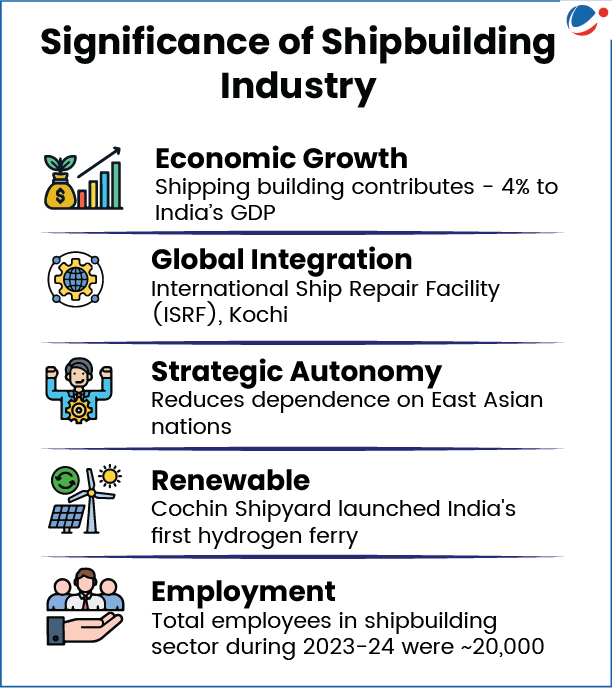
- These guidelines set a roadmap to increase India's commercial shipbuilding capacity to 4.5 million Gross Tonnage (GT) per annum by the year 2047.
About the Operational Guidelines
- Shipbuilding Financial Assistance Scheme (SBFAS)
- Tiered Financial Assistance: 15%-25% assistance of the vessel cost, depending upon the category.
- National Shipbuilding Mission (NSM): To oversee coordinated planning, demand aggregation, and synchronized execution of shipbuilding across the country.
- Shipbreaking Credit Note: Where shipowners scrapping vessels at Indian yards receive a credit note worth 40% of the scrap value.
- Shipbuilding Development Scheme (SbDS)
- Greenfield Infrastructure Development: Offers 100% capital support for common maritime and internal infrastructure in new clusters.
- Research & Skill Development: Establishes the Indian Ship Technology Centre (ISTC) under the Indian Maritime University (IMU).
- Credit Risk Coverage Framework: Provides government-supported insurance to mitigate financial risks.
Shipbuilding Sector in India
- Global Standing: India currently holds less than 1% of the global shipbuilding market share, significantly trailing leaders like China (47%), South Korea (25%), and Japan (18%).
- Current Capacity: India's annual output is approximately 0.072 million Gross Tonnage (GT), with a target to reach 0.33 million GT by 2030 and 4.5 million GT by 2047.
- Fleet Age: The average age of the Indian-flagged fleet is 21 years, creating an immediate domestic demand for nearly 2,500 new vessels for fleet replacement.
- Market Growth: The Indian sector was valued at US$ 90 million in 2022 and is projected to reach US$ 8.12 billion by 2033, growing at a CAGR of 60%.
Challenges and Structural Bottlenecks
- High Capital Costs: Indian shipyards face borrowing costs of 9–11%, compared to 4–6% in China and South Korea, leading to a 20% cost disadvantage.
- Fragmented Ecosystem: Lack of integrated clusters means shipyards are far from component suppliers, increasing logistics costs and timelines.
- Import Dependency: India still imports 60–70% of critical marine components, including specialized steel, propulsion engines, and navigation electronics.
- Infrastructure Limits: Most Indian dry docks are smaller than 310m, making it impossible to build or repair Ultra Large Crude Carriers (ULCC).
- Market Preference: Indian ship-owners often prefer buying second-hand foreign vessels due to lower costs and immediate availability.
- Underdeveloped MRO (Repair): Most Indian-flagged vessels prefer undergoing maintenance in Singapore, Dubai, or Colombo due to superior infrastructure and quicker turnaround.
Initiatives to Promote the Shipbuilding Sector
|
Way Forward
- Transition to Commercial Hub: Leveraging the expertise gained in defense projects to capture a larger share of the global commercial export market.
- Circular Economy: Scaling the Shipbreaking Credit Note to link the recycling industry with new construction, making India a global hub for sustainable ship lifecycle management.
- Innovation: Investing in autonomous shipping and alternative fuels (Ammonia/Hydrogen) to leapfrog established players in the niche green-shipping segment.
Conclusion
India's shipbuilding sector offers significant growth and security potential but is hampered by high costs, poor infrastructure, and import dependency. While recent financial and infrastructure reforms are beneficial, the industry requires more robust policy interventions and domestic manufacturing incentives.



