The SHANTI Bill, 2025, repeals AEA 1962 & CLNDA 2010, creating a unified legal framework for India's nuclear sector.
It permits private sector participation in nuclear operations and power generation, while reserving sensitive activities for the Central Government.
The Act establishes a new civil liability framework with capped operator liability, removes supplier liability, and grants statutory status to AERB.
In Summary
Why in the News?
The President has granted assent to the Sustainable Harnessing and Advancement of Nuclear Energy for Transforming India (SHANTI) Bill, 2025.
More on the News
It aims to create a unified Legal Framework by consolidating existing laws into a single, comprehensive statute, thereby enhancing regulatory clarity and investor confidence.
It repealed the Atomic Energy Act (AEA), 1962 and the Civil Liability for Nuclear Damage Act (CLNDA), 2010.
Key Features of the Act
Private Sector Participation
It permits private companies, joint ventures or any other person expressly permitted by the central government to participate in India's nuclear sector, enabling them to undertake:
Plant operations, power generation, equipment manufacturing, and selected activities such as the fabrication of nuclear fuel including conversion;
Refining and enrichment of uranium-235 up to such threshold value, or production, use, processing or disposal of other prescribed substances.
In addition, all activities that involve radiationexposure must obtain priorsafety uthorization from the regulatory authority.
Activities Under Exclusive Central Government Purview
Certain sensitive nuclear fuel‑cycle activities are reserved exclusively for Central Government or its wholly owned institutions.
These include enrichment of radioactive substances, management of spent fuel, etc.
Grants Statutory status to Atomic Energy Regulatory Board (AERB)
To strengthen regulatory independence and authority.
AERB was constituted in 1983 under the AEA, and is now answerable to Parliament rather than solely to the executive.
It is responsible for ensuring nuclear safety, radiation protection, emergency preparedness, and quality assurance across civilian nuclear installations.
New Civil Liability Framework
Introduces a clear graded liability system for nuclear operators.
Government bears liability beyond the cap through a Nuclear Liability Fund.
Removes supplier liability completely (unlike CLNDA, 2010, which allowed claims for defective equipment).
Regulation of Non-Power Applications
Provides a regulatory framework for the use of nuclear and radiation technologies in health care, agriculture, industry, research, and other peaceful applications.
Licensing and Safety Oversight
Establishes a structured system for granting, suspending, or cancelling licences and safety authorisations for nuclear energy production and use.
Allows exemption from a license for limited activities like research, development, and innovation-related work.
Central Government Acquisition Rights
Vests exclusive acquisition rights with the Central Government in specific cases related to nuclear activities.
Dispute Redressal Mechanism
Establishes an Atomic Energy Redressal Advisory Council to facilitate the redressal of disputes.
Nuclear Damage Claims Commission
Provides for a dedicated Commission to handle cases involving severe nuclear damage and ensure timely adjudication.
Territorial Scope of Compensation
Extended to nuclear damage in foreign territories caused by incidents in India, subject to specified conditions.
Appellate Tribunal Provision
The Appellate Tribunal for Electricity, set up under the Electricity Act, 2003, will serve as the appellate authority.
Why is there a need to open the Nuclear Sector for Private Entities?
Increasing share of Nuclear Power: Nuclear power has accounted for around 3% of total electricity generation.
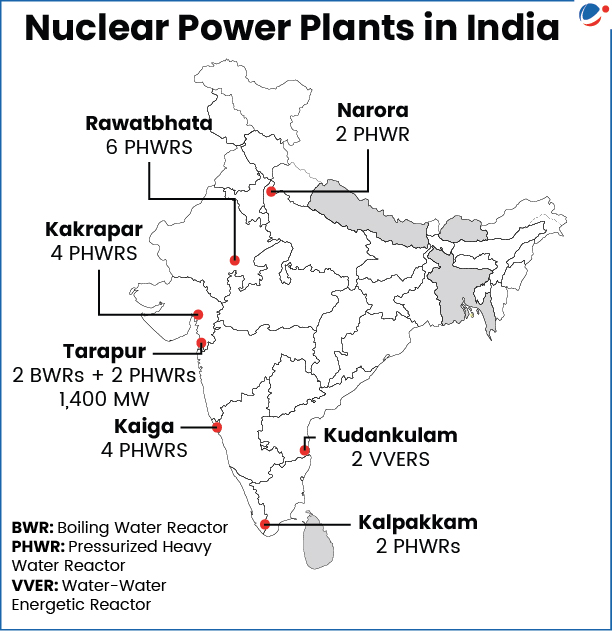
The present nuclear capacity stands at 8.78 GW.
Resource Mobilisation: Private participation expands capital availability, attracting domestic and global investment.
Delay in Completion of Project: E.g.,Prototype Fast Breeder Reactor at Kalpakkam, originally scheduled for 2010 commissioning, has yet to reach criticality.
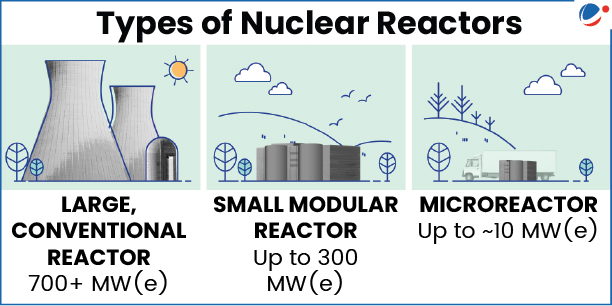
Advanced technology access: Private sector entry accelerates the adoption of advanced technologies such as Small Modular Reactors (SMRs), modular reactor designs and modern safety systems.
Facilitating Clean energy transition: To meet the national target of 100 GW nuclear capacity by 2047 and advance long-term decarbonisation by 2070.
Other Key Initiatives Taken to Promote Nuclear Energy
Nuclear Energy Mission: Announced in the Union Budget 2025-26, it allocated ₹20,000 crore to drive design, development, and deployment of SMRs.
Target: At least five indigenously designed SMRs to be operational by 2033, strengthening India's clean energy roadmap.
Initiatives by Bhabha Atomic Research Centre (BARC): E.g. 200 Mwe Bharat Small Modular Reactor (BSMR‑200)
Three-Stage Nuclear Power Programme: Long-term strategy using PHWRs, Fast Breeder Reactors, and Thorium-based reactors to ensure fuel security.
International Civil Nuclear Cooperation: E.g. India-U.S. Civil Nuclear Agreement or 123 Agreement.
Conclusion
By modernising the legal framework and strengthening institutional oversight, it creates the foundation for a more efficient, innovative, and secure nuclear ecosystem.
Small Modular Reactors (SMRs)
SMRs are advanced nuclear reactors that have a power capacity of up to 300 MW€ per unit.
Its power-generating capacity is about one-third of that of traditional nuclear power reactors.
In Budget 2024-25, the Centre announced that it will partner with the private sector to develop BSRs.
Key Features:
Flexible deployment: Prefabricated units of SMRs can be manufactured and then shipped and installed on site
Reduced fuel requirements: Require less frequent refuelling, every 3 – 7 years, compared to 1 -2 years for conventional plants.
Reduces Wastage: Eliminate or significantly lower the potential for unsafe releases of radioactivity to the environment.
A series of processes involved in nuclear energy production, from mining and refining uranium to fuel fabrication, enrichment, reprocessing of spent fuel, and waste management. Certain sensitive activities within this cycle are reserved for the Central Government under the SHANTI Bill, 2025.
A bilateral agreement between India and the United States concerning peaceful uses of nuclear energy, facilitating civil nuclear cooperation. Such agreements are part of India's broader efforts to promote international civil nuclear cooperation.
Three-Stage Nuclear Power Programme
India's long-term strategy for nuclear power development, utilizing Pressurized Heavy Water Reactors (PHWRs), Fast Breeder Reactors (FBRs), and Thorium-based reactors to ensure fuel security and advance nuclear energy capabilities.
Title is required. Maximum 500 characters.
Search Notes
Filter Notes
Loading your notes...
Searching your notes...
Loading more notes...
You've reached the end of your notes
No notes yet
Create your first note to get started.
No notes found
Try adjusting your search criteria or clear the search.