The National Blood Transfusion Bill, 2025, aims to create a uniform national framework for blood banks and transfusion services.
Key provisions include establishing a National Blood Transfusion Authority (NBTA), mandatory registration of blood centres, and a national haemovigilance system.
The bill addresses public health risks, fragmented legal frameworks, lack of uniform standards, and inequities in blood supply.
In Summary
Why in the News?
National Blood Transfusion Bill, 2025, was introduced in Parliament to establish a uniform national framework for the regulation of blood banks and transfusion services across India.
Key Provisions of The National Blood Transfusion Bill, 2025
Dedicated National Law
It is a standalone legislation to regulate the collection, testing, processing, storage, distribution, and transfusion of human blood and blood components.
National Blood Transfusion Authority (NBTA)
Establishes a statutory central authority to oversee blood transfusion services at the national level.
Headquartered in New Delhi, responsible for nationwide regulation, standard-setting, and supervision of blood centres.
Uniform National Standards
Empowers NBTA to prescribe and enforce uniform standards for quality, safety, and management of blood and blood components across all States and UTs.
Mandatory Registration of Blood Centres
Makes registration with NBTA compulsory for all blood centres; registration is valid for five years and renewable subject to compliance with prescribed norms.
National Haemovigilance System
Provides for a national haemovigilance programme to monitor adverse transfusion reactions and prevent transfusion-transmissible diseases.
Strict Penal Provisions
Prescribes stringent penalties for:
Unregistered blood centres: imprisonment up to 3 years or fine up to ₹10 lakh, or both.
Unsafe or contaminated blood transfusion: imprisonment for 2–5 years with a minimum ₹5 lakh fine.
Other Important Provisions
Includes promotion of voluntary and non-remunerated blood donation,transitional protection for existing blood centers.
Central Government funding support, and accountability through CAG audit and annual reporting to Parliament.
Need for the Bill
Mitigating Public Health and Patient Safety Risks:
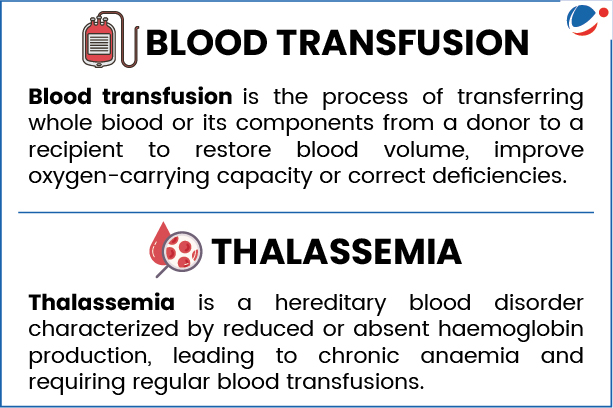
E.g. Recently 6 thalassaemic children in Madhya Pradesh's Satna district contracted human immunodeficiency virus (HIV) through blood transfusions.
Fragmented & Inadequate Legal Framework: Blood transfusion services were governed by dispersed provisions under Drugs and Cosmetics Act, 1940, leading to regulatory gaps and inconsistent standards across States.
Lack of Uniform National Standards: Absence of standardised norms for testing, storage, component separation and advanced matching resulted in regional disparities and compromised clinical outcomes.
Unreliable Blood Supply and Infrastructure Gaps: Seasonal donor shortages, uneven inventory management and lack of advanced facilities (e.g., leukoreduction, alloantibody detection) at peripheral blood centres affected access.
Urban–Rural and Inter-State Inequity: Blood banks and storage centres remain concentrated in urban areas.
Conclusion
Effective implementation of the National Blood Transfusion Bill, 2025, necessitates cooperative federalism, strengthening of peripheral blood centres, integration of robust digital and haemovigilance systems, and sustained financial support to ensure safe, equitable, and reliable blood transfusion services nationwide.
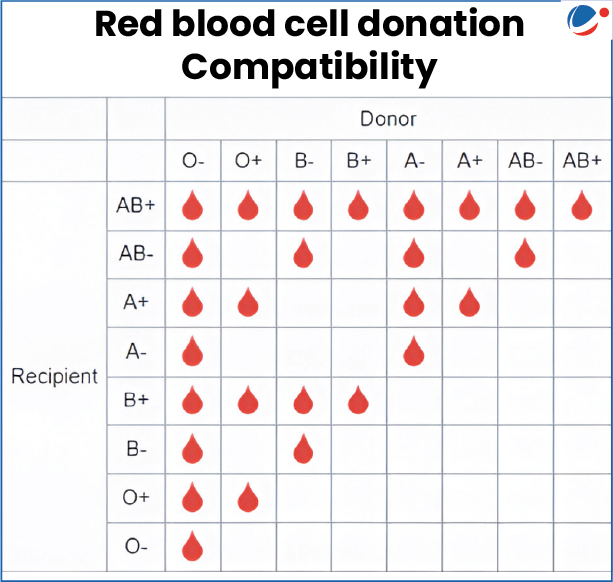
Compatibility in red blood cell transfusion (ABO and Rh system) between receiver and donor
There are four major blood groups determined by the presence or absence of two antigens, A and B, on the surface of red blood cells.
In addition to the A and B antigens, there is a protein called the Rh factor, which can be either present (+) or absent (–), creating the 8 most common blood types (A+, A-, B+, B-, O+, O-, AB+, AB-).
AB+ blood type has A, B, and Rh antigens but lacks anti-A, anti-B, or anti-Rh antibodies, making them the "universal recipient" for red blood cell transfusions.
O-negative (O-) blood is considered the "universal donor" for red blood cells because its red blood cells lack A, B, and Rh (D) antigens, meaning they won't trigger an immune reaction in recipients of any other blood type.
An individual with the O-negative (O-) blood type, whose red blood cells lack A, B, and Rh (D) antigens. This makes their red blood cells compatible with recipients of any ABO/Rh blood group, as they are unlikely to trigger an immune response.
Universal Recipient
An individual with the AB+ blood type, which is considered a universal recipient because their blood lacks antibodies against A, B, and Rh antigens, allowing them to receive red blood cells from any ABO/Rh blood group.
Alloantibody Detection
The process of identifying antibodies in a recipient's blood that are directed against antigens on the donor's red blood cells. This is crucial for preventing transfusion reactions.
Title is required. Maximum 500 characters.
Search Notes
Filter Notes
Loading your notes...
Searching your notes...
Loading more notes...
You've reached the end of your notes
No notes yet
Create your first note to get started.
No notes found
Try adjusting your search criteria or clear the search.