Why in the News?
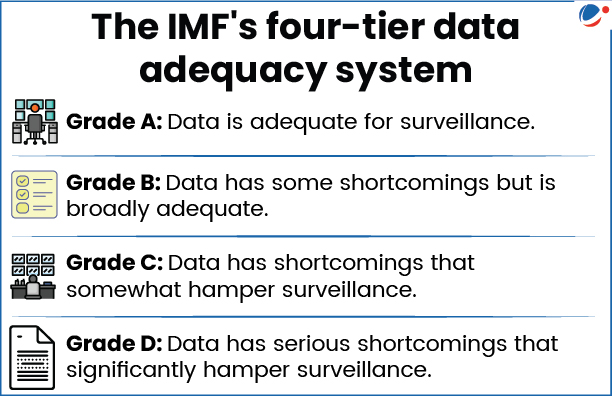
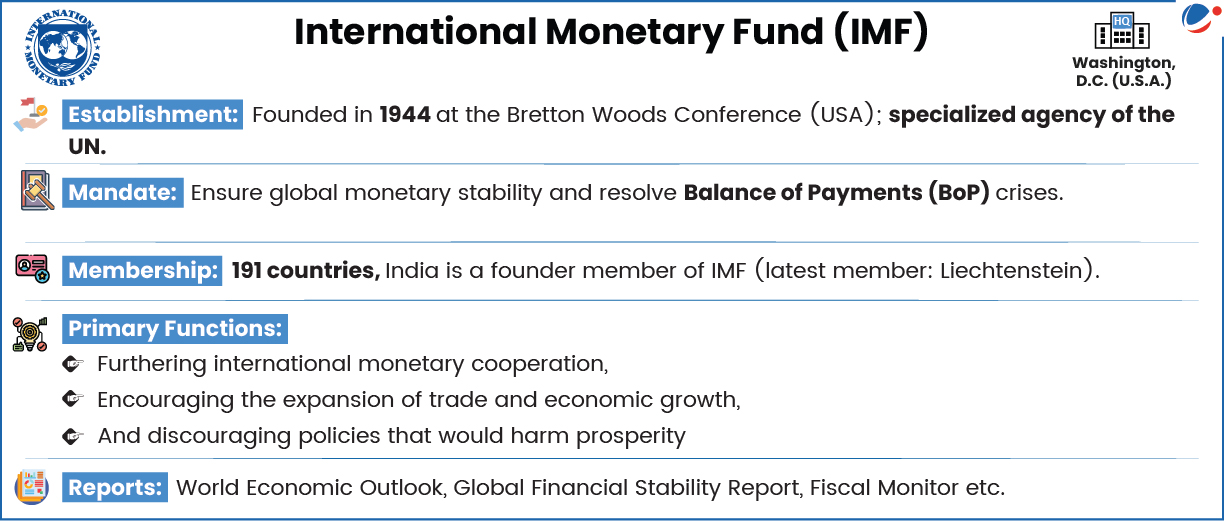
The International Monetary Fund (IMF) assigned a grade of "C" to India's National Accounts statistics (e.g. GDP, GVA etc.).
More on the News
- The IMF's "Data Adequacy for Surveillance" assessment acts as a technical audit of a nation's statistical health. The 2025 report highlighted several critical aspects of India's data ecosystem:
- According to IMF, National accounts data are available at adequate frequency and timeliness and provide broadly adequate granularity.
- However, some methodological weaknesses somewhat hamper surveillance and warrant an overall sectoral rating for the national accounts of C.
- Other Indicators: The Consumer Price Index (CPI), External Sector, and Monetary/Financial statistics received a "B".
Issues with India's Statistical Architecture According to IMF:
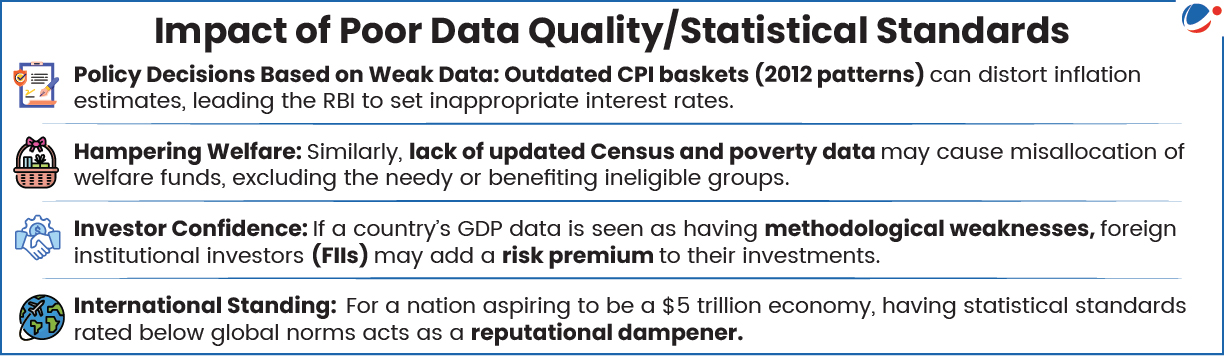
- Outdated Base Years: An outdated base year relies on "weights" assigned to industries that may no longer be relevant.
- India's GDP series is currently anchored to the 2011-12 base year.
- This 14-year-old structure fails to capture the digital economy, the gig sector, and modern services.
- India's GDP series is currently anchored to the 2011-12 base year.
- Deflator Issues: (The Single Deflation Problem):The IMF critiqued the reliance on single deflation (deflating output value only) rather than double deflation (deflating both output and input costs separately).
- WPI vs. PPI: India lacks a Producer Price Index (PPI), which measures the average change in the price of goods and services either as they leave the place of production or as they enter the production process
- Consequently, statisticians use the Wholesale Price Index (WPI), which tracks goods, to deflate the value of services.
- Data Delays & Informal Sector: Current method relies on extrapolating informal sector growth using benchmarks that are over a decade old.
- Without an updated Census, sample surveys (like the PLFS or NSSO consumption surveys) rely on extrapolated population frames from 2011, reducing their accuracy.
- Production vs. Expenditure: The IMF noted sizeable discrepancies between GDP calculated from the production side (GVA) and the expenditure side.
Recent Major Reforms & Updates to India's National Accounts Data by MoSPI
|
Reforms Needed
- Strengthening the National Statistical Commission (NSC): The 27th Report of the Parliamentary Standing Committee on Finance explicitly recommended that the National Statistical Commission (NSC) be given statutory authority.
- Modernization and Methodology:
- Base Year Revision: MoSPI must strictly adhere to the February 27, 2026 deadline for releasing the new National Accounts series (Base Year 2022-23).
- Chain-Base System: Moving away from the static "base year" revision every decade, India should explore a Chain-Weighted System (used by the US and other advanced economies), where weights are updated annually to reflect real-time structural changes.
- Tech Integration: Leveraging Big Data (GSTN data, digital payments data) can provide high-frequency indicators to supplement traditional surveys.
- New Surveys: The introduction of the Annual Survey of Unincorporated Sector Enterprises (ASUSE) is critical. Using ASUSE data will replace old extrapolations with actual annual data for the informal sector.
- Household Income Survey: India's first-ever official Household Income Survey, expected in 2026, will help bridge the gap between income and expenditure estimates.
- Calendar Adherence: The government must prioritize the conduct of the Census. It is the bedrock of the statistical system.
- A strict Advance Release Calendar for all major reports must be adhered.
- Methodological Shifts: The transition from WPI to a PPI-based deflation system is essential to move towards the double deflation standard used by developed economies.
Conclusion
The IMF's "C" grade should be viewed not as a vote of no-confidence in India's growth story, but as a technical wake-up call. Implementing the Parliamentary Panel's recommendations and adhering to the MoSPI's 2026 release calendar will be pivotal in upgrading India's data credibility from a "C" to an "A".