


Why in the News?
Parliamentary Standing Committee on Personnel, Public Grievances, Law and Justice suggests urgent steps to operationalise Lokpal's inquiry, prosecution wings in its 145th Report.
About Lokpal
- It is a statutory, autonomous, and sui generis anti-corruption institution established under the Lokpal and Lokayuktas Act, 2013.
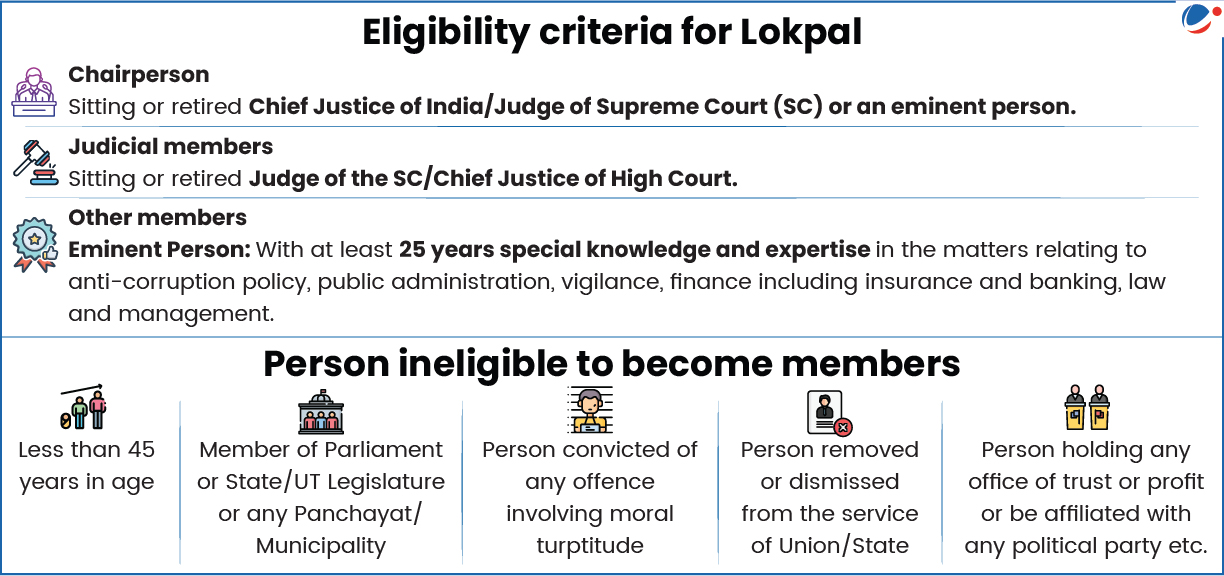
- Composition: Comprising of Chairperson, not exceeding 8 Members (4 Judicial and 4 Non-Judicial).
- At least 50% of total Members must be from SC, ST, OBC, Minorities, and women.
- Appointment: The Chairperson and Members shall be appointed by the President after obtaining the recommendations of a Selection Committee consisting of:
- Prime Minister (Chairperson), Speaker of Lok Sabha, Leader of Opposition in Lok Sabha, Chief Justice of India/Judge of the Supreme Court nominated by him, one eminent jurist to be nominated by the President.
- Term of office of Chairperson and Members: 5 years from the date on which he enters upon his office or until he attains the age of 70 years, whichever is earlier.
- Jurisdiction in respect of Inquiry: It include Prime Minister, Ministers, members of Parliament, Groups A, B, C and D officers and officials of Central Government.
- Lokpal shall not investigate any corruption allegation against the Prime Minister if it is related to international relations, external and internal security, public order, atomic energy and space.
- Inquiry Wing: Under Section 11(1) of the Lokpal and Lokayuktas Act, 2013, the Lokpal is mandated to constitute an Inquiry Wing, headed by a Director of Inquiry, to conduct preliminary inquiries into offences punishable under the Prevention of Corruption (PC) Act, 1988.
- Prosecution Wing: Under Section 12(1) of the Lokpal and Lokayuktas Act, 2013, Lokpal is mandated to constitute, by notification, a Prosecution Wing headed by the Director of Prosecution for the purpose of prosecution of public servant.
- Power and Functions of Lokpal:
- Superintendence Over Investigations of Delhi Special Police Establishment (DSPE) concerning matters referred for preliminary inquiry or investigation.
- Central Vigilance Commission must report to the Lokpal in respect of action taken on complaints referred to it.
- Powers of a civil court for the purpose of any preliminary inquiry, the Inquiry Wing under the Code of Civil Procedure, 1908.
Issues in Functioning of Lokpal
- Inquiry Wing: It was formally constituted in 2024, but not "de facto" functional because the Lokpal cannot commence regular appointments until "Lokpal Officers and Staff (Conditions of Service) Regulations, 2024" are approved by the President of India.
- Prosecution Wing: It remains on hold due to a low volume of cases (only 7 cases involving 13 public servants).
- Presently, the work related to prosecution is being dealt with by the Full Bench of Lokpal by calling upon the Investigating Officer in the concerned case to submit status report.
- Absence of Dedicated Special Courts: The Lokpal has requested a Special Court in Delhi to prioritize cases arising out of Prevention of Corruption Act, 1988; however, this request remains pending with the Department of Personnel and Training.
- Underutilization of Funds: In the 2024-25 financial year, Lokpal utilized only 84.86% (₹57.41 crore) of its Revised Estimate allocation of ₹67.65 crore.
- Other Lacunae in the act:
- Lack of constitutional backing for the offices.
- Delays due to sufficient information from the government departments, and State investigating agencies.
- Complaint against corruption cannot be registered after a period of 7 years.
- Judiciary has been kept out of the purview of the lokpal.
Way forward to strengthen the functioning of the Lokpal
- Parliament committee Recommendations:
- Operationalization of Wings: The committee reiterates that both the Inquiry and Prosecution Wings should be fully constituted within 6 months. The structure, staffing, and jurisdiction of these wings should be well defined.
- Until these wings become fully operational, a dedicated coordination mechanism may be set up with CVC and CBI to streamline the ongoing cases.
- Establishment of Special Courts: The committee supports the Lokpal's request to notify at least one Special Court in Delhi to prioritize cases arising from the Act of 2013, ensuring trials are completed within the statutory one-year timeline.
- Mandatory Timelines for Responses: To prevent procedural delays, the Committee recommends enforcing fixed timelines for public servants to submit comments during inquiries, with an automatic escalation mechanism for non-compliance.
- Digital Infrastructure: Digital platforms should be implemented for secure and real-time submission of comments to minimize procedural delays.
- E.g., Integrating Artificial Intelligence (AI) for efficient data management and analysis.
- Operationalization of Wings: The committee reiterates that both the Inquiry and Prosecution Wings should be fully constituted within 6 months. The structure, staffing, and jurisdiction of these wings should be well defined.
- Other:
- Specialized expertise: Prioritising the recruitment of personnel with specialised expertise including in forensic accounting and cyber investigation to address increasingly sophisticated nature of corruption.
- Stakeholder Engagement: Educating the public about their rights and the role of the Lokpal to ensure an informed populace that will no longer tolerate corruption.
Conclusion
Thus, Lokpal has strong statutory backing but limited impact due to operational delays, staffing gaps, and procedural constraints. Timely institutional strengthening, use of technology, better coordination, and sustained public trust are essential to realize its role as an effective anti-corruption watchdog.



