


Why in the News?
Parliamentary Standing Committee on Chemicals and Fertilisers presented its report on Self-Sufficiency in Production of Fertilisers.
Fertiliser Use in India
- India is the second-largest consumer and third-largest producer of Fertilizers globally.
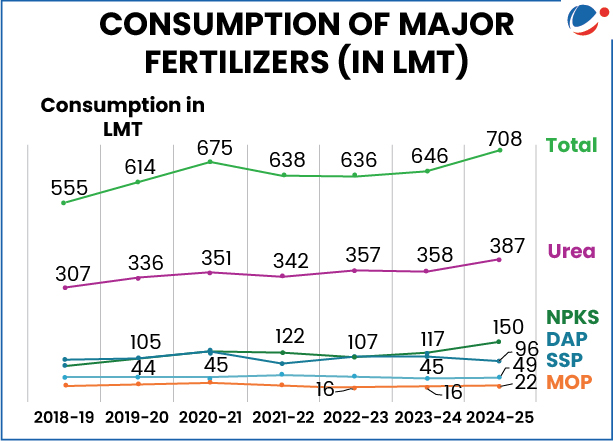
- Major Fertilisers: The broad variety of chemicals used as fertilisers by farmers in the country includes urea, Di-Ammonium Phosphate (DAP), Muriate of Potash (MOP), Nitrogen, Phosphorus, Potassium, and Sulphur (NPKS), and Single Super Phosphate (SSP).
- Fertiliser Subsidy Policy:
- Urea Subsidy Scheme: It aims at ensuring the timely availability of adequate quantity of urea at the statutory controlled price to farmers.
- Nutrient-Based Subsidy (NBS) Scheme: Under it, a fixed amount of subsidy, decided on an annual/bi-annual basis, is provided on subsidized P&K fertilisers depending on their nutrient content.
- It is applicable on 28 Grades including DAP, Mono Ammonium Phosphate (MAP), MOP, Triple Super Phosphate (TSP), 3 grades of SSP, Ammonium Sulphate (AS), Potash Derived from Molasses (PDM) and other 19 grades of NPKS Complex fertilisers.
- Other Policies
- Monitoring System: The movement of all major subsidised fertilisers is monitored throughout the country by an on-line web-based monitoring system called integrated Fertilizer Monitoring System (iFMS).
- New Investment Policy (NIP), 2012: It aims to facilitate fresh investment in the urea sector and to make India self-sufficient in the urea sector.
- One Nation One Fertiliser: Launched under Pradhan Mantri Bhartiya Janurvarak Pariyojana (PMBJP), mandating that all Urea, MOP, DAP and NPK will be sold under the uniform Bharat brand to bring uniformity in the quality and brands.
- Pradhan Mantri Kisan Samriddhi Kendras (PMKSKs): One-stop shops that not only sell fertilisers but also provide advisory services, soil testing, and other agri-inputs to farmers
Issues with Fertiliser Use in India
- Imbalanced Fertiliser Use: India's N:P:K consumption ratio is highly skewed toward nitrogen (far exceeding the recommended 4:2:1), primarily due to heavy subsidy on urea, incentivising its overuse.
- Imbalanced use, along with neglect of micro-nutrients and low addition of organic matter, is leading to micro-nutrient deficiencies in the soil.
- Import Dependence: India is deficit in sufficient reserves of rock phosphate and imports nearly 95% of its phosphate requirements from countries like Saudi Arabia, Jordan, Morocco and Russia.
- India has no known commercial reserves of potash and is 100% dependent on imports from Canada, Russia, Israel and Jordan.
- Subsidy Burden: The fertiliser subsidy remains the second-largest subsidy head after food, accounting for over 10% of total central expenditure.
- Increase in global prices of raw materials (such as natural gas for urea), exchange rate fluctuations, and global supply chain disruptions impact domestic cost of fertilisers.
- Malpractices: Black marketing and diversion of fertilisers is a significant concern since a large fiscal burden is borne by the government to provide subsidies.
- Obsolete Technology: Out of the 33 operational urea plants, 27 plants are older than 25 years and 7 plants are older than 50 years, which uses outdated technology, leading to higher cost of production.
- Moreover, India is dependent on foreign companies for licensing of process technology.
- Environmental and Health Impact: Overuse of chemical fertilizers, especially nitrogen, contributes to environmental pollution, contributing to climate change and water contamination.
Suggested Reforms by Committee
- Increasing Manufacturing Capacity: Constituting a task force to promote domestic urea production under the New Investment Policy.
- Production capacity of phosphatic and potassic (P&K) fertilisers should also be expanded through fiscal and tax incentives for the setting up of new units.
- Ensuring Supply of Raw Material: The Committee observed that 90% of the total cost of urea is natural gas, which is largely imported through long-term agreements.
- The gas procurement mechanism should be modified to ensure a constant supply of natural gas at competitive prices. This will also reduce the cost burden of the subsidy on the government.
- Controlling Malpractices: Formulating stringent policies to stop black marketing, establishing a network of labs to check fertiliser quality, and setting up a grievance redressal mechanism.
- Promotion of Nano Fertilisers: Increasing production of nano fertilisers and introducing a Production Linked Incentive (PLI) scheme for drones for spraying nano fertilisers.
- Nano fertilisers are effectively cheaper than conventional fertilisers in the long-term due to lower raw material requirements, higher nutrient uptake, and higher crop yields with lower fertiliser usage.
- Balanced Fertiliser Use: Training farmers to encourage balanced use of fertilisers, crop rotation, and natural ways of farming.
Conclusion
India's fertilizer challenge lies not merely in ensuring availability, but in achieving a judicious balance between self-sufficiency, fiscal prudence, and environmental sustainability. Doing so requires a calibrated strategy—strengthening domestic manufacturing, indigenising technology, rationalising subsidies to promote balanced nutrient use, and integrating ecological considerations into farm practices.



