


Why in the News?
The Ministry of Statistics and Programme Implementation (MoSPI) has revised the base year of IIP from 2011-12 to 2022-23 to better reflect current industrial structure and dynamics.
Major Changes in New Series of IIP
- Base Year Revision: It is revised to 2022-23 under the aegis of the Technical Advisory Committee for base year revision (TAC-IIP).
- A base year is a specific reference period in time used as a benchmark for comparing economic and financial data, such as production or prices.
- Coverage: It added Gas Supply, Water Supply, Sewerage & Waste Management activities while retaining the existing sectors.
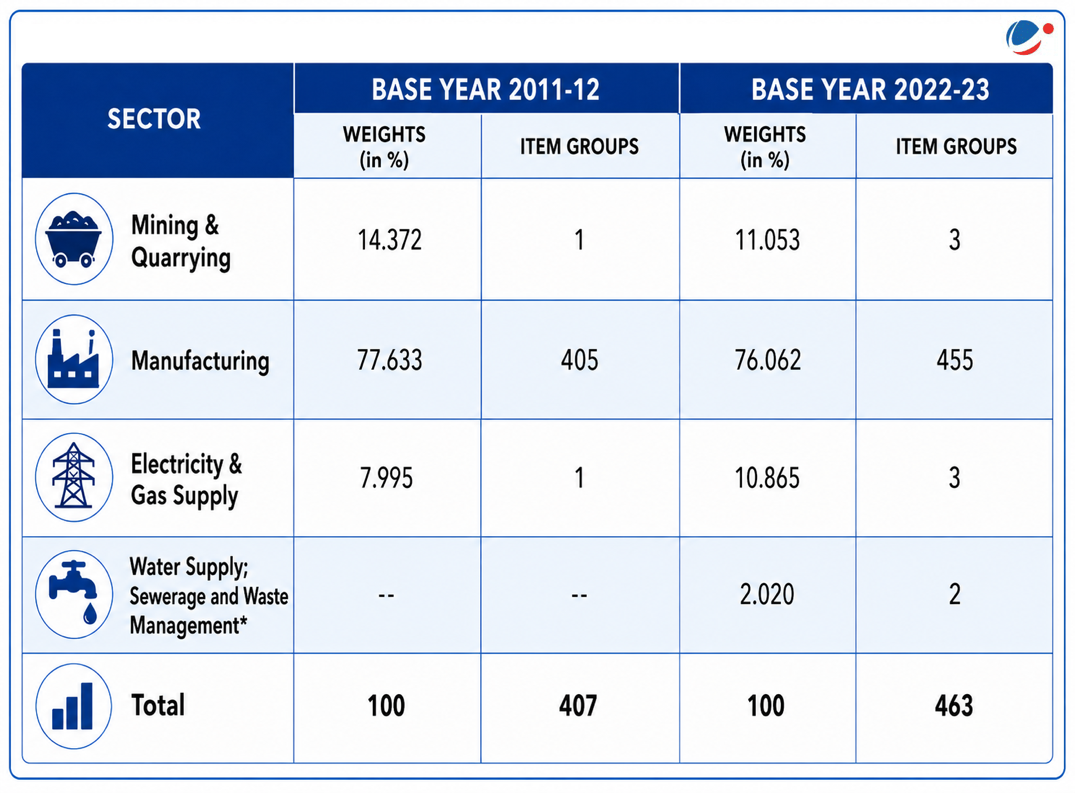
- Inclusive Mining Classification: It added minor minerals and rare earth minerals for better sectoral representation.
- Revamped Item Basket: Basket expanded from 839 items to 1,042 products (463 item groups).
- In index compilation, the base year is assigned an index value of exactly 100, allowing subsequent data to be measured relative to it to easily determine if activity has increased or decreased.
- Additions: Cards with a magnetic stripe, CCTV camera, Articles of non-woven textiles, Parts of aircraft and spacecraft, Stents, Vaccine (other than veterinary).
- Deletions: Kerosene, Fluorescent tubes and CFLs, Tubes for bicycle/ tricycle/ rickshaw tyres. Tubes for LMV tyres, Printing machinery, Sewing machines.
- Inclusion of "n.e.c." Items: "Not elsewhere classified" (n.e.c.) items, which were previously excluded, have been retained to capture niche, diversified, and innovative products that would otherwise remain under-represented.
- Enhanced Granularity: It provides a more detailed disaggregation of industrial activities. In mining covering: (i) Fuel Minerals, (ii) Metallic Minerals, including Rare Earth Minerals, and (iii) Non-Metallic Minerals, including Minor Minerals.
- The Electricity Index now separately tracks generation from renewable and non-renewable sources.
- Factory Substitution and Augmentation: The new methodology allows for the substitution of factories that permanently close or change their production lines with comparable units.
- Chain-Linked Index: Alongside the traditional fixed-base index, a chain-linked IIP is being introduced.
- This allows for annual updates of weights, capturing structural shifts in the industry faster and reducing the bias caused by outdated weights
- Linking Factor: To maintain historical comparability, the new series adopts the Geometric Mean (GM) method (replacing the arithmetic mean) to link the 2011-12 series with the 2022-23 series.
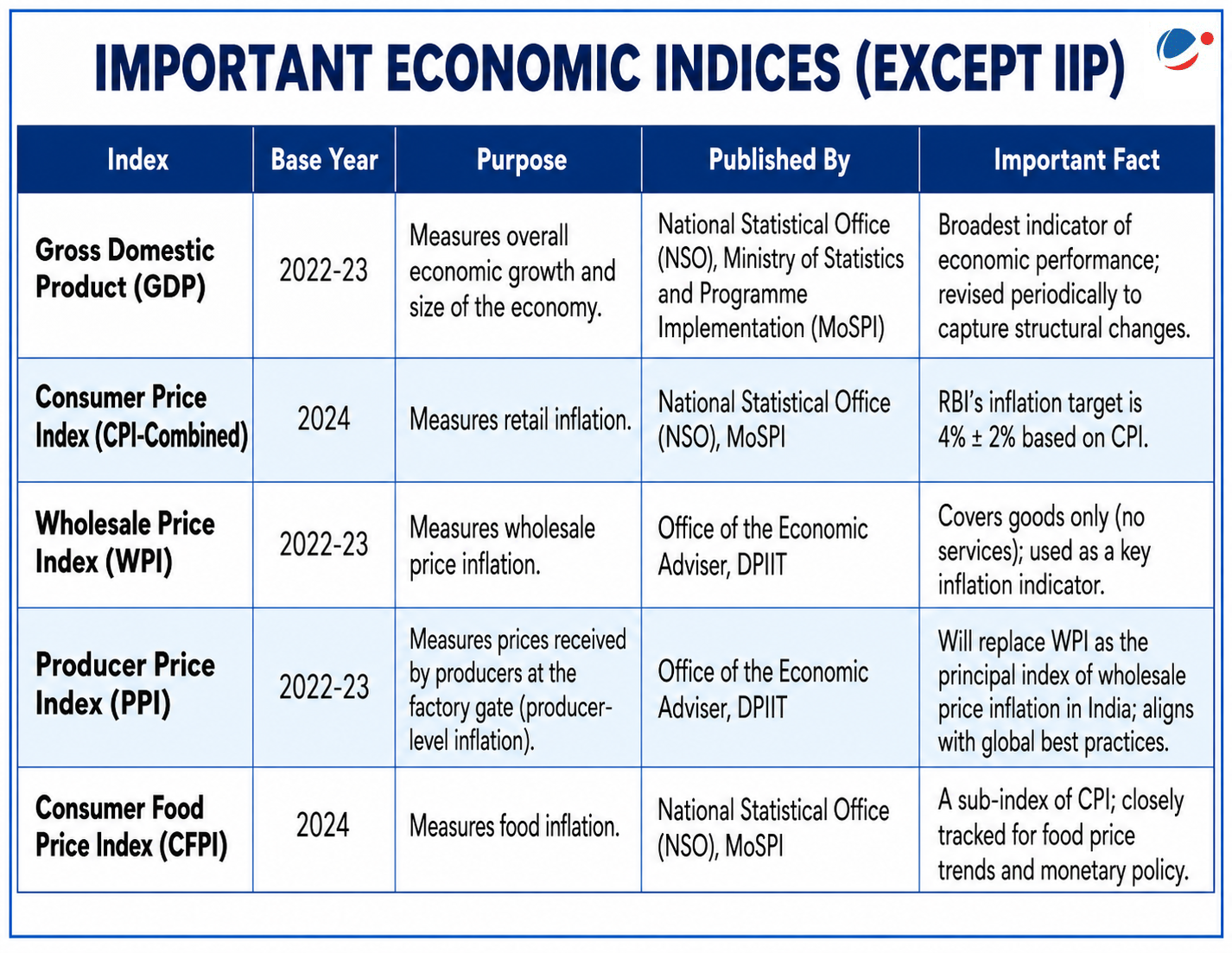
- Price Deflators: Currently, the Wholesale Price Index (WPI) is used as an interim measure to deflate item groups where production data is reported in value terms. However, the Output Producer Price Index (Output PPI) will become the preferred deflator once it is officially released and its stability is evaluated
- Output PPI is internationally preferred as it directly measures product prices received by producers and accounts for quality changes.
- Seasonal Adjustment: Because high-frequency data is heavily influenced by calendar effects, working days, and moving festivals (like Diwali), the MoSPI plans to release seasonally adjusted IIP data.
- This will be undertaken once stable 5-year continuous time series of monthly data is established for new base year.
About All-India Index of Industrial Production (IIP)
|
Implications of revision of base year of IIP
- Boost to Investment and Business Planning: Accurate evaluations of industrial and consumption trends provide clear policy guidance and businesses can rely on data for better forecasting, supply chain planning, etc.
- Enhanced Policy Formulation: A rebased, highly granular IIP ensures that monetary and fiscal policy decisions are anchored to accurate and contemporary data by government and the Reserve Bank of India.
- For instance, tracking separate indices for renewable and non-renewable electricity or minor minerals allows the government to directly monitor the effectiveness of policies, infrastructure investments, and clean energy efforts.
- Harmonization of Macroeconomic Data: This synchronization reduces discrepancies and ensures policymakers can make meaningful, "apples-to-apples" comparisons evaluating growth trends, value additions, etc. across economy.
Conclusion
The recent statistical reforms, particularly the new 2022-23 IIP series, mark a decisive shift towards greater data credibility. These vital upgrades provide a robust, representative foundation for evidence-based policymaking in India's transformed economy.


