


Why in the News?
United States Secretary of State Marco Rubio visited India to strengthen bilateral ties, which have been under strain in recent times.
More on the News
- In the last few years, India–US relations have witnessed a downward trajectory due to policy decisions taken by the incumbent US President, such as tariff impositions, among others.
Key Areas of Convergence in India–US Relations
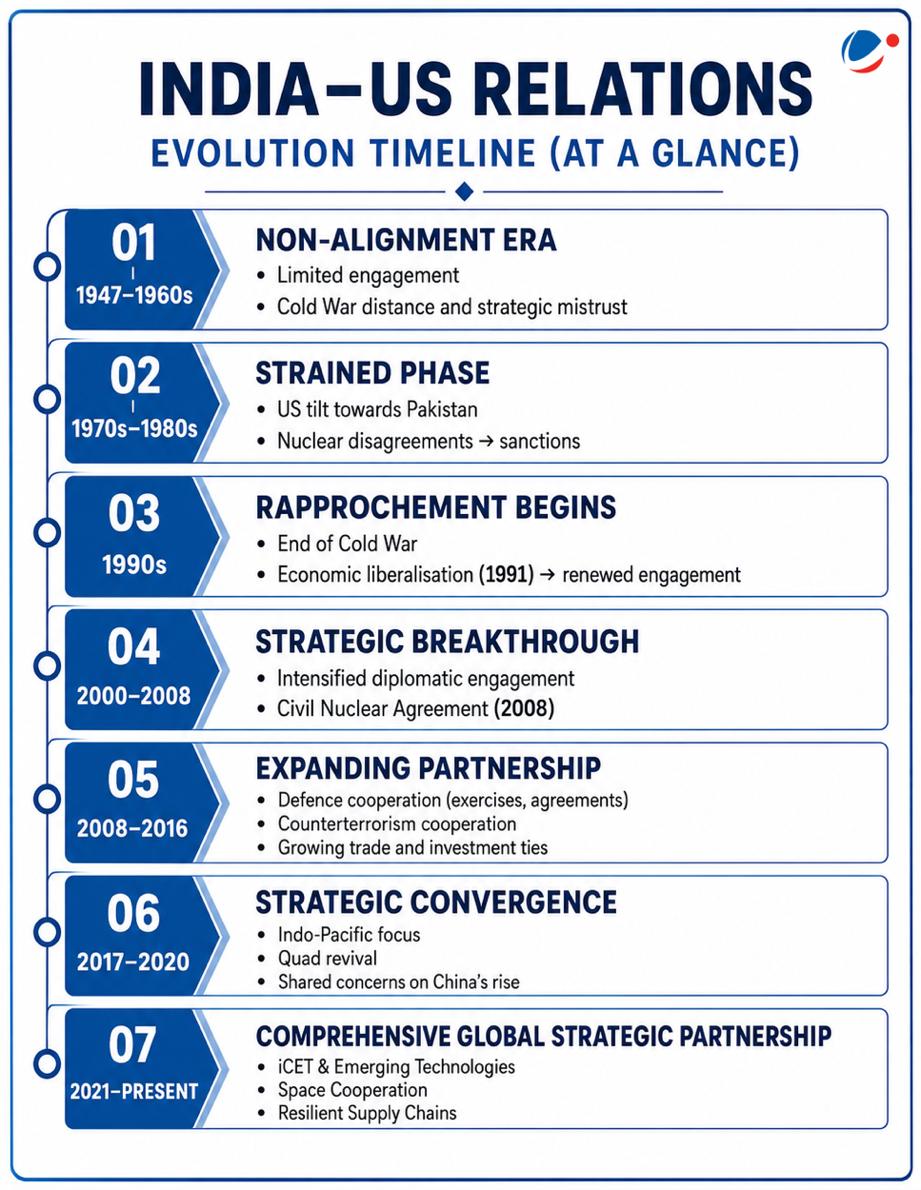
- Indo-Pacific and Regional Security: A major driver of this strategic alignment is their shared concern regarding the rise of China and its expanding regional footprint.
- Through frameworks like the Quadrilateral Security Dialogue (Quad), the two countries coordinate closely on maritime security.
- Defense Cooperation and Co-production: India is designated a "Major Defense Partner". Partnership shifted to co-development and co-production (e.g., INDUS-X).
- Key foundational agreements signed with the US include LEMOA, COMCASA, and BECA.
- Critical Technologies and Innovation: Collaboration through TRUST i.e. Transforming the Relationship Utilizing Strategic Technology on strategic technologies (AI, semiconductors, quantum, telecom).
- Resilient Supply Chains and Critical Minerals: Actively restructuring supply chains to reduce dependence on China; collaborating via a Critical Minerals Framework and the Indo-Pacific Economic Framework (IPEF).
- Clean Energy and Climate Action: Collaboration through the Strategic Clean Energy Partnership (SCEP); launched a Roadmap to unlock $1 billion in multilateral financing for clean energy supply chains.
- Space Exploration: Robust civil cooperation between NASA and ISRO. E.g., NASA-ISRO Synthetic Aperture Radar (NISAR) Mission
- Economic and Trade Partnership: The US is among India's largest trading partners.
- Ensuring Energy Security: In recent years, the U.S. has emerged as one of the largest suppliers of Liquefied Natural Gas (LNG) to India.
Major Bottlenecks in India–US Relations
- Punitive Tariffs and Trade Coercion: In 2025, the US imposed a 50% tariff on certain Indian exports; however, it was later reduced following an interim trade agreement between the two sides.
- This has led to fall in exports to the US.
- Energy Security and Russian Oil: India's persistent procurement of discounted Russian crude oil has become a major flashpoint.
- The US views these purchases as funding Russia's war efforts and has applied heavy economic pressure to force decoupling.
- The Pakistan Rapprochement: The US has recently renewed its diplomatic and military outreach to Pakistan.
- Strategic Autonomy vs. Alliance Expectations: Washington frequently expects India to align with its geopolitical camps.
- In contrast, India insists on "multi-alignment," actively engaging in Western-led groups such as the Quad while also participating in non-Western platforms like BRICS and SCO to preserve its strategic flexibility.
- Shifts in China Policy: Recently, the US and China agreed to build a "constructive relationship of strategic stability" based on fairness and reciprocity.
- Immigration and Visa Policies: The US is restricting its visa norms, which is affecting Indian professionals holding H-1B visas.
- Imposition of Sanctions: The US has raised concerns over the acquisition of advanced weaponry, such as the S-400 air defense system from Russia by India, citing potential implications under the Countering America's Adversaries through Sanctions Act (CAATSA).
Strategies to Better Align India–US Relations
- Finalising Bilateral Trade Agreement (BTA): A comprehensive BTA needs to be signed to provide a stable, predictable, and mutually beneficial trade framework by addressing tariff barriers, market access, etc.
- Easing H-1B Visa Restrictions: The US can streamline visa processes for Indian IT professionals, researchers, etc.
- Waiver under CAATSA: Influence of Indian-Americans can be used to get long-term exemptions for India under CAATSA to strengthen defense ties and counter regional threats.
- Acting as bridge power: Unlike the United States and China, India is not trapped within the same depth of industrial interdependence, nor does it seek geopolitical primacy through hierarchical dependency structures.
- New Delhi can increasingly position itself as a bridge power, adopting a posture that is non-Western without being anti-Western.
- Sustaining Institutional Dialogues and Practical Cooperation: The relationship can be stabilised by continuing to manage divergences through high-level institutional channels, such as the 2+2 Ministerial Dialogue.
- It will help in managing divergent geopolitical interests, such as the US-Pakistan Rapprochement, Interests in the Middle East, etc.
Conclusion
India–US relations reflect strong strategic convergence in defence, technology, energy, and the Indo-Pacific, alongside persistent divergences in trade, visas, sanctions, and geopolitical priorities that occasionally create friction. Going forward, the partnership should be strengthened through institutionalized dialogue, a balanced trade framework, and greater respect for strategic autonomy, along with deeper cooperation in emerging technologies and resilient supply chains to ensure long-term stability.


