


Why in the News?
The government approved the Small Hydro Power (SHP) Development Scheme to boost small hydropower development.
Small Hydro Power in India
- Small Hydro Power (SHP) projects are hydropower projects with an installed capacity of up to 25 MW and are administered by the Ministry of New and Renewable Energy (MNRE).
- Large Hydro Projects: Projects with capacity above 25 MW are administered by the Ministry of Power.
- Run-of-the-River (RoR) Projects: Hydropower projects that generate electricity using the natural flow of a river without large dams or storage reservoirs.
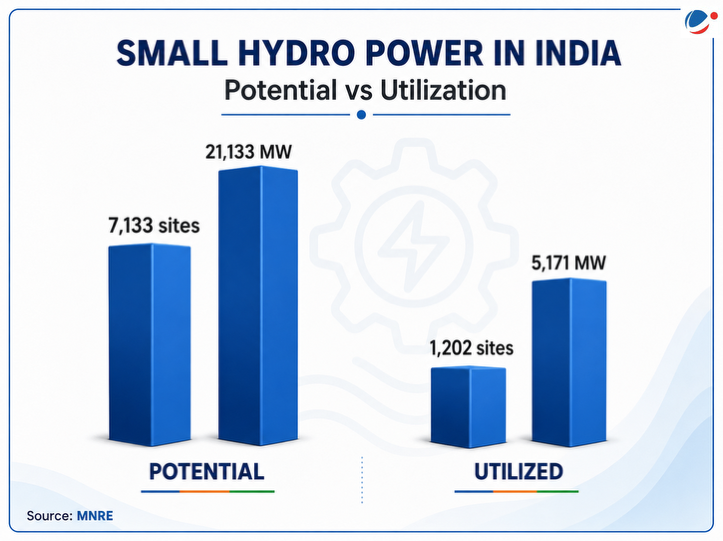
- Installed Capacity: Around 5,171 MW (as of early 2026).
- Potential: India has an estimated 21,133.61 MW of Small Hydro Power potential across 7,133 identified sites, of which only 24.5% has been harnessed so far.
- Highest Potential Region: Northern Region with 7,978 MW (~38% of total SHP potential).
- Himachal Pradesh leads the region with 3,460 MW of SHP potential.
About Small Hydro Power (SHP) Development Scheme
- Ministry: Ministry of New and Renewable Energy (MNRE).
- Duration: Five-year period (2026–27 to 2030–31).
- Outlay: ₹2,584.60 crore.
- Objective: To accelerate the development of Small Hydro Power projects and harness India's untapped hydropower potential, particularly in hilly and North-Eastern regions.
- Target: Addition of approximately 1,500 MW of new SHP capacity.
- Coverage: Small Hydro Projects with installed capacity between 1 MW and 25 MW.
- Focus Areas: Hilly States, North-Eastern States, International Border Districts, and remote areas.
Key Features of the Scheme
- Financial Support Structure
- North-Eastern States & International Border Districts: Financial assistance of ₹3.6 crore per MW or 30% of project cost (whichever is lower), subject to a ceiling of ₹30 crore per project.
- Other Locations: Financial assistance of ₹2.4 crore per MW or 20% of project cost (whichever is lower), subject to a ceiling of ₹20 crore per project.
- Pipeline Development and Detailed Project Reports (DPR) Support
- DPR Support: Assistance for preparation of Detailed Project Reports (DPRs) for a minimum of 200 projects.
- Project Pipeline Development: Separate allocation of ₹30 crore for central and state agencies to developa strong future project pipeline.
- Investment and Economic Impact
- Investment Mobilisation: Expected to attract around ₹15,000 crore investment in the small hydro sector.
- Atmanirbhar Bharat: Promotes the use of indigenous plant and machinery, boosting domestic manufacturing and supply chains.
- Employment Generation
- Construction Employment: Expected to generate approximately 51 lakh person-days during the construction phase.
- Long-Term Livelihoods: Creates sustained employment opportunities in operation and maintenance, particularly in rural and remote regions.
Significance of Small Hydro Power (SHP)
- Decentralised Power: Reduces transmission losses and improves reliability in remote, hilly, and border areas.
- Clean Energy: Generates emission-free electricity without fuel consumption.
- Rural Development: Enhances energy access and supports local economic growth.
- Employment Generation: Creates jobs during construction, operation, and maintenance.
- Environmental Sustainability: Low ecological footprint with minimal land requirement and displacement.
- Energy Security: Provides reliable Round-the-Clock (RTC) renewable power and supports grid stability.
Conclusion
As India advances towards greater energy self-reliance and a sustainable future, small hydro power offers a balanced solution that combines environmental responsibility with socio-economic progress. The scheme will illuminate underserved areas, enhance grid resilience, and contribute meaningfully to building a cleaner, stronger, and more self-sufficient India.


