


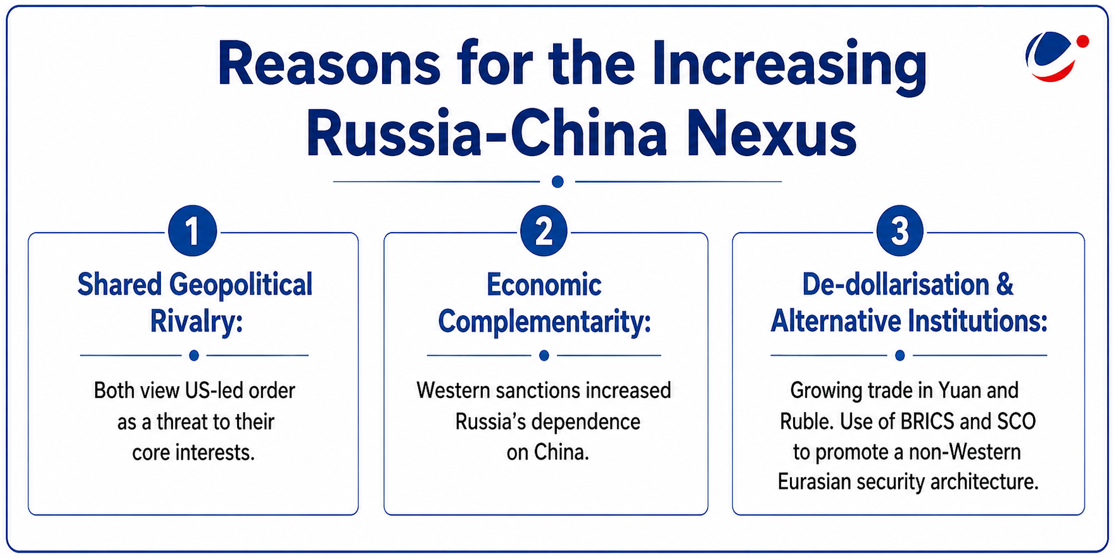
Russian President’s recent China visit highlighted Russia’s growing dependence on China, with both sides signing 40+ agreements and reaffirming support for a multipolar world order against Western dominance.
Implications on India
- Erosion of Russia as a Strategic Balancer: Russia’s growing dependence on China weaken its neutrality in India-China tensions.
- Defence Vulnerabilities: India’s reliance on Russian arms faces risks due to delays in supplies (e.g., S-400, stealth frigates)and transfer of advanced platforms to China affects India’s security.
- Emerging Russia–China–Pakistan Convergence: E.g., Russia is expanding ties with Pakistan through arms sales, discounted oil exports, etc.
- Challenges in Multilateral Forums: E.g., Cooperation between Russia and China in Shanghai Cooperation Organisation
- Pressure on India’s Strategic Autonomy: Russia-China proximity and uncertain US policies constrain India’s multi-alignment strategy.
FTA aligns with India's "Viksit Bharat 2047" vision to integrate into global value chains and empower MSMEs, farmers, women, and youth.
Key Details of FTA
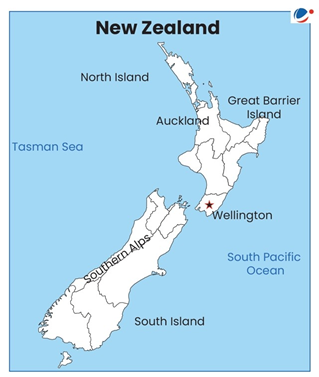
- 100% Duty-Free Access: New Zealand will eliminate duties on all Indian exports, providing a major boost to labour-intensive sectors like MSMEs, textiles, leather, footwear, and gems etc.
- FDI Commitment: New Zealand committed to a USD 20 billion investment in India over the next 15 years.
- Protection of Sensitive Sectors: India has offered market access in 70% of the tariff lines, covering 95% of New Zealand's Bilateral Trade.
- ~30% of tariff lines are in the exclusion category, to shield farmers and domestic industries. E.g. dairy, sugar, vegetable products like onions, aluminium etc.
- Rules of Origin: A robust framework of Product Specific Rules of Origin (PSRs) established to effectively prevent misuse of trade benefits.
- Talent & Mobility: Student Mobility and Post Study Work Visa for STEM Graduates, Skilled Professionals; an annual quota of 5,000 Temporary Employment Visas for skilled Indians.
- Globalizing AYUSH: First-time provision by New Zealand to recognize and facilitate trade in India's traditional medicine systems, including Ayurveda and Yoga.
- Others: Agricultural Productivity Partnership; Market Access across 118 services sectors, with Most-Favoured Nation (MFN) treatment in 139 sectors.
India-New Zealand Relations
|
Article Sources
1 sourceIndia and Vietnam upgraded bilateral relationship to "Enhanced Comprehensive Strategic Partnership".
- The “Enhanced Comprehensive Strategic Partnership” marks an elevation of the Comprehensive Strategic Partnership established between India and Vietnam in 2016.
- This decision was taken during the visit of the President of Vietnam to India.
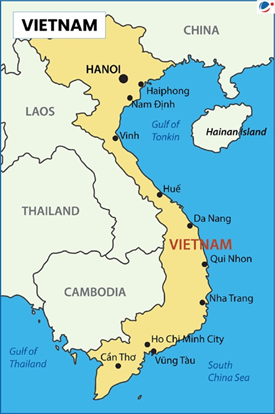
Key Highlights / Outcomes of Visit
- Trade & Economic Cooperation: Bilateral trade target set at $25 billion by 2030 (currently around $16 billion).
- Both sides pushed for Early review and conclusion of ASEAN-India Trade in Goods Agreement (AITIGA).
- 13 strategic MoUs Signed: Across critical minerals cooperation, Digital Connectivity & FinTech, healthcare, digitisation of ancient Cham manuscripts, etc.
- Defence & Security Cooperation: Both countries will establish Strategic Diplomacy–Defence Dialogue (2+2).
- Maritime Integration: Vietnam joined Indo-Pacific Oceans Initiative (IPOI).
- IPOI is a voluntary, non-treaty initiative launched by India at East Asia Summit 2019 in Thailand to promote a free, open, and rules-based Indo-Pacific region.
Significance of Vietnam for India
- Act East Policy: Vietnam is a core partner of India in ASEAN and a critical partner in India's Act East policy, Vision MAHASAGAR and the Indo-Pacific vision.
- Geostrategic location: Vietnam's position in the Indo-Pacific is crucial for maintaining secure and stable trade routes.
- Countering China: Both support freedom of navigation and a rules-based order in the South China Sea in accordance with the 1982 UNCLOS.
- Supply Chain Diversification: Vietnam’s cooperation in imports and rare earths supports India’s manufacturing ecosystem, helps reduce global dependence on Chinese supply chains.
- Energy security: Indian companies have invested in oil and gas exploration projects in Vietnamese waters in South China Sea which are extremely rich in hydrocarbon reserves.
India and EU launched €15.2 million (~₹169 crore) joint initiative to strengthen EV battery recycling under the India-EU Trade and Technology Council (TTC)-working group-2.
- The initiative will be funded through the EU’s Horizon Europe programme and India’s Ministry of Heavy Industries.
About India-EU Trade and Technology Council (TTC)
- Launch: February 2023.
- Objective: It aims to push both regions toward strategic autonomy by actively reducing the EU's dependence on China and India's reliance on Russia.
- Three Core Working Groups (WGs):
- WG 1: Strategic Technologies, Digital Governance and Connectivity.
- WG 2: Green and Clean Energy Technologies.
- WG 3: Resilient Value Chains, Trade and Investment.
The Chinese President raised the “Thucydides Trap”and Peloponnesian War in talks with the US president in Beijing.
About Thucydides Trap:
- Origin: The term was coined by Harvard political scientist Graham Allison.
- He named it after the ancient Greek historian Thucydides who chronicled the Peloponnesian War.
- Peloponnesian War was long war between Athens and Sparta started in 431BC.
- He named it after the ancient Greek historian Thucydides who chronicled the Peloponnesian War.
- Meaning: It describes the danger that emerges when a rising power threatens to displace a dominant one, leading to conflict.
- Modern Relevance: it is used to analyze the complex and tense geopolitical relationship such as between the United States (established power) and China (rising global power).
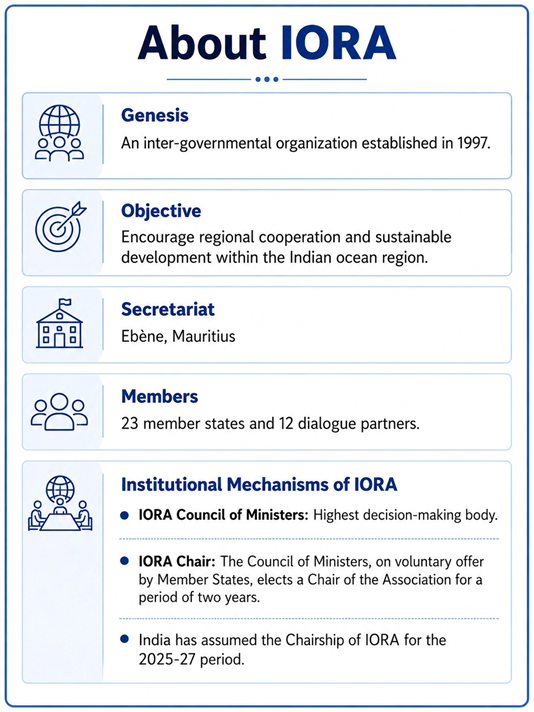
India hosted the 10th Indian Ocean Dialogue (IOD) under the theme "Indian Ocean Region in a Transforming World.”
- IOD is a flagship Track 1.5 platform under Indian Ocean Rim Association (IORA)
Article Sources
1 source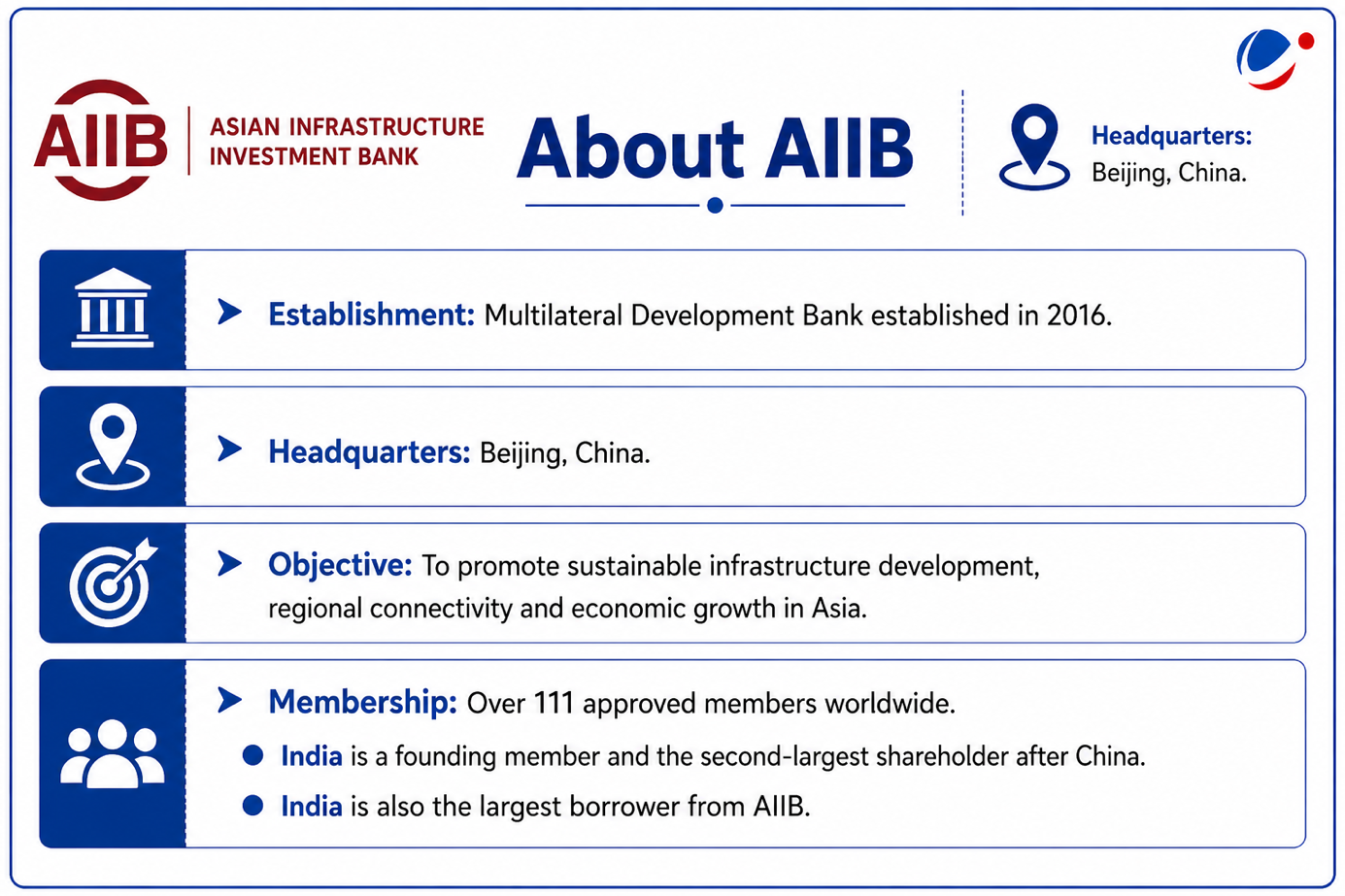
AIIB launched an Energy, Food Security and Economic Resilience Facility to support members whose development may be affected by the conflict in the Middle East.
- It offers a time-bound financing envelope of up to USD10 billion over two years.
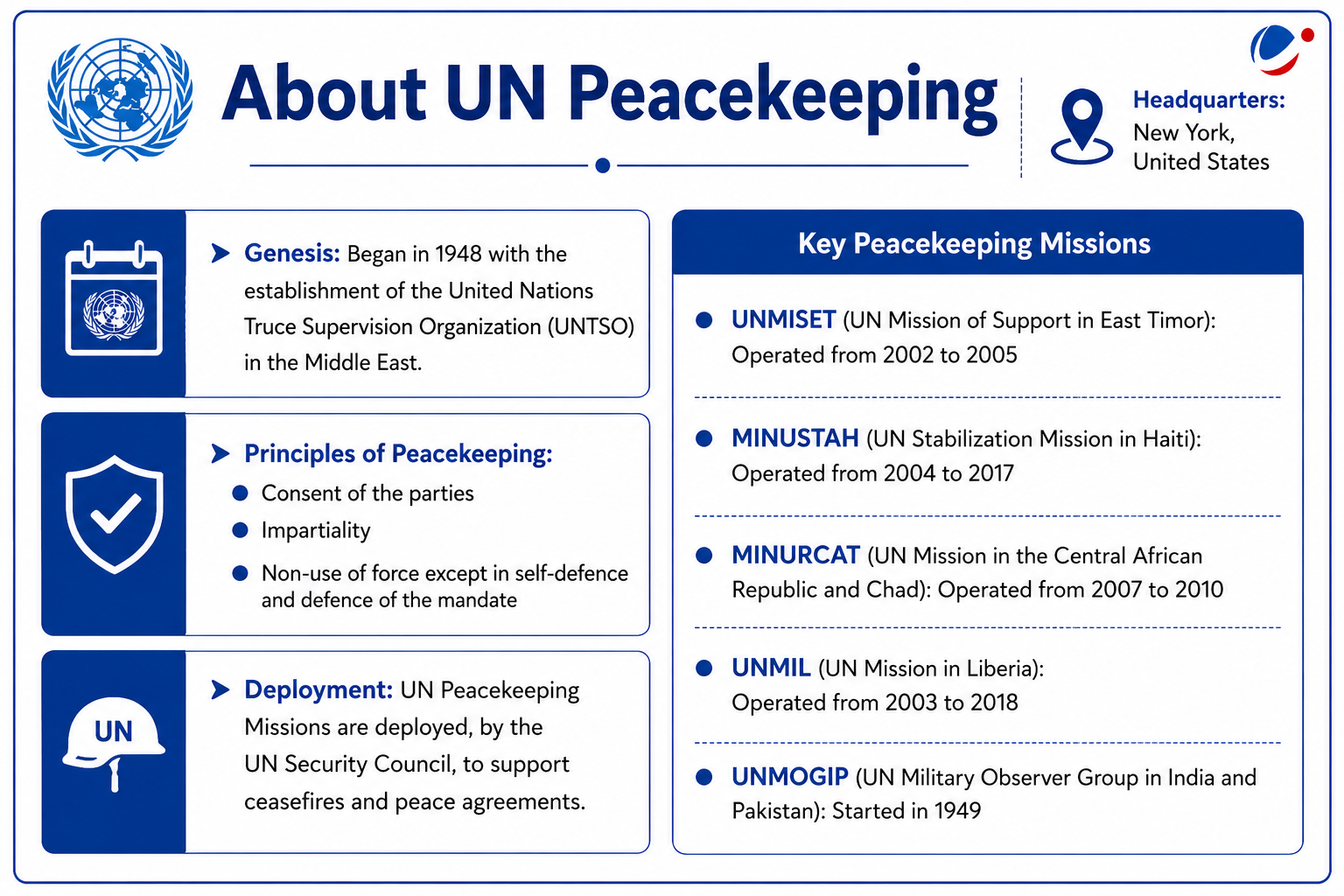
Released by SIPRI (Stockholm International Peace Research Institute), it highlights the key challenges confronting multilateral peace operations.
Key Challenges faced by Peacekeeping Operations
- Funding Shortfall: Unpaid donor contributions (from countries like the USA) caused a $2 billion UN shortfall, forcing deep cuts to peace personnel numbers.
- Geopolitical Gridlock: UN Security Council veto threats complicate mandate renewals. E.g., U.S. is pushing for the termination of missions like the UN Interim Force in Lebanon (UNIFIL)
- Defunding of Regional Missions: E.g., EU redirecting its European Peace Facility (EPF) funding from Africa towards Ukraine and West Asia.
- Rise of Ad Hoc Interventions: E.g., Middle powers (like UAE) are using bilateral military agreements that prioritize short-term security over long-term conflict resolution.
- Unequal Burden on the Global South: All top 10 military and police-contributing nations including India are from the Global South.
- Historic Lows in Personnel Deployments: There were 58 active peacekeeping operations in 34 countries in 2025, dropping below the threshold of 60 for the first time since 2016.
Strengthening peacekeeping operations requires predictable funding, greater burden-sharing by developed countries, and stronger cooperation with regional organizations to address evolving global security challenges.
Global Network Against Food Crises released 10th edition of Global Report on Food Crises, 2026.
- As per the report, more than 266 million people in 47 countries faced high levels of acute food insecurity in 2025.
- Conflict has overtaken extreme weather as main driver.
About Global Network Against Food Crises
- Genesis: Launched in 2016 by Food and Agriculture Organization (FAO) with European Union (EU) and WFP (World Food Programme) at World Humanitarian Summit.
- Purpose: Multistakeholder initiative of humanitarian and development actors, united by commitment to tackle root causes of food crises and to promote sustainable solutions.
Related News: Hunger MapWorld Food Programme has launched a new AI-assisted food alert platform Hunger Map, enhances real-time monitoring to support humanitarian efforts in combating global hunger. About WFP (HQ: Rome)
|
Article Sources
1 source- The 2nd International Migration Review Forum (IMRF) 2026 was recently held in New York to reviews Global Compact for Safe, Orderly and Regular Migration (GCM) progress, identifies gaps, shares best practices, and guides future migration governance.
- Held every four years (quadrennial).
- Concerns highlighted:
- Uneven access and rising displacement
- Most displacement is driven by a mix of conflict, environmental pressures, and structural vulnerabilities.
- Migrant deaths, detention and exploitation of migrants, and
- Growing discrimination, and anti-migrant narratives.
- Uneven access and rising displacement
- Six Priorities highlighted by UN Secretary
- Rights-based migration governance,
- Protect migrants in distress and ensure that returns are safe and dignified
- Crackdown on traffickers and smugglers,
- Expand regular migration pathways for students, workers, families, and people seeking safety and protection.
- Address root causes through development and jobs
- Strengthen international cooperation
Global Compact for Safe, Orderly and Regular Migration (GCM)
|
Article Sources
1 sourceInternational Organisation for Migration released the World Migration Report 2026.
Key Highlights
- Global Migration: ~304 million people were living outside their country of birth in 2024, accounting for 3.7% of the global population, up from 2.9% in 1990.
- Top Corridors: Mexico-US (1st), Afghanistan-Iran (2nd), Syria-Turkiye (3rd), Russia-Ukraine (4th), India-UAE (5th) and India-US (6th).
- Migration driving development: Remittances reached an estimated $905 billion globally in 2024, including $685 billion to low- and middle-income countries
- India related:
- Indian migrants in UAE wereover 3 million while Indians in US were around 3.2 million (second-largest after Mexicans).
- India had a higher share of female immigrants than male immigrants.
Article Sources
1 source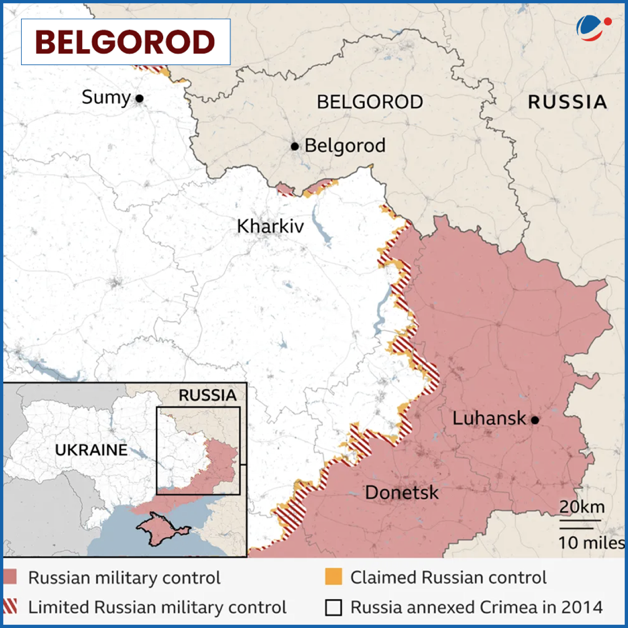
- Belgorod Region (Russia): Missile and drone strike on Russia's Belgorod region caused casualties and damaged critical energy infrastructure.
- Situated in southwestern Russia, also shares a state border with Ukraine.
- Industrial hub, it produces one-third of Russia's iron ore and leads in agriculture.
- Falkland Islands: The UK rejected any change to sovereignty over the Falkland Islands, as United States policy regarding the island remains under review.
- It is internally self-governing overseas territory of the United Kingdom in the South Atlantic Ocean.
- The Falkland Islands are an archipelago comprising two large islands (East Falkland and West Falkland) and several hundred smaller ones.
- It lies about 480 km northeast of the southern tip of South America and a similar distance east of the Strait of Magellan.
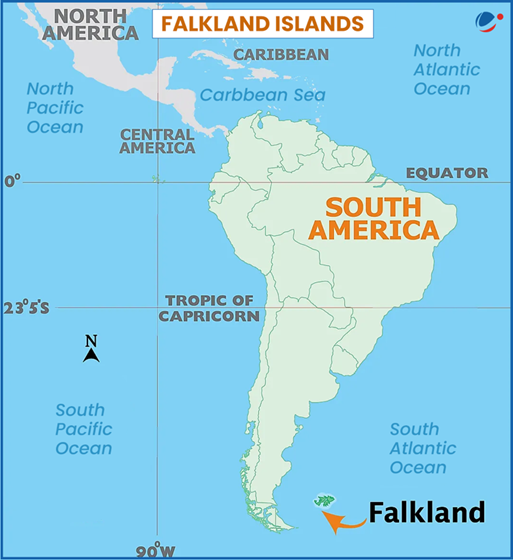
- The islands are claimed by Argentina, and the dispute led to a war in 1982.
- Pratas Island: Chinese Coast Guard ship was recently spotted near Taiwan's strategically located Pratas Islands at top of South China Sea.
- Also known as Dongsha Island, are a small group of three islands forming a coral atoll located in the South China Sea, governed by Taiwan.
- Characterized by circular atoll structure, with Dongsha Island being only island above sea level, while other two (North Vereker Bank and South Vereker Bank) are submerged.
- Contested between China and Taiwan.
- Other Islands of South China Sea: Spratly Islands, Paracel Islands, and Scarborough Shoal.
Over 240 members of the B’nei Menashe community from Manipur and Mizoram were relocated to Tel Aviv by the Israel government.
About B’nei Menashe community
- They are a Jewish-identifying community from Manipur and Mizoram.
- They belong to Mizo-Kuki tribes, who claim descent from one of the “Ten Lost Tribes of Israel” (Tribe of Menashe).
- The tribe was exiled in 722 BC by Assyrian conquerors.
- Bnei Menashe, which is Hebrew for the children of Manasseh, the first son of Joseph.


