


The Government has appointed Lieutenant General NS Raja Subramani (Retd) as the next Chief of Defence Staff (CDS).
About CDS
- Genesis: The post of CDS was created in 2019 on the recommendations of a Group of Ministers (GoM) in 2001, based on the 1999 K. Subrahmanyam Committee (or Kargil Review Committee) Report.
- Roles and Responsibilities of CDS:
- Principal Military Adviser to the Raksha Mantri on all tri-service matters.
- Head of Department of Military Affairs (DMA): As the ex-officio Secretary, the CDS oversees Armed Forces Affairs, Procurement (excluding capital acquisitions), and Integration (promoting "jointness" in training, logistics, etc.).
- Permanent Chairman of Chiefs of Staff Committee: acting as "first among equals" to coordinate between the three Service Chiefs.
- Strategic Mandates: Theatre Commands, Nuclear Authority (Military Adviser to the Nuclear Command Authority) and Policy & Planning.
Article Sources
1 sourceThe proposed Smart Border Project by Ministry of Home Affairs will be equipped with drones, radars, modern cameras, and other advanced technologies, making entire borders with Bangladesh and Pakistan impenetrable.
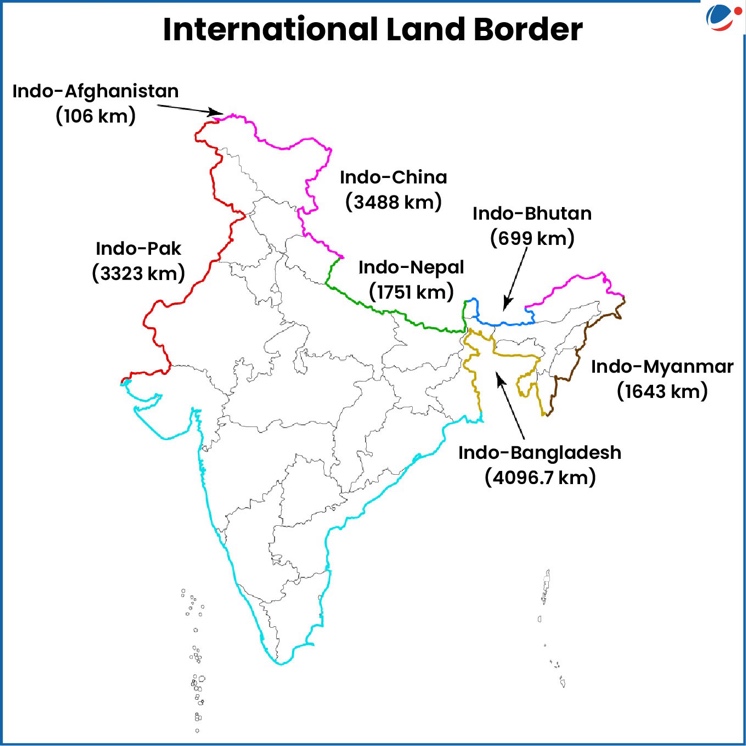
Need for Smart Border Project in India
- Vast Land Border: India shares 15,106.7 kilometres of land border with seven countries (Bangladesh, China, Pakistan, Nepal, Myanmar, Bhutan and Afghanistan).
- Countering Illegal Activities: To curb illegal infiltration, organized crime, smuggling of narcotics, cattle, weapons and counterfeit currency.
- Tackling Emerging Security Threats: Such as cyber threats, hybrid warfare, and drone-based intrusions.
- Managing Difficult Terrain and Climate: Varied terrain such as deserts, glaciers, lakes, rivers, snow-covered peaks, swampy marshes, fertile lands, and tropical forests not suitable for sustaining manpower.
- Enhancing Efficiency Through Technology: To ensure integrated, real-time, and technology-driven border security management.
Initiatives taken for Smart Border Management
- Anti-Drone Systems: Integration of jamming and detection tech to counter aerial threats. E.g. IG T-Shul Pulse Anti-Drone System.
- Comprehensive Integrated Border Management System (CIBMS): Deployment of smart fencing, sensors, radars, CCTV cameras, and command-control systems for real-time border monitoring.
- BOLD-QIT (Border Electronically Dominated QRT Interception Technique) project: It is a high-tech "smart fencing" initiative launched by the Border Security Force (BSF) along the Indo-Bangladesh border.
SIPRI has released the Trends in World Military Expenditure, 2025 Report.
- SIPRI (Stockholm International Peace Research Institute) is an independent international institute dedicated to research into conflict, arms control and disarmament established in 1966 in Stockholm (Sweden).
Key Findings
- The five biggest military spenders in 2025—United States, China, Russia, Germany and India—accounted for 58% of global spending.
- India is the fifth biggest spender (3.2% of total global expenditure) in the world with total expenditure of $92.1 billion.
- India’s spending saw a surge of 8.9% compared to the previous year.
Article Sources
1 sourceDefence Minister laid foundation stone for AMCA programme facility in Andhra Pradesh.
About Advanced Medium Combat Aircraft (AMCA)
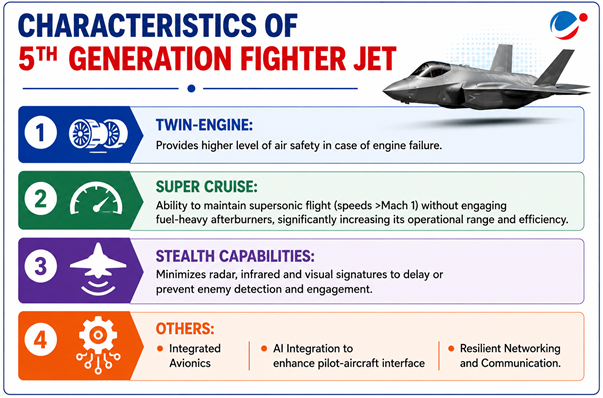
- AMCA is India’s indigenous 5th-generation medium-weight stealth multirole fighter jet.
- Developed by: Aeronautical Development Agency, DRDO.
- Variants: AMCA Mk1 with GE-F414 engines; Mk2 planned with indigenous engines.
- Timeline: Prototype expected by 2028-29 and induction targeted by 2034-35.
Examples of Operational5th Generation Fighter Jets: F-22 and F-35 (United States), Sukhoi Su-57 (Russia), Chengdu J-20 (China).
Strategic Importance of 5th Generation Fighter Jet AMCA
- IAF Modernisation: Fills critical capability gap post-MiG-29/Mirage phaseout, helps restore IAF's depleted squadron strength.
- Technological Sovereignty: Reduces dependency on foreign platforms, enhances long-term defence autonomy through Make in India.
- Atmanirbhar Bharat: Enhances India's indigenous defence capabilities by fostering a robust domestic aerospace industrial ecosystem.
India conducted the 2nd successful flight-trial of ‘Divyastra’ Missile from Dr. APJ Abdul Kalam Island, Odisha.
About ‘Divyastra’ Missile
- It is an advanced Agni Missile equipped with Multiple Independently Targeted Re-Entry Vehicle system (MIRV) system.
- MIRV system: Originally developed in the early 1960s, it allows a single missile to carry multiple nuclear warheads, each capable of striking different targets independently.
- The United States of America (first country to develop MIRV technology), Russia, the United Kingdom, France, and China also have MIRV Technology.
Article Sources
1 sourceIndigenous Vayu Astra-1 successfully completed high-altitude trials.
About Vayu Astra-1
- It is a loitering munition (also referred as kamikaze/suicide drone) capable of hovering, surveillance and precision strikes.
- Suicide drone is an unmanned aerial weapon that can hover over a target area before crashing into and destroying the target with an onboard explosive payload
- Range and Payload: 100 km range tested with a 10-kg warhead.
- Features: Precision & night capability, high-altitude endurance, intelligent combat features, etc.
Mahendragiri, the sixth ship of Nilgiri-class (Project 17A) and fourth ship of the class built at Mazagon Dock Shipbuilders Limited (MDSL), was delivered to the Indian Navy.
- Other P17A ships are Dunagiri, Taragiri, Udaygiri, Himgiri, Nilgiri.
About Project 17A
- Project 17A frigates are versatile multi-mission platforms, designed by the Warship Design Bureau (WDB) and overseen by the Warship Overseeing Team (Mumbai).
- P17A ships are fitted with an advanced weapon and sensor suite as compared to the P17 (Shivalik-class) and include anti-surface, anti-air, and anti-submarine warfare systems.
- These ships are configured with Combined Diesel or Gas (CODOG) propulsion plants, comprising a diesel engine and a gas turbine.
Article Sources
1 sourceDRDO and the Indian Air Force (IAF) successfully conducted the maiden flight trial of the Tactical Advanced Range Augmentation (TARA) weapon in Odisha.
About TARA
- It is India’s first indigenous glide weapon system that converts unguided warheads into precision-guided weapons.
- Developed by: the Research Centre Imarat, Hyderabad, along with other DRDO laboratories.
- Advantage: Its stand-off capability allows pilots to release bombs from outside hostile air defence coverage.
- Once deployed, the bombs glide at high subsonic speeds (>650 km/h), with a range of more than 80 km, making interception difficult.
- Other glide bomb in India: Gaurav (Long Range Glide Bomb - LRGB), SAAW (Smart Anti-Airfield Weapon), etc.
Recent proposal by Iranian state media to impose charges on undersea cable operators in the Strait of Hormuz highlights the growing vulnerability of global undersea cables.
Undersea Cables
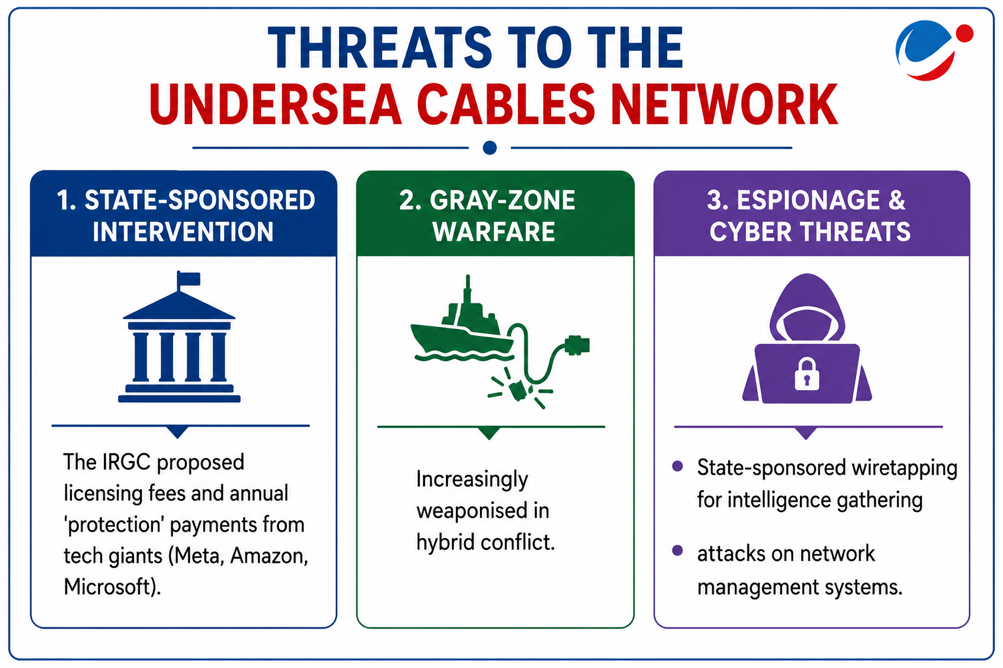
- Undersea, or submarine, cables are fibre optic lines laid on the ocean floor to carry global data and serve as the backbone of modern digital connectivity.
- These "invisible highways" transmit between 95% and 99% of all international data traffic.
- United Nations General. Assembly (UNGA) in 2010 had described Submarine cable as “critical communication infrastructure”.
- Subsea cables carry a much larger bandwidth and are more efficient, cost-effective, and reliable than satellites.
- Narrow maritime corridors such as the Red Sea, Strait of Hormuz, where multiple undersea cables converge, are often referred to as “digital chokepoints.”
Implications for India
- Financial Sector: E.g., Stock trading and banking systems relying on fast connectivity could face paralysis within minutes.
- IT and Outsourcing Sector: E.g., India’s IT-BPM industry relies on uninterrupted global connectivity for providing services to international clients.
- Strategic and National Security Risks: E.g., Military communications and intelligence sharing
National Investigation Agency (NIA) highlights the use of rare explosive mixture TATP in the 2025 Red Fort blast.
About TATP (C9H18O6)
- Also known as “Mother of Satan” and acetone peroxide, it is a semi-stable crystalline solid, attractive as a terror weapon as it is relatively easy to prepare.
- Key Characteristics: belongs to a class of organic peroxide explosives.
- extremely sensitive to impact, friction, static electricity, and heat.
- extremely dangerous, and even small quantities (1gram) can cause injury and damage.
- Terror Linkages: Used in major terror attacks like Paris (2015), Brussels (2016), Manchester Arena (2017), etc.
Article Sources
1 sourceThe Narcotics Control Bureau, under Operation RAGEPILL, unearthed the first ever international drug syndicate involved in the trafficking of Captagon.
About Captagon
- Captagon mainly contains Fenetylline (Used to treat conditions such as ADHD, depression and narcolepsy) and Amphetamine which are Psychotropic Substances under the Narcotic Drugs and Psychotropic Substances Act, 1985.
- NDPS Act is enacted to prohibit and regulate the production, possession, trafficking, and consumption of narcotic drugs and psychotropic substances.
- Also known as the “Jihadi Drug” (used by militant groups like ISIS).
- Banned internationally in the 1980s after concerns over addiction and abuse, and was later placed under Schedule II of the UN Convention on Psychotropic Substances.
- CINBAX Exercise: Joint military exercise with Royal Cambodian Army.
- Exercise PRAGATI 2026: Multilateral military exercise led by the Indian Army at Umroi Military Station, Meghalaya.
- Participating Countries: 12 nations (Bhutan, Cambodia, Indonesia, Laos, Malaysia, Maldives, Myanmar, Nepal, Philippines, Seychelles, Sri Lanka and Vietnam).
- PRAGATI stands for Partnership of Regional Armies for Growth and Transformation in the Indian Ocean Region.

