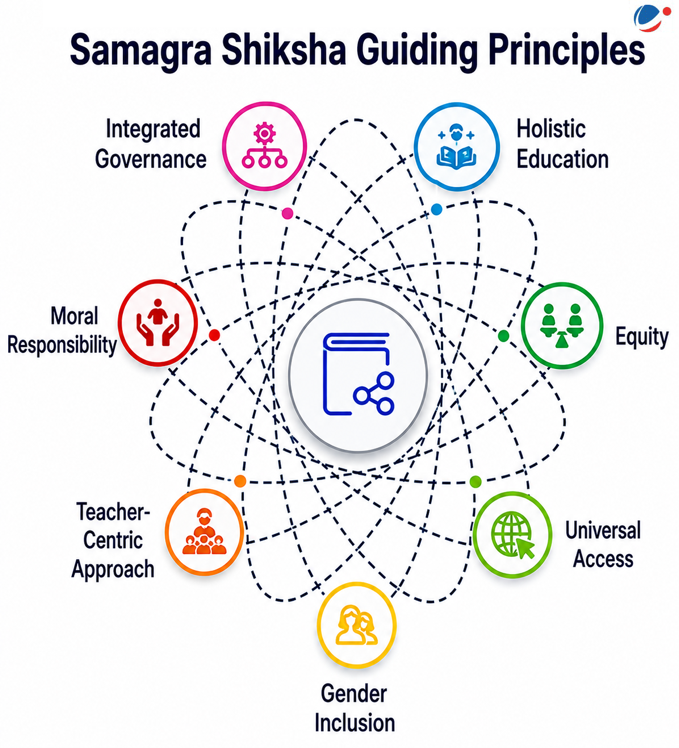
The Union Government extended the Samagra Shiksha Scheme for school education until September 30, 2026.
The scheme aims to implement NEP 2020, RTE Act, promote Foundational Literacy and Numeracy, and ensure equity and inclusion.
Launched in 2018, it subsumed Sarva Shiksha Abhiyan, RMSA, and Teacher Education, covering over 15 crore students.
In Summary
Why in the News?
The Union Government extended the Samagra Shiksha, Integrated Scheme for School Education, whose term ended on March 31, 2026, till Sept 30 or the date of approval of the scheme for the 16th Finance Commission cycle by the competent authority, whichever is earlier.
Core Objective
Salient Features of the Scheme
Support implementation of National Education Policy 2020 recommendations.
Facilitate implementation of the RTE Act, 2009.
Strengthen Early Childhood Care and Education (ECCE).
Promote Foundational Literacy and Numeracy (FLN).
Foster holistic, inclusive, activity-based learning and 21st-century skills.
Improve quality of education and learning outcomes.
Bridge social and gender gaps in school education.
Ensure equity and inclusion at all levels.
Strengthen State Councils for Educational Research and Training (SCERTs)/State Institutes of Education and District Institutes for Education and Training (DIET).
Provide a safe, secure, and conducive learning environment.
Promote vocational education and skill development.
About Samagra Shiksha Scheme
Launch Year: 2018.
Ministry: Ministry of Education
Aim: To universalize access to school education; to promote equity through the inclusion of disadvantaged groups and weaker sections, and to improve the quality of education across all levels of school education from pre-primary to class XII.
Type: Centrally Sponsored Scheme.
Implementing agency:
State Level: State Implementation Society (SIS) at the State/UT level.
National Level: Governing Council (GC) headed by Minister of Education and a Project Approval Board (PAB) headed by Secretary, Department of School Education and Literacy.
Fund Sharing Pattern:
NE & Himalayan States: 90:10 sharing between Centre and States.
Union Territories without a legislature: 100% Central assistance.
All Other States: 60:40 sharing between Centre and States.
It subsumed the erstwhile Sarva Shiksha Abhiyan, Rashtriya Madhyamik Shiksha Abhiyan, and Teacher Education Scheme.
Sarva Shiksha Abhiyan: Universalizes elementary education with infrastructure support per RTE Act, 2009.
Rashtriya Madhyamik Shiksha Abhiyan (RMSA): Enhances access and quality of secondary education.
Teacher Education Scheme: Develops infrastructure for teacher training and academic support for elementary and secondary schools.
Coverage: The scheme covers 11 lakh 60 thousand schools, more than 15 crore 56 lakh students and 57 lakh teachers from government and government-aided schools.
Key Interventions:
Universalising access to quality education: By provision for new/ upgradation of schools from pre-primary to senior secondary level.
Focus on Girl Education: Upgradation of Kasturba Gandhi Balika Vidyalayas (KGBVs).
Inclusive Education: Supporting Children with Special Needs (CWSN) in schools at all levels Classes-I to XII.
Nipun Bharat (National Mission on Foundational Literacy and Numeracy) has been launched under the scheme.
Strengthening of Teacher Education and Training:
Specific training modules under NISHTHA (National Initiative for School Heads' and Teachers' Holistic Advancement) scheme of National Council of Educational Research and Training (NCERT) for training secondary teachers and primary teachers.
Innovation:
Support for the activities of National Assessment Centre, PARAKH (Performance, Assessment, Review and Analysis of Knowledge for Holistic Development).
Provision for qualitative and innovative interventions such as Holistic Progress Card (HPC), sports grant, library grant etc.
Appointment of language teachers has been added to the scheme.
Digital Initiatives: Information Communication and Training (ICT) laboratory, smart classrooms with digital boards, virtual classrooms etc.
Information Communication and Technology (ICT) laboratory
A facility within schools equipped with computers and internet access to facilitate digital learning and enhance technological literacy among students and teachers. This is a digital initiative under the Samagra Shiksha scheme.
Holistic Progress Card (HPC)
A comprehensive assessment tool designed to track and evaluate a student's overall development, including academic performance, skills, and competencies, rather than just marks. It is an innovative intervention supported by the Samagra Shiksha scheme.
PARAKH (Performance, Assessment, Review and Analysis of Knowledge for Holistic Development)
The National Assessment Centre established under the Samagra Shiksha scheme to set norms, standards, and guidelines for student assessment and evaluation, promoting holistic development.
Title is required. Maximum 500 characters.
Search Notes
Filter Notes
Loading your notes...
Searching your notes...
Loading more notes...
You've reached the end of your notes
No notes yet
Create your first note to get started.
No notes found
Try adjusting your search criteria or clear the search.