


Why in the News?
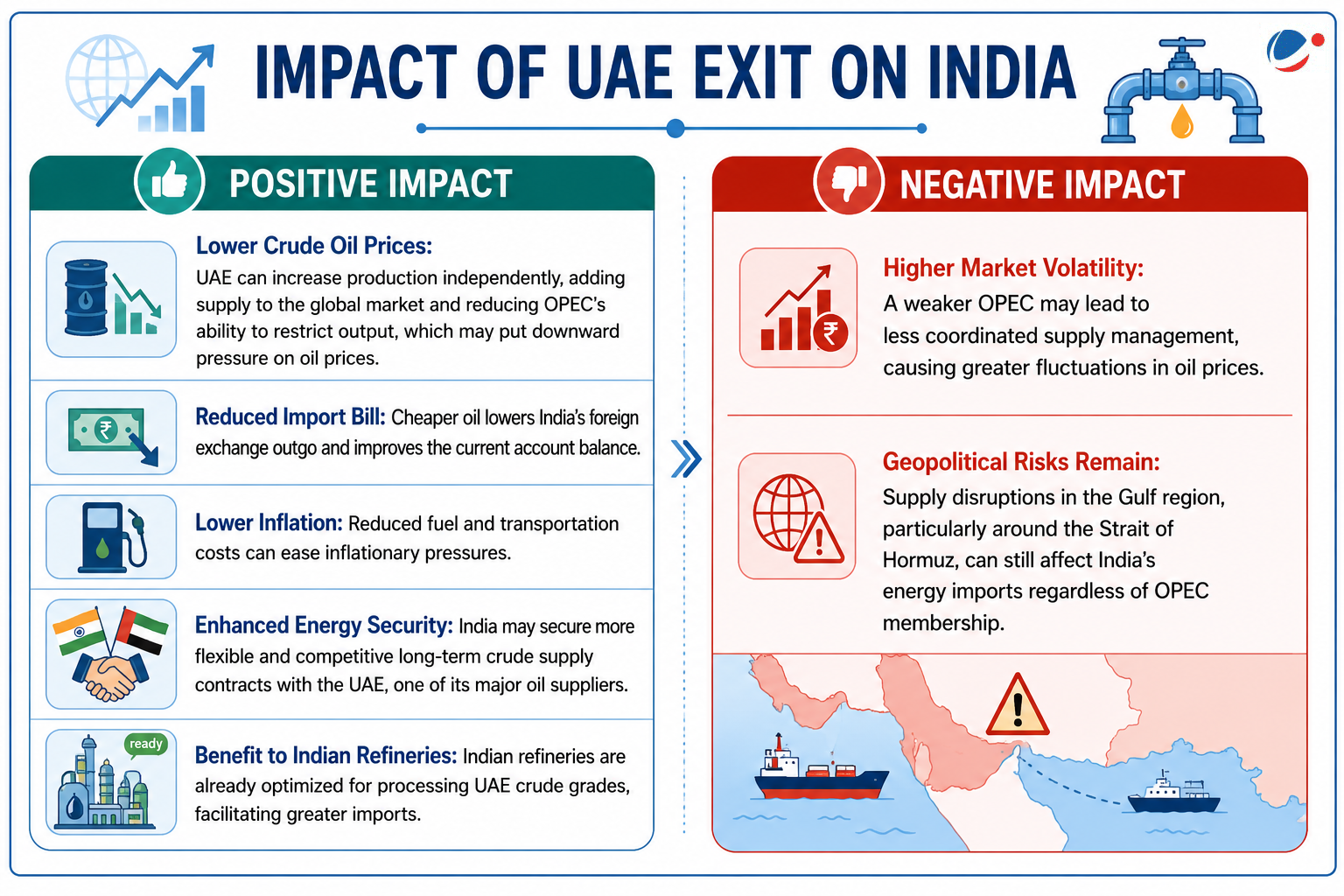
The United Arab Emirates (UAE) officially exited the Organization of the Petroleum Exporting Countries (OPEC) and OPEC+.
Why the UAE Left OPEC and OPEC+?
- Regional Security: A lack of solidarity from Arab and Gulf region in the face of Iranian missile strikes on UAE.
- Production Quota disputes: OPEC quotas limited the UAE from fully utilizing its growing oil production capacity.
- Energy transition and Economic diversification: The UAE sought to monetize oil reserves quickly and invest in a post-oil economy.
- Strategic autonomy: The UAE wanted greater independence in its energy and foreign policy decisions.
- Geopolitical: Divergent interests with Saudi Arabia on regional issues such as Yemen, Sudan, and broader Gulf geopolitics.
About OPEC
- It is a permanent intergovernmental organization of 11 oil-exporting developing nations.
- Genesis: It was created at the Baghdad Conference in 1960, by Iran, Iraq, Kuwait, Saudi Arabia and Venezuela.
- HQ: Vienna (Austria)
- Objective: To co-ordinate and unify petroleum policies among Member Countries, to secure fair and stable prices for petroleum producers.
- OPEC influences the Benchmark Prices by making use of its large share of crude production to increase or decrease the available supply of oil in the market.
- Members: After the Exit of UAE, OPEC currently has 11 members namely Algeria, Republic of Congo, Equatorial Guinea, Gabon, Iran, Iraq, Kuwait, Libya, Nigeria, Saudi Arabia, and Venezuela
- India is not a member.
- Countries who were members in the past: Ecuador, Indonesia, Qatar, Angola, UAE.
What are Benchmark Prices?
|
About OPEC+
- OPEC+: In response to falling oil prices driven by significant increase in U.S. shale oil output, OPEC signed an agreement with 10 other oil-producing countries in 2016 to create OPEC+.
- Together, the OPEC+ framework has historically controlled about 41% of the global oil supply.
- Members:Russia, Azerbaijan, Kazakhstan, Bahrain, Brunei, Malaysia, Mexico, Oman, South Sudan, and Sudan.


