


Why in the news?
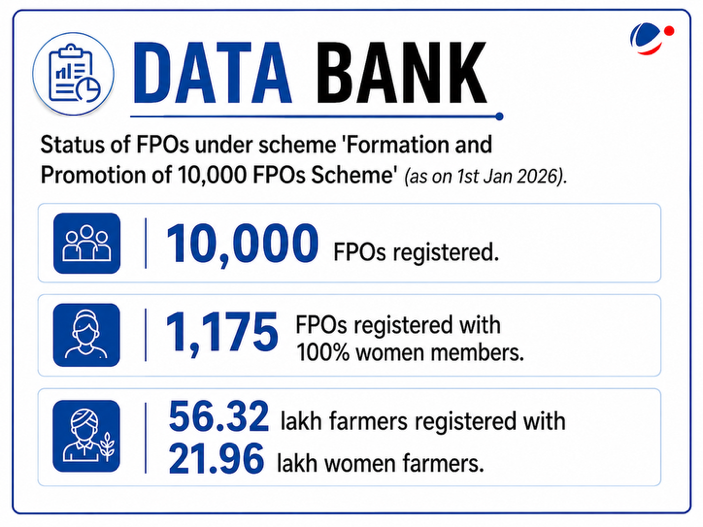
National Academy of Agricultural Sciences (NAAS) in a recent policy paper suggested key measures to enhance efficiency and sustainability of Farmers Producer Organisations in India.
About FPOs
- FPOs are a type of producer organization (legal entity formed by primary producers viz. farmers, fishermen, weavers, etc.) where the members are farmers (NABARD 2015).
- Incorporated/ registered under: Part IXA of Companies Act or under Co-operative Societies Act of the State or Central Govt.
- Small Farmers' Agribusiness Consortium (SFAC): Mandated by Ministry of Agriculture, to support State Governments in formation of FPOs.
- FPO Registry Portal: FPO must be registered with this portal maintained by Central Government and a receives a unique identity number, i.e. RIC (Registration Identity Code).
- Status: Most FPOs (85%) focus on field crops and horticulture while only 15% of focus on dairy, livestock, and fisheries.
- Key Features of FPOs:
- Ownership lies with members and management is through the representatives of members;
- Shares a part of profit amongst the producers and the surplus is added to its own funds for business expansion.
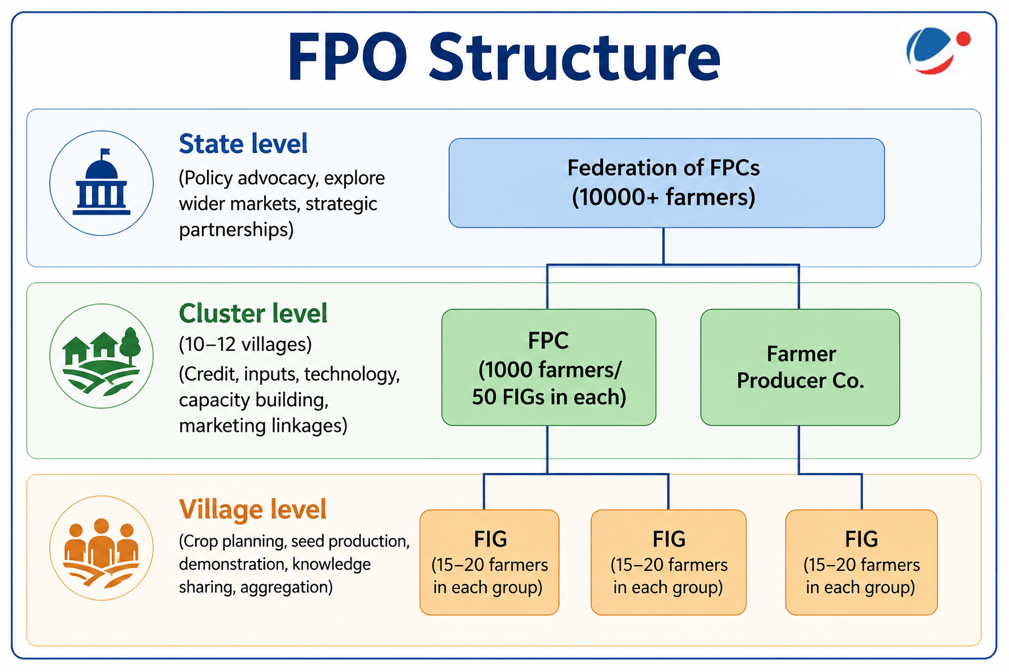
- Structure of FPO: Farmers are mobilised into groups of between 15-20 members at village level (called Farmer Interest Groups or FIGs) and further build up association (see infographic).
Benefits of FPOs
- Collective Bargaining: FPOs facilitate collective bargaining for small farmers by bringing them together into a structured entity, enabling them to reduce costs and achieve economies of scale.
- E.g., bulk purchasing reduces costs by 20-40%.
- Direct Market Access: FPOs eliminate 3-4 middlemen layers through access to eNAM and other digital platforms.
- Enhanced Technology Adoption: FPOs enable shared access to farm machinery (tractors, harvesters), precision farming tools (drones, sensors) and digital record-keeping and traceability.
- Financial Inclusion: FPOs enhance access to credit at lower interest rates, crop insurance and Government subsidies.
- E.g., under Formation & Promotion of 10,000 FPOs scheme, financial assistance of upto Rs.18 lakhs is provided to each FPO towards management cost for 3 years.
- Value Addition: FPOs provide services such as processing units for higher-value products, branding and packaging support, Organic/GI certification assistance etc.
- Risk Reduction: FPOs reduce risk for members by diversifying income sources (multi-cropping, processing), enabling collective bargaining during price fluctuations and climate-smart agriculture training.
- Policy Advocacy: Through representation in regional/national forums FPOs can advocate for favourable policies and regulations related to agriculture, trade, and market access and influence policy decisions.
- Knowledge Sharing and Capacity Building: Through expert consultations (agronomists, market specialists), training exercises and best practice sharing among members, FPOs help in building capacities in areas like modern and sustainable farming practices, market intelligence and quality standards.
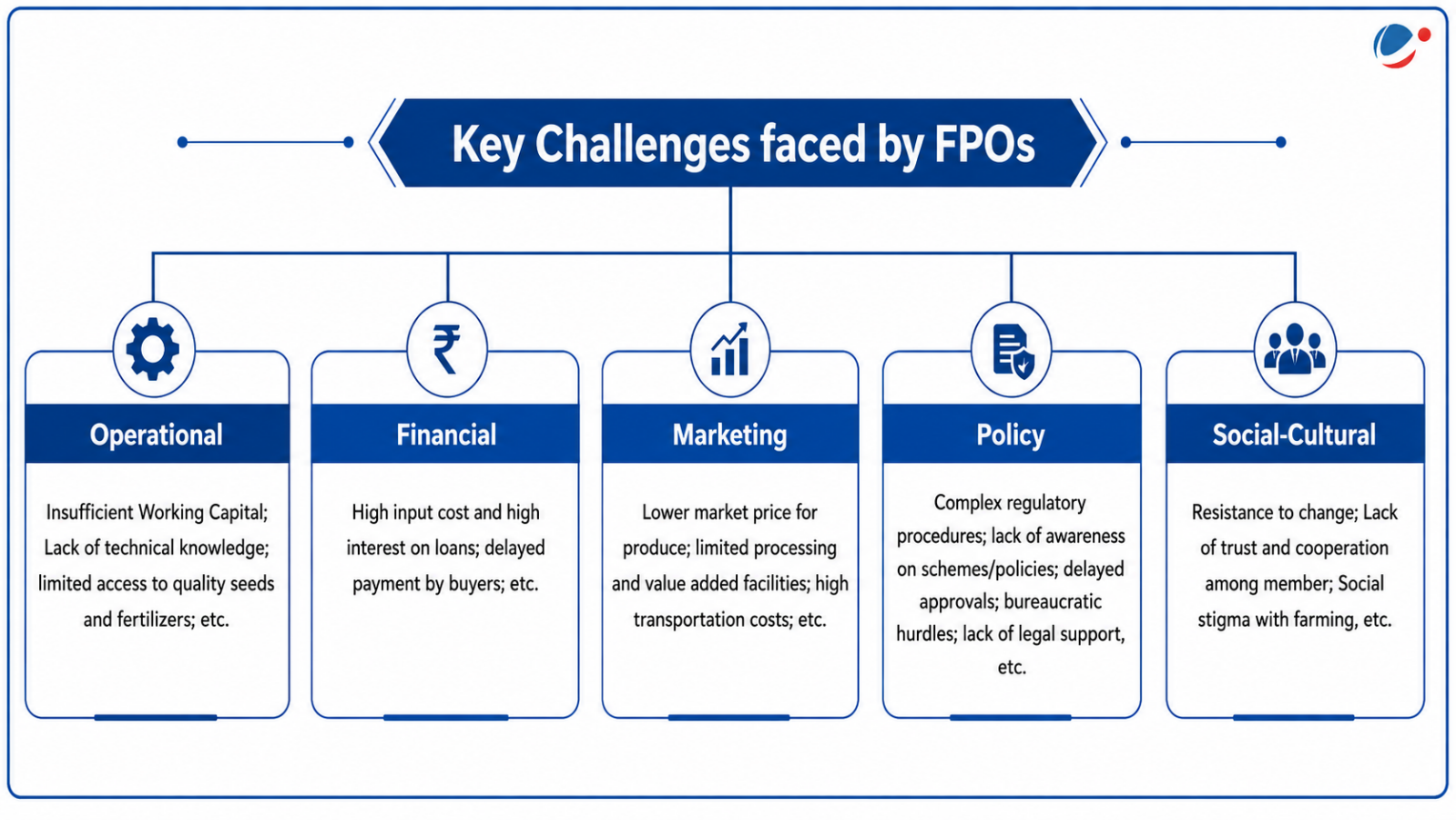
Key recommendations on Improving the Efficiency and Sustainability of FPOs
- Financial Support: Improving internal financing, equity, and working capital by building strong membership base and retaining profit margins to accumulate more working capital.
- Risk Management: Using modern technologies like artificial intelligence (AI), Internet of Things (IoT) and group insurance to improve adaptive capacity and overcome weather-related and other biotic risks.
- Post-harvest management: Specialized training in fruit bagging, harvesting techniques and value addition through primary processing can build an efficient FPO value chain, facilitate internal coordination, and minimize waste.
- Integration of Digital Technologies: Technologies like blockchain, IoT, and AI can help FPOs adapt to various challenges.
- E.g., Traceability, enabled by blockchain technology increases transparency; Big data and IoT applications improve precision farming, logistics management, etc.
- Government Policy and Support: Although FPOs are exempted from income tax for turnover up to Rs. 1000 million, they have to pay minimum alternate tax which could be streamlined and restructured.
- Simplification of compliance: Ministry of Agriculture to collaborate with Ministry of Corporate Affairs to review and simplify compliance requirements, adopt a single window system for all relevant FPO issues, etc.
- Link institutional buyers with FPOs: Institutional buyers like Railways, Military, and Food Corporation of India (FCI), must prioritize FPOs in procurement of both food and non-food commodities.
- Strengthening the linkages of FPOs with R&D: ICAR and NAAS can accelerate research and initiatives focused on FPOs, enhancing their promotion and operations. E.g. In Farmer FIRST project, FPOs can be integrated as research collaborators.
Key Initiatives taken towards Promotion of FPOs
|
Conclusion
A dedicated "FPO Support and Development Mission" offering integrated financial assistance, capacity building, market linkage support, and simplified regulatory services through single-window system could be implemented enabling FPOs to function efficiently and sustainably.


