


Why in the News?
A forecast of a super El Niño in late 2026, possibly the strongest in a century, has raised concerns that it could worsen extreme weather events.
More in the News
- The Earth's atmosphere is continuing to warm rapidly due to human-induced (anthropogenic) climate change.
- According to the World Meteorological Organization (WMO), 2025 was among the top three warmest year ever recorded globally.
- The already elevated temperatures could be further intensified by the development of a strong ("super") El Niño, which typically raises global temperatures and increases the likelihood of extreme heat events.
About El Niño and Super El Nino
- What is El Niño?
- The term El Niño means "Little Boy" in Spanish.
- It was named by Peruvian fishermen because unusually warm Pacific waters generally appeared around Christmas.
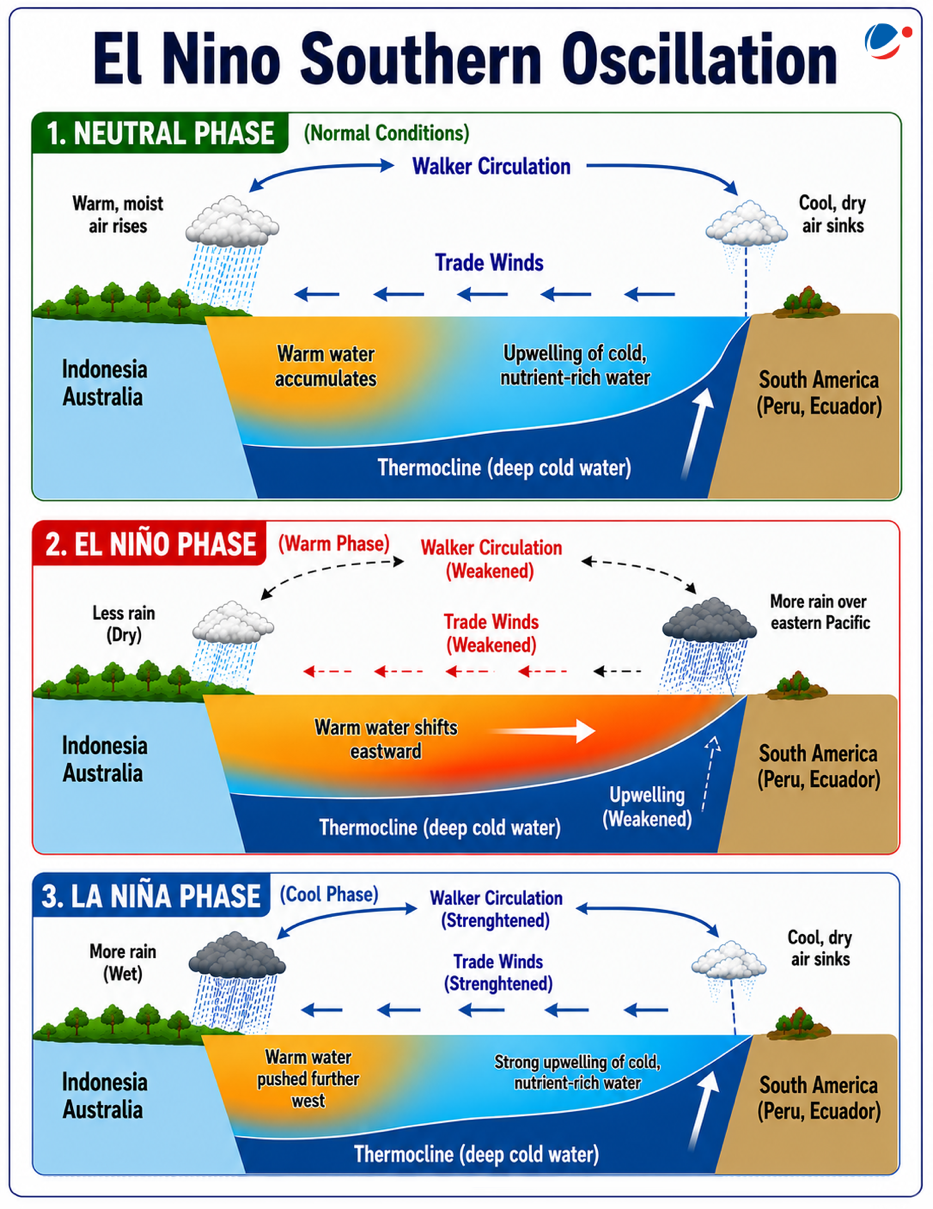
- It is one of the three phases of the natural climatic phenomenon called El Niño–Southern Oscillation (ENSO). ENSO has three phases:
- El Niño — Warm phase
- La Niña — Cool phase
- ENSO-neutral phase
- Super El Niño
- El Niño becomes extremely intense when sea-surface temperatures in the central and eastern Pacific Ocean rise far above normal levels.
- Such exceptionally strong events are informally called "Super El Niño."
- Although "Super El Niño" is not an official scientific category used by the World Meteorological Organization, the term is commonly used for unusually powerful El Niño events with major global impacts
- El Niño becomes extremely intense when sea-surface temperatures in the central and eastern Pacific Ocean rise far above normal levels.
- What is ENSO?
- It is a large-scale climate phenomenon involving periodic changes in: Sea surface temperatures (SST), atmospheric pressure, trade winds, and ocean circulation across the equatorial Pacific Ocean.
- It is one of the most important drivers of global climate variability and significantly influences: monsoons, rainfall patterns, droughts, floods, cyclones, agriculture, and global temperatures.
- ENSO has three phases:
- ENSO: Neutral phase
- El Niño: Warm phase. Induces less rainfall in India.
- La Niña: Cool phase. Induces more rainfall in India.
Impact of El Niño on India
- Weak Monsoon: El Niño weakens the Southwest Monsoon by reducing moisture flow toward India, leading to below-normal and uneven rainfall.
- Impact on Indian Agriculture
- Reduced Crop Productivity: El Niño reduces crop productivity by disrupting the basic requirements for crop growth such as adequate rainfall, suitable temperatures, and sufficient soil moisture.
- Increase in Pests and Diseases: Higher temperatures and dry conditions during El Niño years increase pest breeding and infestation.
- Pests such as aphids and whiteflies spread rapidly, while stressed crops become more vulnerable to diseases.
- Dryland Agriculture: Dryland areas usually have limited irrigation facilities.
- El Niño weakens the monsoon and causes below-normal and irregular rainfall in dryland regions.
- As it depends mainly on rainfall for its water harvesting techniques, crops become highly vulnerable to moisture stress.
- Drought Conditions: Many major droughts in India, such as 2002 and 2009, were linked to El Niño events.
- Economic Impact: Poor agricultural output increases food inflation, rural distress, and slows GDP growth.
- Water Scarcity: Reservoir levels, groundwater recharge, and irrigation water availability decline during weak monsoon years.
Other related Concepts
|
- Health and Environment: El Niño can increase heat waves, dengue and malaria cases, forest fires, and coral bleaching.
Initiatives Taken to Minimise the impact
- National Mission for Sustainable Agriculture (NMSA) supports climate-resilient farming practices in rainfed areas.
- Rainfed Area Development (RAD) component under NMSA follows a watershed-based approach for conserving natural resources.
- Mission Mausam aims to reduce the impact of extreme weather events caused by climate change and build stronger, more resilient communities.
- Government provides crop insurance support under schemes such as Pradhan Mantri Krishi Sinchayee Yojana (PMKSY) also strengthens climate adaptation in agriculture.
- Per Drop More Crop (PDMC) component under PMKSY promotes efficient irrigation technologies such as drip and sprinkler irrigation.
Conclusion
Super El Niño highlights the increasing interaction between natural climate variability and human-induced climate change, amplifying the risks of extreme weather, water stress, and food insecurity. For a monsoon-dependent country like India, strengthening climate-resilient agriculture, improving early warning systems, promoting efficient water management, and enhancing disaster preparedness are essential to reducing vulnerability.




