


Why in News?
Recently, Survey on Household Social Consumption: Health was released by National Statistical Office (NSO)
More on News
- It is 8th such survey and being brought out during National Sample Survey (NSS) 80th round (January-December 2025).
- Except some diseases like AIDS, Cancer, most diseases were identified using self-reporting increasing the chances of under or over reporting.
Key Drivers of Progress
- Ayushman Bharat PM-Jan Arogya Yojna :Centrally Sponsored Scheme under Ministry of Health (MoHFW) that provides free health cover of 5 lakh per family per year for secondary and tertiary care.
- Swasth Bharat Portal, by MoHFW. Its API-based federated architecture brings multiple national health programmes on a single interface, eliminating multiple logins and repetitive data entry, increasing interoperability and reducing duplications.
- AMRIT Affordable Medicines and Reliable Implants for Treatment pharmacies: Provides medicines at 50% to 90% discounts, reducing treatment costs.(managed by HLL Lifecare Limited a central public sector enterprise)
- Janani Suraksha Yojna: Centrally Sponsored Scheme under national health mission of MoHFW provides cash assistance to eligible pregnant women (all in low performing states having institutional deliveries)
- Doctor to Population Ratio: has increased to 1:811 (incorporating both allopathic and AYUSH practitioners) which is better than WHO recommended 1: 1000
Challenges Highlighted
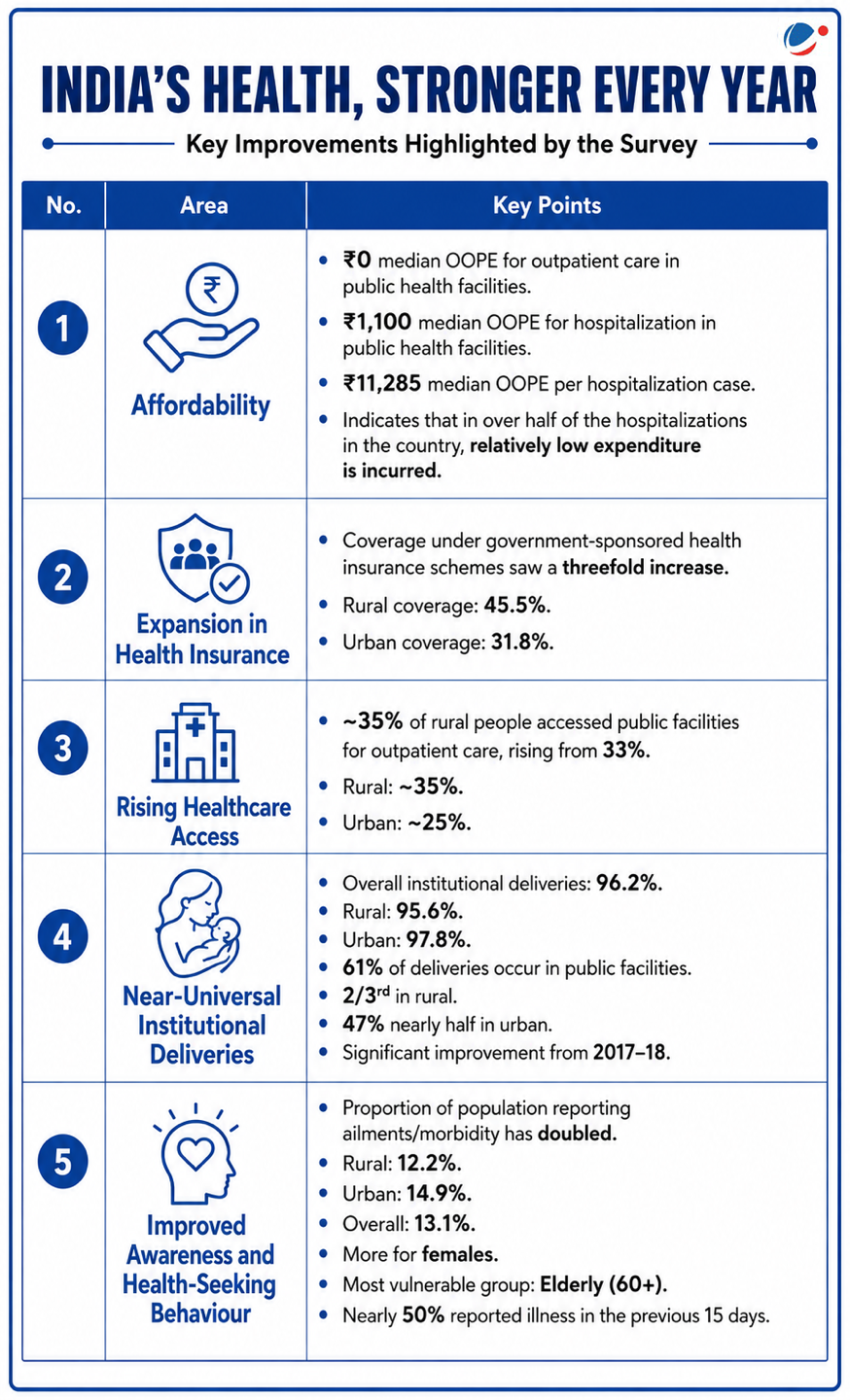
- Epidemiological Shift to NCDs: A fall in infectious disease is supplemented by rising non-communicable diseases (NCDs) like diabetes now afflict people at younger ages.
- Number of people suffering from heart disease is up almost 3 times since 2017-18
- Dependence on Private Care: For hospitalizations, over 60% of cases (57.9% rural, 64.6% urban) occur in private hospitals, while for outpatient care it was 43 % ( rural ) and 44 % (urban).
- Persistent Financial Risk: Despite insurance gains, average OOPE for hospitalization in private hospitals stands at INR 50,508, compared to INR 6,631 in public facilities.
- Mental Health among working population: Reporting of Psychiatric/Neurological issues peak in young adulthood (15-29)
- Vulnerability to catastrophic health expenditures: even though % covered under at least 1 Health insurance rose to 47.4 % in rural India and 44.3 % in urban areas, still more than half remains vulnerable.
Other Issues plaguing the health care
- Sub-optimal Public Health Expenditure: Government health expenditure as a share of GDP is 1.43% against the target of 2.5% of national health policy 2017.
- Skewed Distribution: Especially w.r.t. doctors and infrastructure. E.g. 80% of healthcare professionals are concentrated in urban areas. Rural India has 70% of people but only 40% of the hospital beds.
- Fragmented Healthcare Governance: Health is primarily a State subject, leading to variations in policy implementation. Weak coordination among different levels of government hampers effective service delivery.
- Emerging Threats: Climate change, antimicrobial resistance, zoonotic diseases, and future pandemics pose new challenges that require stronger public health preparedness and surveillance systems.
- Poor primary care: E.g. there is 1 rural Primary Health Centre (PHC) for 33,800individuals (against the norm of 30,000 individuals). Many times, they are understaffed, lack essential physical infrastructure like piped water, diagnostic equipment etc.
Way Ahead
- Ramping Up Financing & Infrastructure: The government must scale health expenditure to 2.5% of GDP prioritizing Primary Health Centres (PHCs) in line with WHO's Alma Ata declaration (endorsed by India) .
- Pivot to Preventive Care: With rise of NCDs, the focus must shift from curative to preventive care. Ayushman Arogya Mandirs must be leveraged for early screening and lifestyle management of NCDs.
- Addressing the Mental Health Crisis: The spike in psychiatric issues requires integrating mental health services into primary care, destigmatizing mental health in corporate and informal workplaces etc.
- Rationalizing Private Healthcare Costs: Government needs to standardize treatment costs, enforce transparency in hospital billing etc. to tackle the massive OOPE gap
Conclusion
The survey reflects significant progress in affordability, insurance coverage, and access to healthcare, while highlighting persistent gaps in equity, financial protection, and the growing burden of non-communicable diseases. Achieving Universal Health Coverage (UHC) will require higher public investment, stronger primary healthcare, preventive care, and resilient health systems in line with the National Health Policy, 2017 and SDG 3 (Good Health and Well-being).

