


Why in the news?
India is undertaking one of the world's largest dam rehabilitation and safety modernisation programmes Dam Rehabilitation and Improvement Project (DRIP) focused on strengthening ageing water infrastructure.
Status of Dams in India
- Global ranking: India ranks 3rd in terms of Large Dams worldwide, after the United States and China with 6,628 specified dams.
- Ownership:
- 98.5% owned by State Governments.
- 0.7% by Central Public Sector Undertakings
- 0.6% by private entities
- 0.2% by Central Government
- State-wise distribution: Maharashtra has the highest number of specified dams, followed by Madhya Pradesh, and Gujarat.
Concerns Associated with Dam safety in India
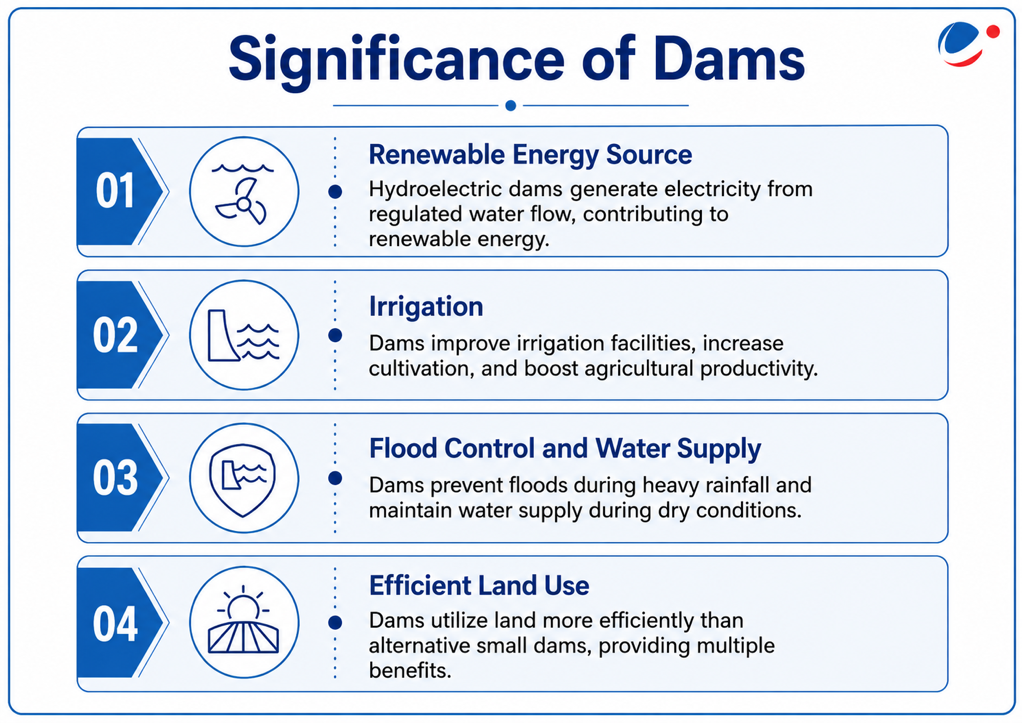
- Ageing infrastructure: About 26% (1,681 dams) of the dams in India are more than 50 years old, of which 291 that are more than 100 years old.
- Loss of storage capacity: Reservoirs have lost an average of 19% of their gross storage capacity with an average reservoir age of 42 years due to sedimentation. (CWC data)
- Seismic vulnerability: E.g. The earthquake in Bhuj (Gujarat) in 2001, led to liquefaction in the foundation of Chang Dam.
- Vulnerability to Glacial Lake Outburst: E.g., in 2023, Chungthang Dam's (Sikkim) collapse during flash floods was caused by a glacial lake outburst.
- Maintenance funding gap: Dam safety concerns are often constrained by underfunded Operations and maintenance budgets.
- Others: Changing hydrological patterns; Structural failures due to seepage, corroded piping, and/or weak foundations; increasing climate variability; coordination issues in Transboundary river and basin etc.
Initiative taken to ensure Dams Safety in India
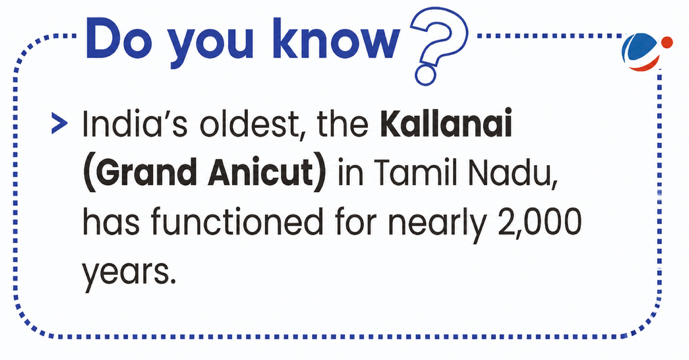
- Dam Rehabilitation & Improvement Programme (DRIP): It is being implemented in 3 phases to improve the safety and operational performance of existing dams through structural repairs, modernisation of spillways and gates, and installation of advanced monitoring systems.
- DRIP Phase I (2012–2021): Launched in April 2012 with support from the World Bank; Covered 223 dams across seven states; Introduced Dam Health and Rehabilitation Monitoring Application (DHARMA).
- DRIP Phase II & III: Operationalised in 2021; Co-financed by the World Bank and Asian Infrastructure Investment Bank (AIIB); Covers 736 dams across 19 states and three central agencies.
- Dam Safety Act, 2021: It provides for surveillance, inspection, operation and maintenance of specified dams. Key features of the act include-
- Creation of a 4-tier institutional structure-
- National Committee on Dam Safety (NCDS): Apex body
- National Dam Safety Authority (NDSA): Regulatory and implementing arm
- State Committees on Dam Safety (SCDS) and State Dam Safety Organisations (SDSO): Responsible for surveillance, inspection, and compliance at the state level.
- Responsibility on dam owners to allocate adequate funds for maintenance and repairs,
- Others: Regular inspections, installation of instrumentation systems, comprehensive dam safety evaluations, Risk Assessment Studies, Inflow Forecasting, Early Warning System, etc.
- Creation of a 4-tier institutional structure-
- Capacity Building and Research: International Centres of Excellence for Dams (ICEDs) have been established at IIT Roorkee and IISc Bengaluru and National Centre for Earthquake Safety of Dams at MNIT Jaipur to focus on seismic hazard mapping, advanced rehabilitation technologies, and risk assessment.
- Digital Monitoring and AI Integration:
- Dam Health and Rehabilitation Monitoring Application (DHARMA) App: Digitally records inspections, tracks maintenance and hosts safety data for dams
- eAabhas: An AI/ML and IoT-based real-time monitoring and flood forecasting platform for dams and barrages.
Way Forward
- Shift to Lifecycle Management: Future policies must continue to transition the national focus from merely constructing new dams to prioritizing the safety, resilience, and comprehensive lifecycle management of existing infrastructure.
- Climate Resilience: Dam owners in vulnerable regions must aggressively pursue Glacial Lake Outburst Flood (GLOF) studies and the installation of Early Warning Systems (EWS) prior to monsoon seasons.
- Sustainable Financing: To ensure long-term maintenance, sustainable financial models must be adopted.
Conclusion
The proactive and comprehensive reforms will not only safeguard downstream populations and reduce disaster risks but will also guarantee the long-term sustainability, operational efficiency, and resilience of India's vital water infrastructure for future generations.


