


Why in the News?
Ministry of Panchayati Raj released Panchayat Advancement Index (PAI) 2.0 for the FY Year 2023–24.
What is Panchayat Advancement Index?
- It is an instrument launched by the Ministry of Panchayati Raj to measure the incremental progress of over 2.6 lakh Gram Panchayats (GP)/Equivalent to GP in India on the various sectors of development in rural areas.
- The Index is anchored in the framework of Localization of Sustainable Development Goals (LSDGs), which aggregates the 17 global SDGs into 9 thematic areas (see infographic) relevant to Panchayati Raj Institutions.
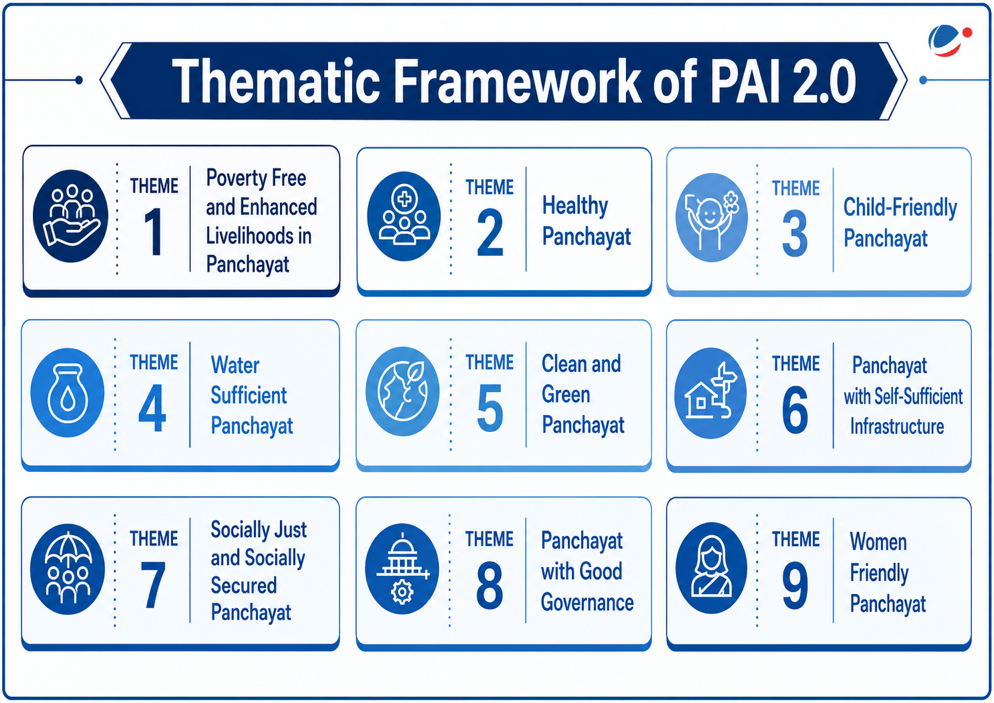
- Performance Categories: Based on composite scores, Gram Panchayats/Equivalent to GP are classified into 5 categories:
- Achiever (A+): 90 and above, Front Runner(A): 75 to below 90; Performer (B): 60 to below 75; Aspirant (C): 40 to below 60 and Beginners (D): below 40.
- PAI 2.0 has recorded an exceptional national participation of 97.30 %, across 33 States and Union Territories submitting validated data.
- 80.79 % participation was achieved under PAI Version 1.0 (launched in 2025).
- Key improvements in PAI 2.0 vs PAI 1.0:
- Single integrated data entry form.
- Mandatory Gram Sabha validation for transparency and accountability.
- Enhanced auto-porting of data from national portals of nodal Union Ministries and Departments.
- Soft and cross-data validation mechanisms for improved data accuracy.
- Real-time dashboards for intuitive navigation.
- Embedded vernacular language support.
Key findings of the PAI 2.0
- Overall Performance: No Gram Panchayat (GP) are fallen under Achiever (A+) grade.
- ~1.4% GPs fall under the Front Runner category, ~45.72% GPs in the Performer category, ~47.6% in Aspirant and 5.27% in Beginners.
- Top-Performing vs. Lagging States
- Leading States: Tripura emerged as the standout performer, with an impressive 80% of its Gram Panchayats rated as "Front Runners" followed by Kerala and Odisha.
- Lagging States: In Uttar Pradesh, only 51 of its 57,678 Gram Panchayats reached the "Front Runner" category and in Rajasthan (8), Bihar (2), and Punjab (1).
About Panchayati Raj Institutions (PRIs)
|
How PAI has helped in transforming PRIs?
- Evidence Based Planning: PAI helps Panchayats identify and prioritize focus areas in their Gram Panchayat Development Plans (GPDPs).
- Data Driven Governance for Informed Decision: PAI compiles quantifiable metrics across nine SDG-linked themes such as poverty, health, education, sanitation, etc., which allows panchayats to identify strengths and weaknesses.
- Enhanced Transparency and Citizen Engagement: To promote accountability at the grassroots level, Panchayats are actively displaying their PAI scorecards outside their office.
- Some states use PAI scores to allocate additional resources to Panchayats.
- Localized Development Priorities: It helps tailor development initiatives to specific local needs.
- E.g., if a GP scores low on sanitation or water availability, the Gram Panchayat can prioritize those sectors in its annual action plan.
- Healthy Competition and Rewarding Excellence: The index fosters a competitive spirit among PRIs by highlighting best practices and linking a Panchayat's performance with national recognition and awards.
- Strengthening Panchayat Governance: It also been institutionalized for policy decisions, including identification of Beacon Panchayats, Panchayat Learning Centers, and Model Women-Friendly Panchayats, promoting peer learning and replication of best practices.
Conclusion
Panchayat Advancement Index (PAI) will be a significant tool for Union Ministries and State Government to assess the outcome of their schemes (E.g., MGNREGS, Swachh Bharat Mission, Jal Jeevan Mission) and also pave the path for policy formulation, ensuring more transparent & accountable rural governance.


