


Why in the News?
The Government of India, in partnership with the International Fund for Agricultural Development (IFAD), launched the Country Strategic Opportunities Programme (COSOP) 2026–2033.
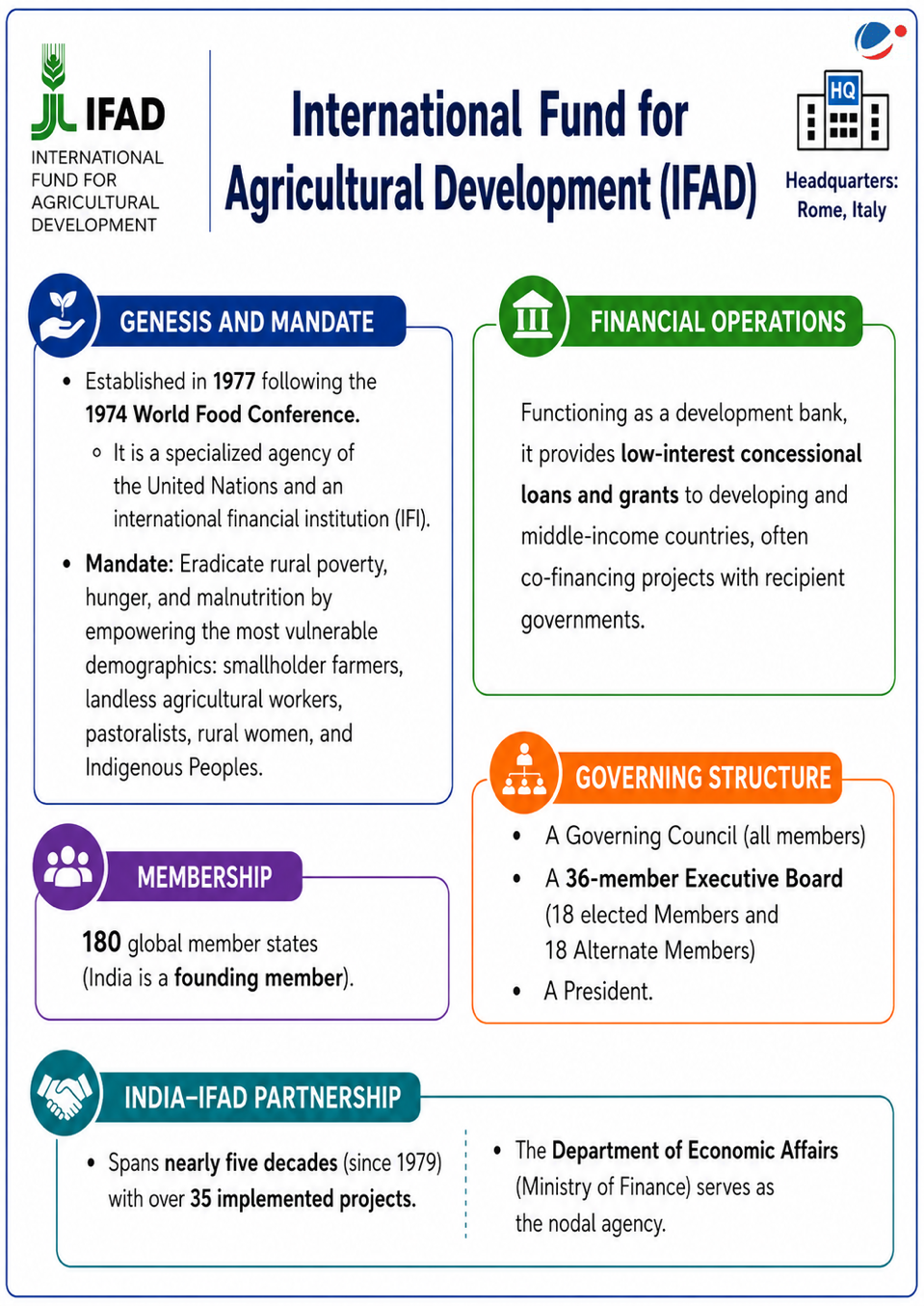
More on the News
- The launch featured a parallel strategic partnership agreement with the National Bank for Agriculture and Rural Development (NABARD) to bolster rural financial ecosystems and deepen inclusive credit access for marginalized farmers.
- The COSOP is a multi-year cooperative framework designed to guide IFAD's long-term rural investment priorities across India. The programme revolves around two main pillars:
- Enhancing the social, economic, and climate resilience of rural communities, and
- Strengthening knowledge systems to scale proven development models.
- It places a central emphasis on utilizing SHGs, FPOs, and rural cooperatives as the primary platforms to link rural populations with finance, markets, and infrastructure.
Challenges of India's Rural Economy
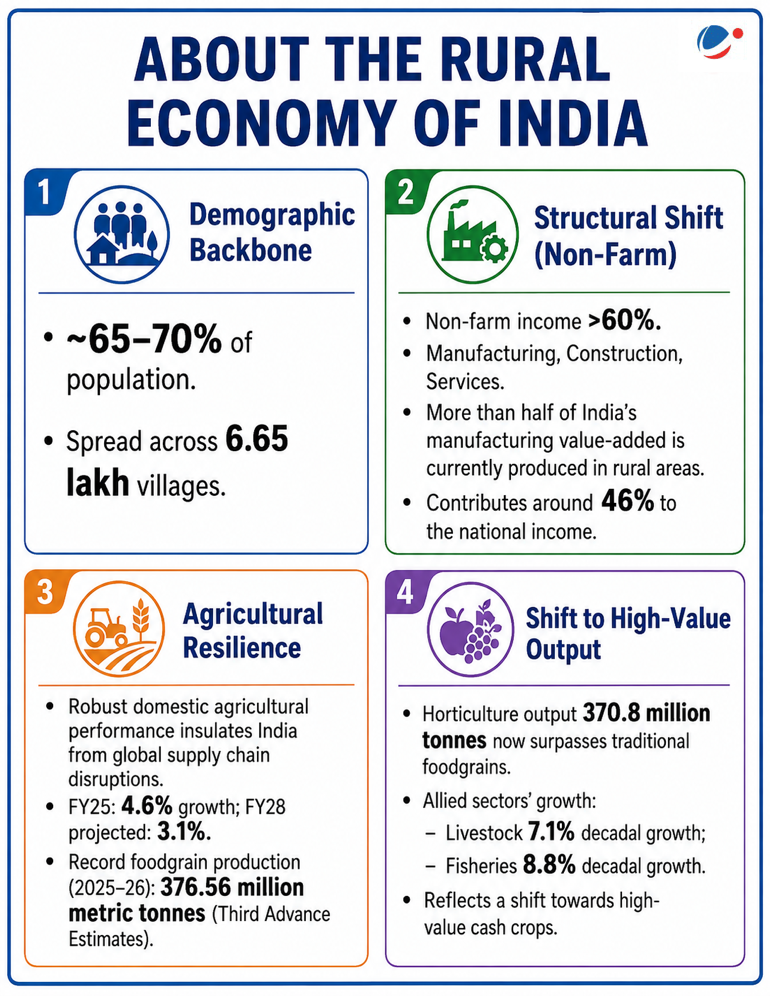
- Agrarian Distress & Disguised Unemployment: Rural manufacturing has adopted capital-intensive technology, resulting in jobless growth that fails to absorb the surplus labor transitioning out of agriculture.
- The stark asymmetry between agriculture's low GDP contribution (~18%) and its massive workforce share (~46%) leads to near-zero marginal productivity, depressing per capita rural incomes.
- Severe Skill Deficits: A significant mismatch exists between traditional rural skill sets and the demands of modern industrial and service sectors. Over 75% of the rural workforce lacks secondary-level qualifications, restricting their entry into high-paying formal roles.
- Climate Change Vulnerability: Depleting water tables, land degradation (affecting ~30% of geographical area), and the indiscriminate use of chemical fertilizers pose severe threats to long-term rural productivity.
- Gender and Labor Market Gaps: Women exiting agriculture often face a lack of localized, safe manufacturing roles, leading to a de-feminisation of the formal rural workforce and a reliance on unpaid caregiving.
- Fragmented Landholdings: The dominance of small and marginal farmers (over 85%) severely restricts the adoption of mechanized farming and economies of scale, resulting in crop yields that remain below global averages.
- Credit & Financial Constraints: Despite high basic banking penetration (Jan Dhan accounts), access to low-interest, formal capital investment credit remains highly restricted for marginalized farmers.
Way Forward
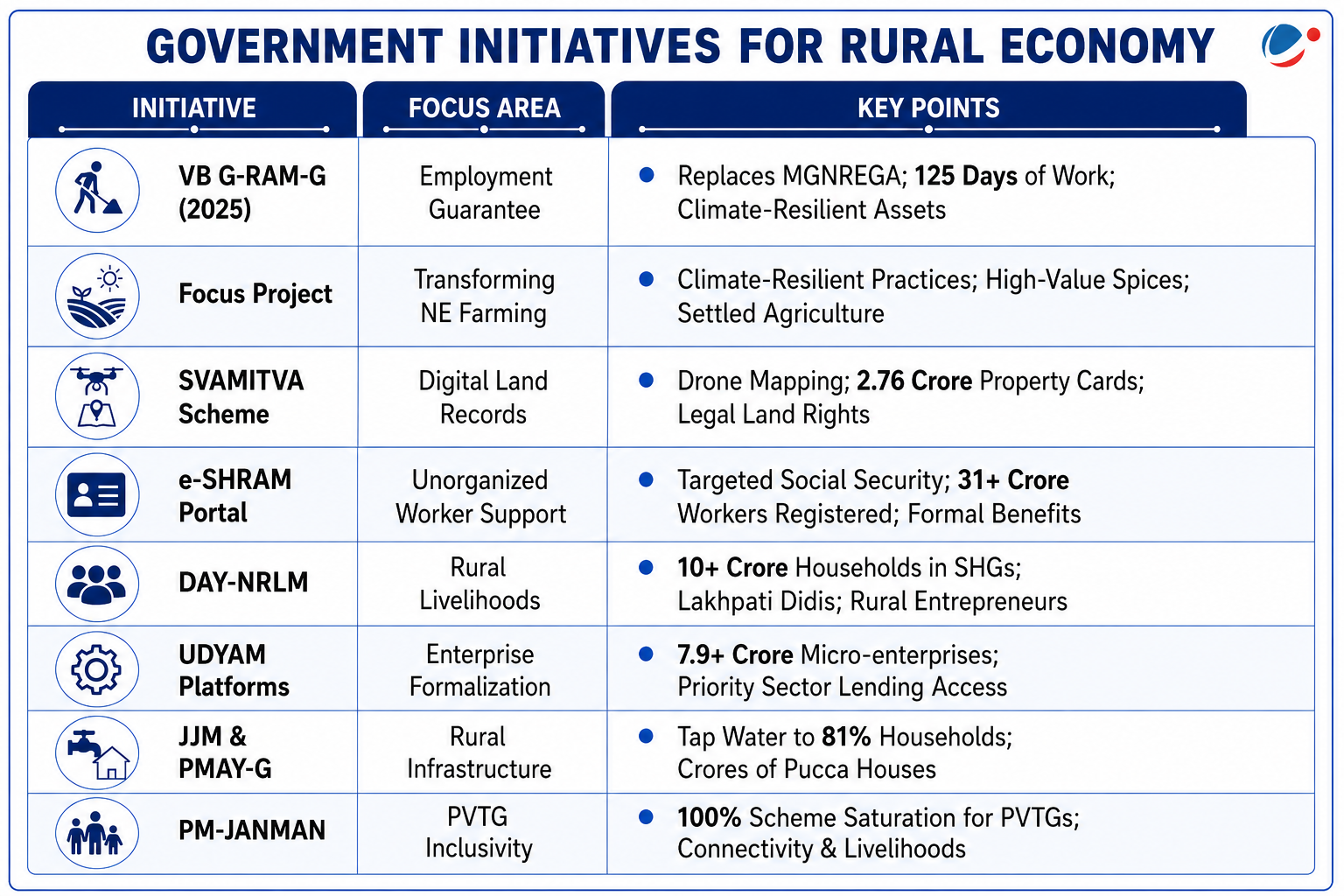
- Expanding Rural Industrialization: Focus public capital expenditure on rural MSMEs, food processing parks, and physical connectivity to systematically transition surplus labor from agriculture to the non-farm sector.
- Accelerating Agri-Tech Adoption: Expand digital public infrastructure, AI-driven predictive weather analytics, and drone technology (e.g., Namo Drone Didi) to optimize input usage and streamline crop insurance assessments.
- Scaling Collectivization: Empower FPOs, SHGs, and cooperatives with enhanced working capital and simplified regulatory compliance to transform primary producers into active participants in the agro-processing value chain.
- Strengthening Local Value Chains: Developing localized agriculture clusters and facilitating direct farm-to-fork market linkages will optimize supply chains, and increase the profit margins realized by primary producers.
- Innovative Rural Finance: Leverage the IFAD-NABARD partnership to shift rural credit portfolios from short-term crop loans to long-term capital investment financing tailored specifically for rural micro-entrepreneurs and women.
- Revitalizing Village Commons: Community-managed lands must be rehabilitated using GIS mapping and sustainable frameworks. Integrating waste-to-energy projects and solarization will convert these lands into robust, climate-resilient economic assets.
Conclusion
The structural transformation of India's rural economy is the cornerstone of realizing the Viksit Bharat@2047 vision. This exhaustive roadmap provides a timely framework to fortify this transition and uniquely positions India to export its proven models of rural prosperity to the broader Global South during the Amrit Kaal.


