


Why in the News?
China recently unveiled its new Atlas drone swarm system (atlas or atelasi).
More on the News
- It is an AI-enabled UAV drone swarm warfare system developed by China Electronics Technology Group Corporation.
- A UAV (Unmanned Aerial Vehicle) swarm is a group of autonomous drones that work collectively to perform tasks through coordination, communication, and distributed decision-making.
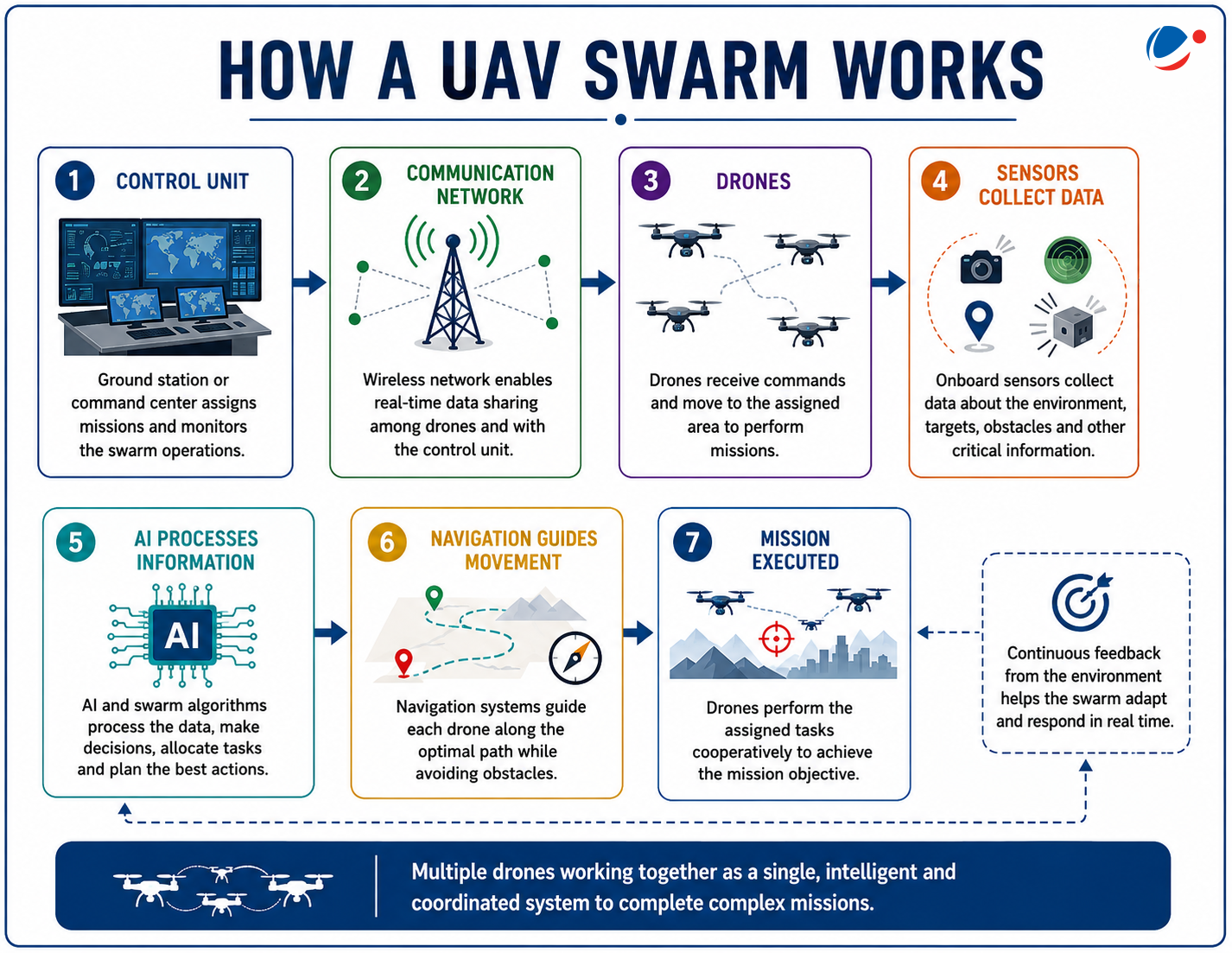
Key features of Drone Swarm System
- Scalability: UAV swarms can easily increase or decrease the number of drones based on mission requirements.
- Their effectiveness remains high even as the swarm size grows significantly.
- Robustness & Survivability: The swarm can continue operating even if some drones are destroyed or malfunction the other drones automatically compensate for losses, ensuring mission continuity.
- Adaptability & Flexibility: UAV swarms can modify their behavior according to changing environments and mission objectives.
- AI enables real-time route changes, target updates, and formation adjustments.
- Parallelism: Multiple drones can perform different tasks simultaneously which significantly improve mission speed, efficiency, and area coverage.
- Multi-Tasking: Different groups within the swarm can execute surveillance, communication, and strike missions at the same time.
- It enables one swarm to perform multiple battlefield functions simultaneously.
- Decentralized Control:
- Drones coordinate directly with each other rather than relying entirely on a central controller. This makes the swarm more resilient to communication disruptions and enemy jamming.
- Collective Intelligence: Individual drones share information and make coordinated decisions as a group.
- The swarm behaves like a single intelligent system (hive mind) capable of solving complex tasks.
- Autonomous Decision-Making: AI and Machine Learning enable drones to recognize targets, avoid obstacles, and allocate tasks autonomously.
- This reduces human workload and accelerates battlefield decision-making.
Similar military systems
|
Challenges of UAV Swarms
- Communication and Coordination: Maintaining reliable communication among a large number of drones is difficult.
- Path Planning & Collision Avoidance: Drones must continuously calculate safe routes while avoiding obstacles and each other.
- Energy Constraints: Limited battery life restricts flight time, payload capacity, and operational range.
- Environmental Disturbances: Maintaining coordinated formations in strong winds, bad weather, or complex terrain is challenging.
- Ethical Concerns: Issues of privacy, airspace regulation, accountability, and autonomous weapons remain unresolved.
Conclusion
As drone swarms become a key component of future military doctrines, countries must strengthen indigenous capabilities, develop effective counter-swarm technologies, and establish international norms to ensure their responsible and secure use.

