


‘Moving Towards Effective City Government: A Framework for Million-Plus Cities’ Report released by NITI Aayog.
- India’s 47 million-plus cities account for nearly 1/3rd of India’s urban population and contribute to 60% of India’s GDP.
- However, these face acute challenges related to infrastructure deficits, service delivery, housing, mobility, environmental sustainability, and social inclusion that impact overall livability and quality of life in these growth centres.
Challenges in Urban Governance in Million-Plus Cities
- Limited devolution of functions: On average, city governments have full control over only 4 functions out of 18 functions (74th Constitutional Amendment Act).
- Fragmented institutional setup and ineffective leadership: Absence of clear role demarcation between elected representatives and the municipal administration.
- Mayors are not regarded as the real heads.
- Weak revenue base and limited devolution of funds: Weak own-source revenues, high dependence on tied grants, delays in constitution, inadequate institutional support and weak/ selective implementation of State Finance Commissions’ recommendations.
- Weak public service delivery: City governments continue to play little or no role in key services like public transport, planning, water and sanitation.
- Capacity constraints: Shortfalls in recruitment, high dependence on deputation, frequent transfers, and limited investment in training.
Key Recommendations of Report
|
Ministry of home affairs notified the Citizenship (Amendment) rules, 2026.
It aims to streamline processes concerning Overseas Citizen of India (OCI) cardholders and tightening passport norms for minors.
Key Highlights
- Applicants seeking citizenship under the Citizenship Amendment Act (CAA), 2019, will have to submit an affidavit declaring whether they hold a valid or an expired passport from Pakistan, Afghanistan or Bangladesh.
- Dual Passport Ban for Minors: A new proviso mandates that a minor child cannot at any time hold the passport of any other country while also holding the Indian passport.
- Under the 2009 rules, parents registering the birth of a child born outside India at an Indian consulate had to declare that the child did not hold any other country's passport.
- e-OCI: OCI status can now be issued in an electronic format (e-OCI) alongside traditional physical cards.
- Mandatory Online OCI Applications: OCI processes, including registration, are now completely online via a designated portal (ociservices.gov.in).
- Digital Renunciation: Streamlines renunciation and cancellation procedures of OCI, including mandatory surrender of physical cards and digital acknowledgment.
- Fast Track Immigration (FTI) Consent: OCI applicants may now consent to share biometric data for automatic registration under the Fast Track Immigration Programme.
- Appellate Mechanism: Revisions against OCI-related orders will now be handled by an authority one rank higher than the original deciding authority.
About the Overseas Citizen of India (OCI) scheme
|
Recently, two-thirds of the Rajya Sabha MPs of AAP quit the party and joined the BJP, leading to the submission of a disqualification plea.
- As per the Tenth Schedule, Disqualification on the grounds of defection not to apply in case of merger.
- It provides that member of a House shall not be disqualified where his original political party merges with another political party with at least 2/3 members.
- The disqualification plea argues that Tenth Schedule requires a genuine merger of the original political party, not just legislators switching sides.
Tenth Schedule and Disqualification of Legislators
- Popularly referred Anti-Defection Law
- Added in the Constitution through the Fifty-Second Amendment Act, 1985.
- The 91st Constitutional Amendment Act strengthened the anti-defection law by removing the 1/3rd split provision, making it at least 2/3rd.
- Objective: aimed to combat political defections and safeguard democracy.
- Grounds for Disqualification:
- Voluntarily giving up party membership;
- Defying party whip during voting;
- If an independently elected legislator joins a political party;
- If a nominated member joins any political party, after six months from the day he becomes a legislator.
- Entrusted the Speaker/Chairman with adjudication for fearless and expeditious decisions, explicitly to avoid lengthy court delays.
NCRB acts as a repository of information on crime and criminals to assist investigators.
Key Highlights of Report (2024)
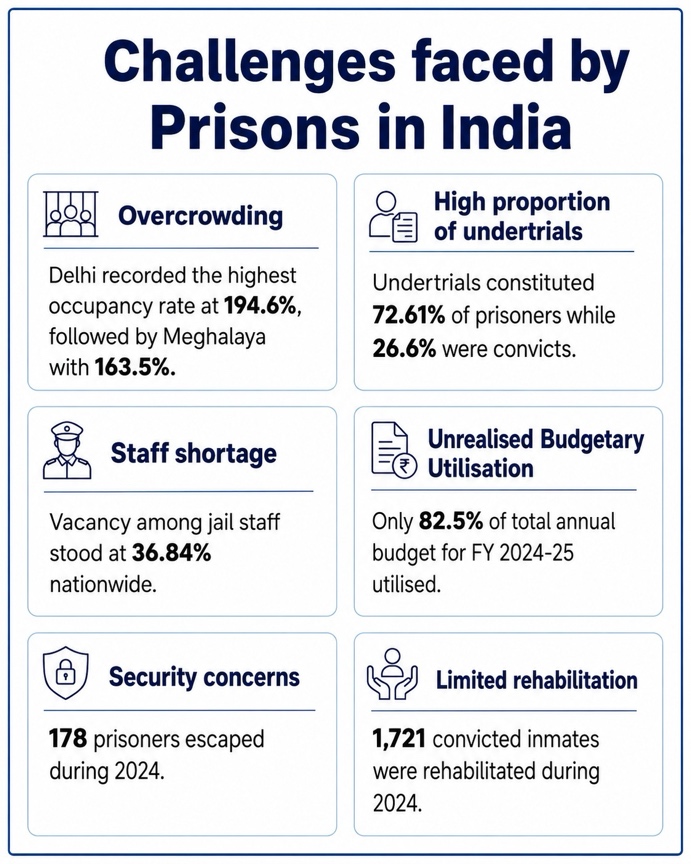
- Number of Prisons: Increased by 0.1% (1333 prisons) at the national level.
- The actual capacity of prisons has increased by 3.3% while number of prisoners lodged in jails has decreased by 3.5%.
- Decline in Prison Occupancy Rate: From 120.8% in 2023 to 112.7% in 2024.
- Gender-wise Prison Population: 95.8% prisoners were male, 4.14% were female, 122 were transgender persons.
- There are only 34 women jails; 21 States/UTs have no separate Women Jails.
Way Forward/ Recommendations
- By Supreme Court: Upholding Human rights; establishing open prisons (Suhas Chakma case 2024); Establish a Data-Driven Rehabilitation Tracking System.
- Justice A.N. Mulla Committee: Setting up an All India Service called Indian Prisons & Correctional Service, reduce undertrials in jails etc.
- Justice Amitava Roy Committee: Special fast-track courts, Use of Video Conferencing etc.
Measures taken for Prison Reforms
|
Union Cabinet approved the Supreme Court (Number of Judges) Amendment Bill, 2026.
The bill seeks to amend the Supreme Court (Number of Judges) Act, 1956 to increase the judge strength of the Supreme Court from present 33 to 37 (excluding the Chief Justice of India (CJI)).
- Article 124 of the Constitution of India provides for the establishment of the Supreme Court and empowers Parliament to determine the number of judges over time.
- Parliament enacted The Supreme Court (Number of Judges) Act, 1956 to fix the number of judges of SC at 10 (excluding the CJI).
- SC’s strength was then subsequently increased by amendments in 1960, 1977, 1986, 2008 and 2019.
- Once the amended law comes into force, the Supreme Court Collegium would recommend judges to the government for appointment to the top court.
- Chief Justice of India (CJI), in consultation with collegium members, initiates the proposal for appointment of judges in Supreme Court.
- Collegium’s recommendations are sent to Union Law Minister, who submits them to the Prime Minister, who in turn advises President to formally appoint the judges.
- Significance: Additional judges will help in faster disposal of cases, timely delivery of justice, and reducing pendency of cases.
- Presently, Supreme Court has total 92,926 pending cases.
Article Sources
1 sourceChief Justice of India declares Sikkim to be the first paperless state judiciary in the country.
- A fully paperless judiciary is a system in which all legal processes are done electronically rather than through physical paper, using measures such as digital files, e-filing, online hearings, digital case tracking etc.
- Such digital transformation of courts is being undertaken under e-Courts Mission Mode Project.
e-Court Mission Mode Project
- Pan-India initiative to computerise and digitise the judiciary for delivering efficient and accessible justice services.
- Launch: Launched in 2007 under the National e-Governance Plan (NeGP).
- Implementing Authority: Department of Justice under the guidance of the e-Committee of the Supreme Court of India.
Article Sources
1 sourceTripura became the first state to complete all priority areas under Deregulation Phase-II of the National Compliance Reduction and Deregulation initiative.
- Deregulation is reduction or elimination of government oversight of an industry.
About National Compliance Reduction and Deregulation initiative
- Genesis: Task Force on Compliance Reduction and Deregulation was constituted in 2025 under the chairmanship of the Cabinet Secretary.
- Objective: Identifying redundant or outdated compliances and recommending their rationalisation; guiding states in amending laws and procedures to align with principles of minimal regulation.
- The Task Force identified 23 Priority Areas across 5 broad sectors.
- Phase II was rolled out in January 2026 to cover priority areas, including land, building and construction, utilities and permissions, environment, education, health, labour, and overarching reform.

