
Marine Carbon Dioxide Removal (MCDR) | Current Affairs | Vision IAS

Upgrade to Premium Today

Start Now
MENU
Home
Quick Links

High-quality MCQs and Mains Answer Writing to sharpen skills and reinforce learning every day.

Watch explainer and thematic concept-building videos under initiatives like Deep Dive, Master Classes, etc., on important UPSC topics.

A short, intensive, and exam-focused programme, insights from the Economic Survey, Union Budget, and UPSC current affairs.

ESC

Marine Carbon Dioxide Removal (MCDR)

30 Jun 2026
2 min

In Summary

  • Marine Carbon Dioxide Removal (mCDR) enhances ocean CO₂ absorption for climate mitigation, including restoring mangroves and seagrass.
  • mCDR is needed due to high CO₂ levels, the ocean's storage capacity, Paris goals, and blue economy support.
  • Challenges include MRV, environmental risks, scalability, lack of standards, governance gaps, and public concerns.

In Summary

Why in the news?

There has been growing interest in Marine Carbon Dioxide Removal (mCDR) as a climate-change mitigation tool.

About mCDR

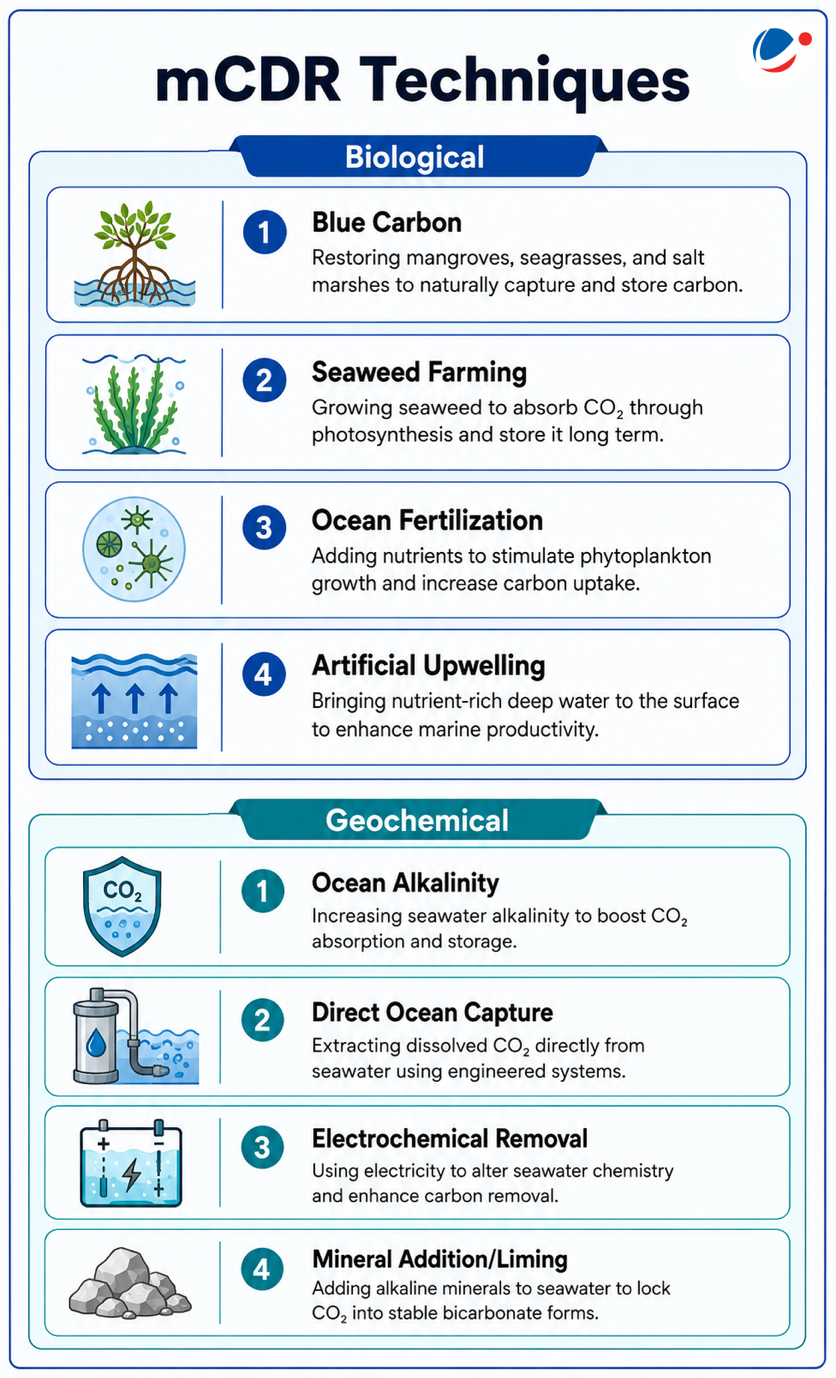
  • It refers to methods that enhance the ocean's ability to absorb and store atmospheric CO₂ to help tackle climate change.
  • Examples include restoring mangroves and seagrass, ocean alkalinity enhancement, biomass sinking, and artificial upwelling.

Need of mCDR 

  • Rising Atmospheric CO₂ Levels: Global CO₂ emissions remain high despite mitigation efforts, mCDR can help remove excess CO₂ already present in the atmosphere.
  • Ocean's huge Carbon Storage Capacity: Oceans store over 50 times more carbon than the atmosphere, making them a potential large-scale carbon sink.
  • Meeting Paris Climate Goals: Achieving the 1.5°C and 2°C targets may require large-scale carbon removal in addition to emission reductions.
  • Supports Blue Economy: It can generate employment and economic opportunities in sectors such as seaweed farming, ecosystem restoration, and marine technologies.

Challenges of mCDR

  • Measurement, reporting, and verification challenges: Accurate CO₂ tracking and carbon accounting remain difficult due to evolving monitoring technologies. 
  • Environmental risks: Ocean chemistry changes may harm marine ecosystems. 
  • Scalability: Large-scale deployment with high energy efficiency is challenging. 
  • Lack of standards: Robust carbon accounting and environmental assessment protocols are still evolving. 
  • Governance gaps: Clear regulations and permitting frameworks are lacking. 
  • Public concerns: Geoengineering fears may hinder acceptance and policy support. 

Conclusion

Marine Carbon Dioxide Removal (mCDR) can complement but not replace deep emission reductions in addressing climate change. Unlocking its potential will require science-based regulation, robust monitoring, environmental safeguards, and international cooperation to ensure that ocean-based carbon removal is safe, effective, and equitable, supporting global net-zero and Paris Agreement goals.

Tags:

Explore Related Content

Discover more articles, videos, and terms related to this topic

RELATED VIDEOS

2
Carbon Markets

Carbon Markets

YouTube HD
What is Artificial Rain? | Deep Dive With VisionIAS

What is Artificial Rain? | Deep Dive With VisionIAS

YouTube HD

RELATED TERMS

3

Net-Zero

Net-zero emissions refer to a state where greenhouse gas emissions are balanced by removing them from the atmosphere. This is a key goal in global climate action to limit global warming.

Geoengineering

Large-scale intervention in the Earth's climate system to counteract climate change. mCDR is a form of geoengineering, specifically focused on removing CO₂ from the atmosphere using oceanic processes.

Measurement, Reporting, and Verification (MRV)

A crucial framework for accurately tracking, documenting, and independently assessing greenhouse gas emissions and emission reduction activities. Robust MRV systems are essential for the credibility and functioning of carbon markets and climate policies.

Title is required. Maximum 500 characters.

Search Notes

Filter Notes

Loading your notes...
Searching your notes...
Loading more notes...
You've reached the end of your notes

No notes yet

Create your first note to get started.

No notes found

Try adjusting your search criteria or clear the search.

Saving...
Saved

Please select a subject.

Referenced Articles

linked

No references added yet