


To be built with partnership of Space-tech firm, Pixxel and AI startup, Sarvam where former will design, build, launch, and operate pathfinder satellite, while latter would provide AI backbone.
- The ODC, along with enhancing country’s space computing capabilities, would promote technological sovereignty by operating independently of foreign cloud infrastructure.
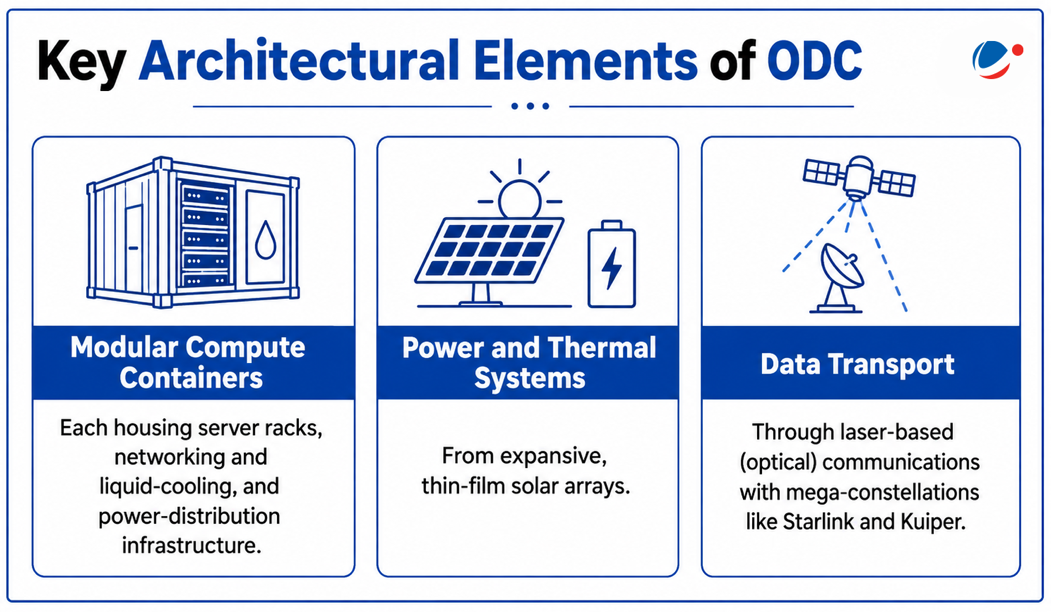
About Orbital Data Centres (ODCs)
- Meaning: Scalable, cloud-enabled data processing and storage infrastructure operating directly in space.
- Work either in conjunction with terrestrial cloud infrastructure or independently.
Significance of ODCs
- Abundant, Uninterrupted power: In a dawn-dusk sun-synchronous orbit (SSO), it can leverage continuous, high-intensity solar power, unhindered by night-time, weather, or atmospheric attenuation.
- Free radiative cooling: Deep vacuum of space serves as a gigantic, cold heatsink having effective ambient temperature of around -270 Celsius, eliminating freshwater needs for cooling.
- Single 40 megawatt (MW) terrestrial cluster can consume over 1 million tons of water annually for cooling.
- Scalability and speed of deployment: ODCs can be linearly scaled almost indefinitely through modular design, and be launched faster compared to building terrestrial infrastructure.
- Overcome Limitations of Terrestrial Data Centres:
- Huge Power Consumption: Large data centres consume approximately 1.5% of global power (WEF).
- Land and permitting constraints: Hyperscale data centres require significant land along with extensive planning, rights-of-way and environmental reviews.
About Pathfinder
|
TRAI releases Consultation Paper on Regulatory Framework for Vehicle-to-Everything (V2X) Communication.
- It identifies Cellular-V2X (C-V2X) as the preferred technology, leveraging existing 4G and 5G networks.
- V2X relies on two main wireless technologies: Dedicated Short-Range Communication (DSRC) and C-V2X.
- DSRC uses Wi-Fi whereas C-V2X is a more comprehensive standard, leveraging cellular networks.
About V2X Communication
- V2X refers to a communication system where a vehicle exchanges real-time information (E.g. position, speed) with other vehicles, infrastructure, pedestrians, and networks using short-range and/ or direct communications.
- It is a core component of Intelligent Transport Systems and connected mobility.

Significance of V2X
- Road Safety: Enables safety applications like collision avoidance, intersection management, and emergency vehicle warning systems, reducing accidents and fatalities.
- SDG 3.6 aims to halve global road traffic deaths and injuries by 2030.
- E.g. Forward Collision Warning System (USA) showed a 9% decrease in rate of forward collision conflicts.
- Traffic Efficiency: Optimizes traffic flow and reduces congestion through smart signal coordination.
- Autonomous Vehicle Support: Enhances decision-making for self-driving systems with external data inputs.
- Environmental Benefits: Lowers fuel consumption and emissions contributing to UN SDGs.
- 5G & Smart City Integration: Enables low-latency communication for connected urban mobility systems.
Challenges of V2X
|
DRDO successfully conducted a test of its Actively Cooled Full Scale Scramjet Combustor, achieving a run-time of over 1,200 seconds (earlier 700 seconds).
Scramjet Propulsion System
- Concept: Scramjet stands for Supersonic Combustion Ramjet.
- It is an advanced air-breathing jet engine designed to operate efficiently at hypersonic speeds by allowing the combustion of fuel to occur supersonically.
- Operating Mechanism: Vehicle's forward motion to "ram" and compress external air into the combustor.
- It uses atmospheric oxygen as its oxidizer as it flies through the air.
- Fuel Types: Hydrogen or advanced liquid hydrocarbon endothermic fuels.
- Advantages: Reduce total weight of vehicle, making it a highly efficient propulsion system for low-cost, reusable access to space and an ideal foundation for hypersonic cruise missile development.
Article Sources
1 sourceWorld’s first OptoSAR satellite Mission Drishti launched.
- Developed by Indian Space Start-up GalaxEye, launched aboard SpaceX’s Falcon 9 rocket, it is India's largest privately built Earth Observation satellite.
About Mission Drishti
- Uses OptoSAR: It is the first to combine Multispectral Imaging (MSI) and Synthetic Aperture Radar (SAR) on a single platform.
- Orbit: Sun-synchronous Low Earth Orbit (LEO).
- LEO orbits around Earth at an altitude of about 160 km to 2,000 km.
- Capability: All-weather, day-night, intuitive imaging capabilities.
- It will promote space-based surveillance.
- Resolution: Highest among Indian private players.
About OptoSAR
- It is an end-to-end system of hardware and software designed to work in perfect harmony.
- Technology Used: SyncFusion Stack
- Addresses Limitations of Earlier Satellites:
- Optical sensors: Deliver clear, intuitive images, but are limited by clouds and darkness.
- SAR: Can see through cloud cover and operate day and night, but imagery is harder to interpret.
Sweden joins India's Shukrayaan (Venus Orbiter) mission.
- Venus, the closest planet to Earth and believed to have formed in conditions similar to Earth.
About Venus Orbiter Mission (VOM)
- It is India's first scientific mission designed to explore the planet Venus, approved in 2024.
- Objective: For a better understanding of the Venusian surface and subsurface, atmospheric processes and the influence of the Sun on the Venusian atmosphere
- It is planned to be launched in March 2028.
- ISRO will be responsible for the development of the spacecraft and its launch.
- LVM-3 has been identified as the candidate launch vehicle which will place the spacecraft in an Elliptical Parking Orbit (EPO).
The SMILE mission successfully launched aboard a Vega-C rocket from Europe's Spaceport in French Guiana (South America).
About SMILE Mission:
- Joint Mission: European Space Agency (ESA) and the Chinese Academy of Sciences (CAS).
- Objective: to capture the first-ever panoramic imaging of the interaction between the solar wind and Earth’s magnetosphere, helping scientists understand space weather phenomena like geomagnetic storms.
- Instruments: Light ion analyser, Magnetometer, Soft X-ray imager, Ultraviolet aurora imager.
- World’s First Space-Borne Soft X-ray Imager (SXI): To visualize the previously "invisible" boundaries of Earth's magnetosphere.
Recently, scientists using data from NASA's MAVEN mission made the first-ever observation of the Zwan-Wolf effect occurring in a planetary atmosphere rather than just a magnetosphere
- MAVEN (Mars Atmosphere and Volatile Evolution) spacecraft is a robotic orbiter dedicated to surveying the upper Martian atmosphere.
- A magnetosphere is the region around a planet dominated by the planet's magnetic field.
About Zwan-Wolf effect
- It is a phenomenon where electrically charged particles are squeezed along magnetic structures known as flux tubes, similar to toothpaste being squeezed out of a tube.
- This effect plays a key role in deflecting solar wind around the planet
Article Sources
1 sourceNew Study on Wave-driven turbulence generated by Alfvénic/kink waves may explain the extremely high temperature of the Sun’s corona compared to its surface.
- Solar Corona: Outermost layer of the Sun’s atmosphere extending millions of kilometres above the surface into space.
- Temperature Paradox: Corona temperature reaches about 1 million °C, much hotter than the Sun’s surface/photosphere (~5,500°C).
About Alfvénic/Kink Waves
- Alfvénic/Kink Waves: Transverse magnetohydrodynamic (MHD) waves that travel along magnetic field lines in the Sun’s corona, causing sideways oscillation of coronal plasma structures.
- They play a crucial role in understanding coronal heating.
Article Sources
1 sourceScientists have mapped the extent of the Vela Supercluster for the first time.
About Vela supercluster
- It is a collection of at least 20 galaxy clusters, each of which contains hundreds or thousands of galaxies, all gravitationally bound into a single entity.
- It stretches across about 300 million light-years and contains an enormous amount of matter equivalent to about 30 million billion Suns.
- It lies around 800 million light-years from Earth within a region called the Zone of Avoidance (ZoA).
- ZoA is a ~20% region of the night sky obscured by the Milky Way’s interstellar dust and stars, hiding background galaxies from optical observation.
- It is more massive than Laniākea, the supercluster that contains Earth and the rest of our galaxy.
India's Chandrayaan-3 mission was honored with prestigious 2026 Goddard Astronautics Award by the American Institute of Aeronautics and Astronautics (AIAA).
About the Award
- Significance: Highest honor bestowed by AIAA for notable achievements in the field of astronautics.
- Background: Named after Robert H. Goddard, a pioneer in liquid rocket engine development, and received its current widened criteria in 1975.
Chandrayaan-3 Mission
- Historic Landing: On August 23, 2023, Chandrayaan-3 made history by becoming the first spacecraft to achieve a soft landing near the Moon's South Pole.
- Mission Life: One lunar day (~14 Earth days).
- Components: Vikram Lander and Pragyan Rover.
Article Sources
1 sourceThe rapid growth of egocentric data collection has triggered ethical questions around surveillance, consent and labour displacement.
About Egocentric Data
- Egocentric data refers to video and sensor recordings captured from the perspective of the person performing a task.
- Typically collected using cameras mounted on the head, chest or wrist, the footage shows exactly what a human worker sees while carrying out an activity including hand movements, object interactions, navigating spaces etc.
- Significance:
- Designed to mimic the visual viewpoint a robot itself would have during deployment.
- Valuable for training Vision-Language-Action (VLA) models, which are AI systems that combine visual understanding, language instructions and physical movement.
- Related Issues: Surveillance, privacy, ownership, compensation.
Ministry of Communications launched Cell Broadcast System (CBS).
About CBS
- It is a telecom-enabled public warning system that enables authorities to broadcast simultaneous, geo-targeted alerts to mobile devices within a defined area.
- It is integrated with the CAP-based SACHET platform.
- It is an indigenous technology developed by the Centre for Development of Telematics (C-DOT) under the Department of Telecommunications (DoT), in collaboration with the National Disaster Management Authority (NDMA) and the Ministry of Home Affairs (MHA)
- It overcomes the limitations of traditional SMS-based systems, ensuring that critical information can be disseminated quickly and efficiently to large populations within targeted areas.
Article Sources
1 source79th World Health Assembly (WHA) concluded in Geneva.
- Held under theme “Reshaping global health: a shared responsibility”, it adopted multiple resolution and decisions on issues including antimicrobial resistance, etc.
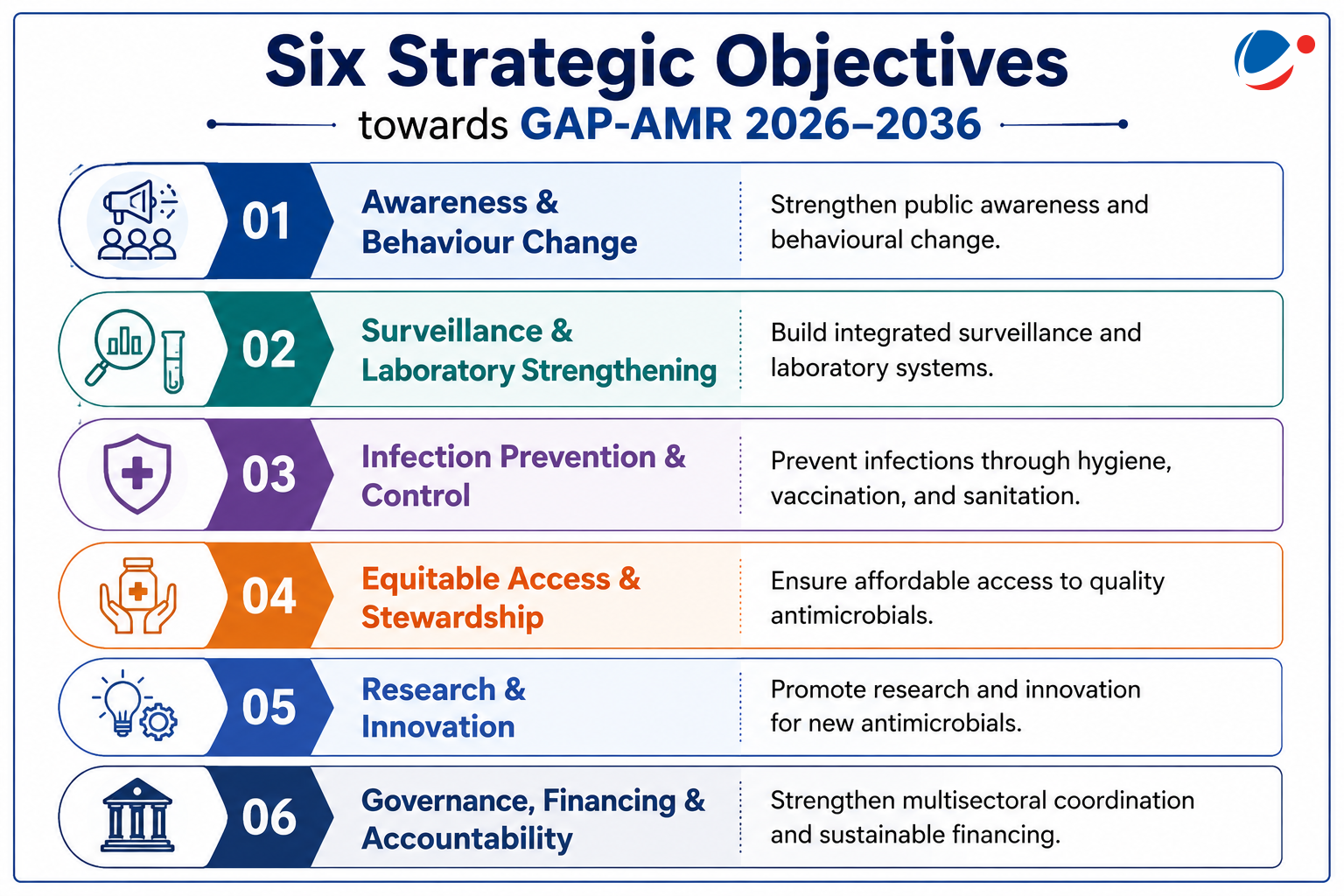
Global Action Plan on Antimicrobial Resistance (GAP-AMR) for 2026–2036
- About: 2nd edition of GAP-AMR that builds on a decade of implementation of first GAP-AMR adopted in 2015.
- Aim: Attainment of 2024 UN General Assembly target of 10% reduction in bacterial AMR-associated deaths in humans, reducing antimicrobial use in agrifood systems, and minimizing environmental pollution from resistant microbes by 2030.
- Technical support and Coordination: Provided with WHO and Quadripartite partners, i.e., Food and Agriculture Organization (FAO), United Nations Environment Programme (UNEP) and World Organisation for Animal Health (WOAH).
About AMR
- Meaning: Occurs when bacteria, viruses, fungi and parasites no longer respond to antimicrobial agents like antibiotics, antivirals, antifungals, etc.
- Burden: AMR can cause up to 39 million deaths by 2050.
- Key Initiatives:
- India: National Action Plan on AMR (NAP-AMR); Red Line Awareness Campaign, etc.
- Global: WHO’s Global Antimicrobial Resistance and Use Surveillance System (GLASS)
Other Key Resolutions Adopted at 79th WHA
|
Article Sources
1 sourceGlobal Hepatitis Report 2026 released by World Health Organization (WHO).
- As per the report, India is among top contributors to global hepatitis deaths, particularly from hepatitis B and C.
About Hepatitis
- It is an inflammation of the liver, caused majorly by Hepatitis viruses, however, other infections, toxic substances (e.g. alcohol, certain drugs), and autoimmune diseases can also cause it.
- 5 main hepatitis viruses: Type A, B, C, D and E.
- Types B and C lead to chronic disease and are most common cause of liver cirrhosis and cancer.
- Hepatitis A and E typically caused by ingestion of contaminated food/water.
- Hepatitis B, C and D occur usually due to parenteral contact with infected body fluids.
International panel has renamed polycystic ovary syndrome (PCOS) as PMOS.
- PCOS is a common hormonal condition affecting women of reproductive age.
- In this, ovaries produce excess androgens (hormones regulating masculine characteristics), causing irregular menstruation, ovarian cysts, acne, weight gain and fertility difficulties.
- “PCOS” was considered misleading because many women diagnosed with it do not have polycystic ovaries; narrowing down both diagnosis and treatment.
About PMOS
- PMOS highlights multiple hormonal pathways, central metabolic dysfunction and broader systemic risks.
- Polyendocrine: involvement of multiple hormone-producing systems.
- Metabolic: connection with metabolic dysfunction, insulin resistance and cardio-metabolic dysfunctions as central features.
- Ovarian: irregular menstruation, infertility and ovulation problems
- Syndrome: complex multisystem disorder and not single-organ complication.
Article Sources
1 sourceHantavirus outbreak trapped 150 people on Dutch flagged cruise ship MV Hondius leaving 3 persons dead.
About Hantavirus
- Zoonotic viruses carried by rodents (rats and mice) that can cause severe disease in humans.
- Transmission: People usually get infected through contact with infected rodents or their urine, droppings or saliva.
- It causes 2 types of syndromes:
- Hantavirus Cardiopulmonary Syndrome (HCPS): A rapidly progressive condition affecting the lungs and heart.
- Haemorrhagic fever with renal syndrome (HFRS).
- There is no specific cure available.
Article Sources
1 sourceScientists warn that rising temperatures due to climate change can spread the risk of disease-causing amoeba, particularly, brain-eating amoeba.
About Brain-Eating Amoeba
- Lives in soil and warm freshwater lakes, rivers, ponds, and hot springs around the world.
- Enters the body through the nose, and attacks the brain tissues.
- Can cause an infection called Primary Amebic Meningoencephalitis (PAM).
- PAM is a rare, fulminant infection of central nervous system, that is always fatal.
Article Sources
1 sourceAyush Anudan Portal under Ayush Grid Initiative launched aiming to digitize the submission, processing, approval, and monitoring of grant proposals.
About Ayush Grid Initiative
- A digital initiative, launched by the Ministry of Ayush in 2018, to build an integrated, transparent, and citizen-centric digital ecosystem for the Ayush sector.
- Under this initiative, multiple digital platforms including Ayush Hospital Management Information System (A-HMIS) and e-Aushadhi have been developed.
- It complies Ayushman Bharat Digital Mission (ABDM) and spans areas including education, research, medicinal plant administration, drug regulation, etc.

