
Money Laundering | Current Affairs | Vision IAS

Upgrade to Premium Today

Start Now
MENU
Home
Quick Links

High-quality MCQs and Mains Answer Writing to sharpen skills and reinforce learning every day.

Watch explainer and thematic concept-building videos under initiatives like Deep Dive, Master Classes, etc., on important UPSC topics.

A short, intensive, and exam-focused programme, insights from the Economic Survey, Union Budget, and UPSC current affairs.

ESC

Money Laundering

30 Jun 2026
4 min

In Summary

  • ED's FY26 report shows a 23-fold increase in attached assets for money laundering, from ₹5,171 crore (2005-14) to ₹1.19 lakh crore (2014-24).
  • ED filed 657 PMLA complaints in FY26, nearly double FY25's 333, with a ~94% conviction rate in money laundering cases.
  • Challenges in preventing money laundering include judicial delays, increasing complexity of transactions, lack of coordination among agencies, and inadequate regulation in certain sectors.

In Summary

Why in the news?

Directorate of Enforcement (ED) released its FY 2025–26 Annual Report, which highlights a 23-fold increase in assets attached in money laundering cases, rising from ₹5,171 crore (2005–14) to ₹1.19 lakh crore (2014–24).

Other Key findings of Annual Report

  • Stronger Prevention of Money-Laundering Act (PMLA), 2002 Enforcement: ED filed 657 main prosecution complaints in FY 2025–26 (nearly double 333 in FY 2024–25). 
    • Over 41% of all PMLA complaints filed to date were registered in last two years
  • Conviction rate: ~94% in money laundering cases.
  • Fugitive Economic Offenders Act (FEOA), 2018: Properties worth ₹2,178.34 crore confiscated under it.

Directorate of Enforcement (HQ: New Delhi) 

  • Genesis: Established on 1st May 1956 as "Enforcement Unit" under Department of Economic Affairs for enforcing Foreign Exchange Regulation Act, 1947 (FERA).
    • Presently, it operates under Department of Revenue, Ministry of Finance.
  • About: A multi-disciplinary organization mandated with investigation of offence of money laundering and violations of foreign exchange laws.
  • Implement Legislations: Entrusted  with implementation of Foreign Exchange Regulation Act, 1973; Foreign Exchange Management Act, 1999; PMLA 2002; FEOA, 2018.

About Money Laundering

  • UN Vienna 1988 Convention describes Money Laundering (ML) as the conversion or transfer of property derived from criminal activity to conceal its illicit origin or to help offenders evade legal consequences.
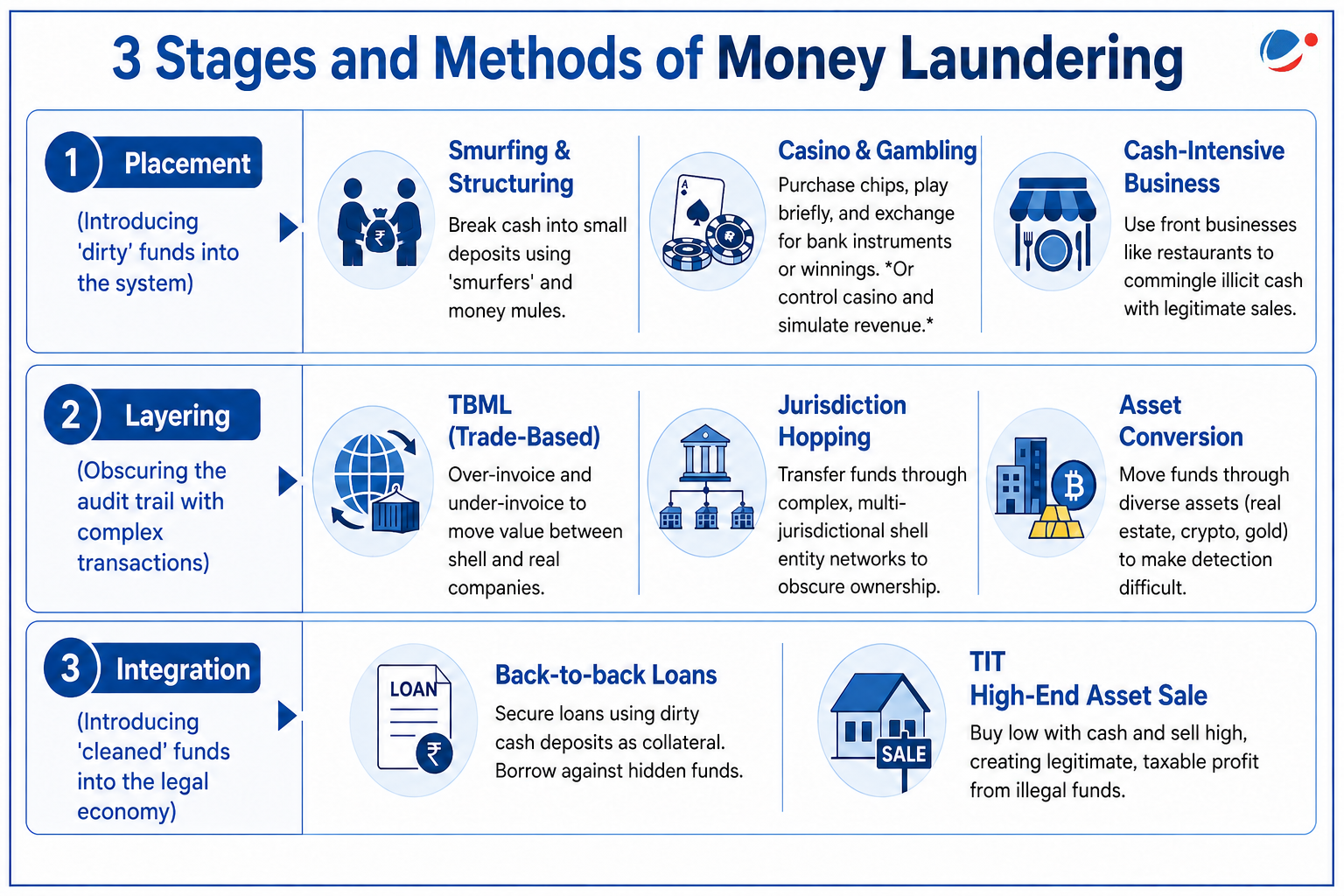
Impact of Money Laundering

  • Economic Impact
    • Economic Distortion: ML distorts markets by channelling illicit funds into sectors such as real estate etc., creating artificial price inflation, while simultaneously reducing government revenues through tax evasion, under-reporting of income, and concealment of assets.
    • Discourages Investment: Rise in ML undermines financial transparency, reducing domestic/foreign investment while damaging country's reputation in global financial system.
    • Parallel Economy: The legitimization of illegally earned income strengthens black economy and encourages cash-based, unregulated transactions.
  • Political Impact
    • Threat to Democratic Processes: Illicit funds enable criminal networks to influence elections, political campaigns, and policymaking, undermining democratic institutions. 
  • Governance Impact
    • Rise in Corruption: By concealing illicit gains from bribery and abuse of public office, it perpetuates corruption, weakens accountability mechanisms, and erodes institutional integrity.
    • Increased Administrative Burden: Combating ML requires extensive monitoring, investigation, prosecution, etc.
  • Security Impact
    • Organized Crime/Terrorism: ML enables the funding of organized crimes and terrorist activities, strengthening criminal networks and posing serious threats to internal security and national stability.
  • Social Impact
    • Widening Inequality: ML enables individuals engaged in illegal activities to accumulate and retain vast wealth outside the formal economy, further leading to socio-economic disparities.

Measures taken to tackle Money Laundering

  • Legislative Measures:
    • Benami Transactions (Prohibition) Amendment Act, 2016: Route unaccounted money into financial system and seize Benami properties and punish those who are involved in these properties.
    • Black Money (Undisclosed Foreign Income and Assets) Act, 2015: Aims to bring back undisclosed (black) money stashed abroad.
  • Financial Intelligence Unit–India (FIU-IND): Central national agency to provide quality financial intelligence for safeguarding financial system from abuses of ML, terrorism financing and other economic offences.
    • In January 2026, FIU-IND Guidelines brought Virtual Digital Asset (VDA) Service Providers within anti-money laundering, Countering Financing of Terrorism (AML/CFT) regulatory framework, requiring them to comply with due diligence and reporting obligations similar to other reporting entities.
  • KYC directions by RBI: Regulated Entities shall carry out ML and Terrorist Financing (TF) Risk Assessment exercise periodically to identify, assess ML and TF risk for clients, countries or geographic areas etc.
  • Double Taxation Avoidance Agreements (DTAA): Prevent tax evasion, ensuring taxpayers cannot exploit loopholes in international tax rules to avoid paying taxes.
  • International Cooperation: 
    • UN Vienna Convention (1988): It provides comprehensive measures against drug trafficking, including provisions against ML and the diversion of precursors chemicals.
    • Financial Action Task Force (FATF):  Researches how money is laundered and terrorism is funded, promotes global standards to mitigate ML risks. India is a member.
    • Palermo Convention, 2000 (UN Convention against Transnational Organized Crime (UNTOC)): Criminalize participation in an organized criminal group, ML, corruption, and obstruction of justice.

Challenges in Preventing Money Laundering

  • Judicial Delays: ML cases often involve lengthy investigations and prolonged court proceedings, resulting in low conviction rates and significant gap between assets seized and assets ultimately confiscated.
  • Increasing Complexity: The use of advanced technologies, crypto currency, digital assets, layered transactions, etc. makes it difficult to trace illicit funds.
  • Lack of Coordination: The involvement of multiple agencies (ED, CBI, financial intelligence) in AML enforcement leads to delays in information sharing, fragmented investigations, etc.
  • Lack of Regulation: Inadequate regulation in sectors such as real estate, jewellery etc., coupled with prevalence of cash transactions.
  • Multi-Jurisdictional Frameworks: AML compliance regulations vary across jurisdictions. For organisations with a global presence, it is a challenge to ensure compliance with multiple cross-border regulations. 
    • E.g. European Union directives versus local frameworks like PMLA, 2002 in India.

Conclusion

Strengthening the anti-money laundering and counter-terror financing framework requires a coordinated approach encompassing faster prosecution, risk-based regulation, robust supervision, enhanced international cooperation, and effective intelligence sharing.

Explore Related Content

Discover more articles, videos, and terms related to this topic

RELATED TERMS

3

Palermo Convention, 2000 (UN Convention against Transnational Organized Crime (UNTOC))

A UN convention aimed at promoting cooperation to effectively prevent, combat, and punish trafficking in persons and the smuggling of migrants. It also includes provisions against transnational organized crime, corruption, and money laundering.

Financial Action Task Force (FATF)

An intergovernmental organization that sets international standards to combat money laundering and terrorist financing, and works to ensure that its members effectively implement these standards.

Virtual Digital Asset (VDA)

A digitally generated asset, code, number, or token created using cryptographic or similar means, representing digital value and being electronically transferable, storable, or tradable. This definition is provided under the Income-tax Act, 1961, and includes items like Non-Fungible Tokens (NFTs).

Title is required. Maximum 500 characters.

Search Notes

Filter Notes

Loading your notes...
Searching your notes...
Loading more notes...
You've reached the end of your notes

No notes yet

Create your first note to get started.

No notes found

Try adjusting your search criteria or clear the search.

Saving...
Saved

Please select a subject.

Referenced Articles

linked

No references added yet