


Why in the News
Indian Navy Maritime Security Strategy (INMSS -2026) was released.
More in the News
Freedom to Use the Seas (2007): Securing Oceanic Access
Ensuring Secure Seas (2015): Broadening Maritime Security
|
It is the third public articulation of India's naval strategy in less than two decades, following Freedom to Use the Seas (2007) and Ensuring Secure Seas (2015).
Drivers for Reviewing the INMSS
- Evolving Geopolitical Landscape:
- Salience of the Indo-Pacific: Increasing importance due to US–China strategic competition and global trade connectivity.
- India's Economic and Strategic Rise: Greater strategic autonomy, influence over critical corridors, and a stronger global role.
- Persistent Regional Threats: Challenges from collusive inimical states, a fragile neighbourhood, and emerging security risks.
- Emerging Warfighting Concepts:
- No War No Peace (NWNP) Paradigm: Persistent competition replacing the traditional war–peace binary.
- Primacy of Grey Zone Actions: Growing use of grey-zone tactics as a preferred strategy by adversaries.
- New Domains of Warfare: Expansion of conflict into space, cyber, and cognitive domains alongside conventional warfare.
- Disruptive Technologies: Use of AI-enabled targeting, precision-guided munitions, long-range stand-off vectors, and space-based ISR.
- Higher Defence Organisation and Maritime Security Architecture:
- Military Structural Evolution: Reforms such as the CDS and DMA require recalibrated naval strategies.
- Jointmanship and Theaterisation: Greater integration and impending theaterisation demand an adaptive framework.
- Integrated Maritime Governance: NMSC under the NSCS strengthens a whole-of-government approach to maritime security.
Factors Influencing Maritime Security
- Maritime Geography:
- Strategic Location: India's central position in the IOR astride major International Shipping Lanes (ISLs) enhances regional reach and influence.
- Vast Maritime Domain: 11,098.81 km coastline, 1,389 islands, and an EEZ of over 2 million sq km.
- Expanding Continental Shelf: Expected addition of about 1.2 million sq km to India's continental shelf.
- Maritime Outlook:
- Policy Focus: Initiatives such as MAHASAGAR, SAGAR, Maritime India Vision 2030, and Sagarmala promote maritime growth and regional prosperity.
- Diaspora & Seafarers: Maritime security supports India's 34 million diaspora and 300,000 seafarers (about 12% of the global workforce).
- Maritime Economy:
- Blue Economy & Trade: Blue economy is projected to contribute $100 billion by 2030; 95% of trade by volume and 68% by value moves by sea.
- Import Dependence: Sea routes carry 88% of crude oil, 50% of natural gas, and 20% of coal imports, besides fertilisers and edible oils.
- Strategic Corridors: Chennai–Vladivostok Maritime Corridor, INSTC, and IMEC strengthen connectivity and reduce dependence on vulnerable choke points.
- Marine Infrastructure:
- Ports & Shipyards: Trade and logistics depend on 12 major ports, 217 non-major ports, and 79 shipyards.
- Submarine Cables: Undersea cables carry over 95% of intercontinental internet and voice traffic.
- Overseas Research Stations:Bharati and Maitri (Antarctica) and Himadri (Arctic) enhance India's scientific and strategic presence.
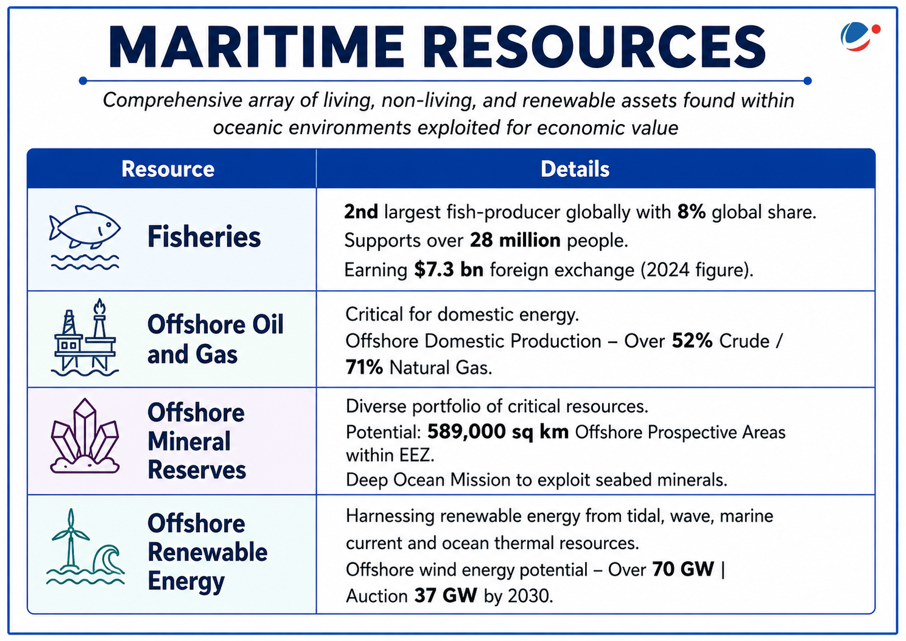
Maritime Threats and Challenges
- State-Based and Hybrid Threats:
- Direct State Adversaries: Use of military and naval forces by hostile states against India.
- Undermining the Rules-Based Order: Violations of the IMBL, illegal activities in the EEZ, use of dual-use platforms/ infrastructure, and regional militarisation.
- Hybrid Threats: Use of proxies, maritime militias, cyber-attacks, and deniable operations to achieve strategic objectives below the threshold of war.
- Maritime Terrorism:
- Attacks From and At Sea: Terrorist groups exploit the maritime domain to launch attacks.
- Technology and State Support: Threat amplified by Commercial Off-The-Shelf (COTS) technologies, specialised expertise, and support from state sponsors or radicalised agencies.
- Maritime Crimes and Illicit Activities:
- Piracy and Armed Robbery: Attacks on maritime trade on the high seas and within territorial waters.
- Trafficking and Smuggling: Sea-based movement of narcotics, small arms, human beings, protected wildlife, and WMD-related materials.
- IUU Fishing: Illegal, Unreported and Unregulated (IUU) fishing threatens marine ecosystems, biodiversity, food security, and coastal livelihoods.
- Marine Pollution: Large-scale pollution, particularly plastic waste, degrading marine ecosystems.
- Dark Vessels and Shadow Fleets: Ships disabling AIS and other tracking systems to evade regulations, sanctions, and detection.
- Maritime Incidents and Emerging Threats: Security-related events such as fires, flooding, collisions, and groundings at sea or ashore.
Strategies Adopted for Maritime Security (INMSS -2026)
- Shape a Favourable Maritime Environment:
- Proactive Presence & Crisis Response: Maintain persistent deployments to secure sea lanes and act as a First Responder during disasters and evacuation operations.
- Preferred Security Partner: Strengthen friendly foreign countries through training, joint exercises, capacity building, and material support.
- Governance & Awareness: Contribute to global maritime governance and promote maritime consciousness among citizens.
- Security of Coastal and Offshore Interests:
- Coordinated Inter-Agency Action: Conduct layered patrols and joint contingency planning among the Navy, Coast Guard, and Marine Police through Joint Operations Centres (JOCs).
- Community Engagement: Integrate coastal and fishing communities as the "eyes and ears" of maritime security.
- Deter Potential Adversaries:
- Nuclear & Conventional Deterrence: Maintain a survivable SSBN-based nuclear deterrent and a modern, balanced conventional force.
- Posture & Signalling: Use forward deployments, strategic communication and international partnerships to signal readiness and raise the costs of aggression.
- Prevail Below the Threshold of Conflict (No War No Peace):
- Continuous Assessment: Sustain intelligence gathering and threat evaluation to detect and counter adversarial actions early.
- Scalable Responses: Employ calibrated options, including autonomous systems, for swift action without unintended escalation.
- Attain National Objectives During Conflict:
- Swift & Overwhelming Force: Rapidly transition to conflict through concentrated kinetic and non-kinetic multi-domain operations.
- Economic Warfare: Protect India's trade and energy routes while disrupting the adversary's maritime commerce and strategic commodities.
- Power Projection & Defence: Defend coastal and offshore assets and project power ashore through precision maritime strikes and amphibious operations.
Conclusion
By aligning operational readiness with strategic foresight, strengthening integration across agencies and domains and continuously adapting to emerging risks, the Indian Navy will remain central to safeguarding India's maritime interests in the decades ahead.



