


Supreme Court (SC) in ‘Lucknow Public School Vs. The State of Uttar Pradesh & Ors’ held that neighbourhood schools are obligated to provide immediate admission to eligible students under the RTE Act, 2009.
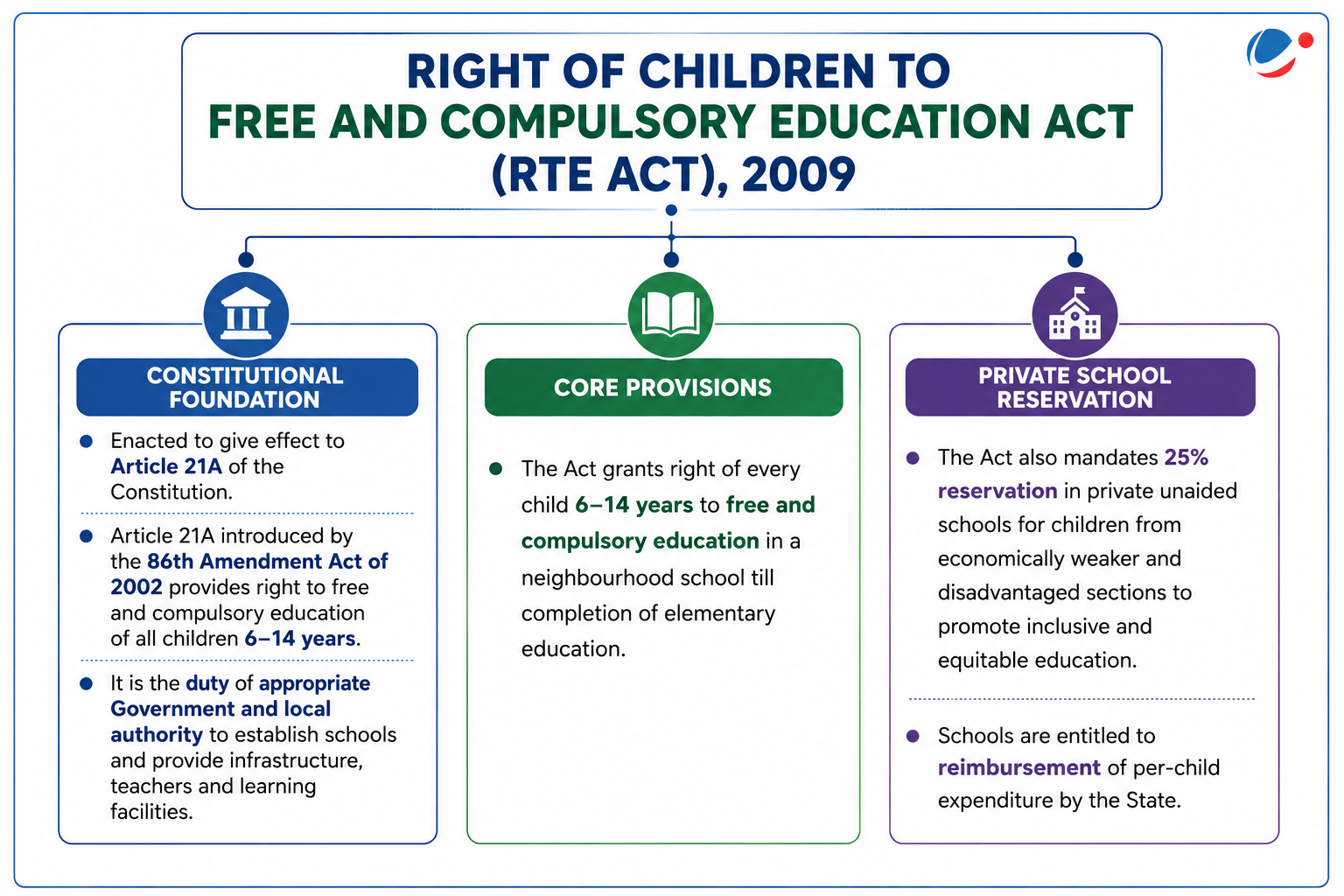
Challenges in Implementation
- School-Level Resistance: Private schools continue to resist full inclusion of EWS students.
- Hidden Costs Burden: Expenses for uniforms, books, and materials shift the burden onto poor families.
- Other: Weak monitoring, limited accountability, inter-state variations in execution and outcomes, inadequate grievance redressal mechanisms, last-mile delivery challenges, etc.
Significance of the Judgement
Other Constitutional Provisions related to Right to Education
|
Article Sources
1 sourceMinistry of Statistics and Programme Implementation released Women and Men in India 2025 Report.
- The report presents a broad overview of gender-related trends across population, education, health, employment and decision-making in India.
Key Highlights of the Report
- Population
- Sex ratio at birth: Improved from 904 in 2017-19 to 917 in 2021-23.
- Arunachal Pradesh has highest sex ratio (1085), while Jharkhand (899) is at the bottom.
- Population Growth: India’s average annual exponential population growth follows an inverted U-shape, peaking in 1971–81 and declining thereafter.
- Sex ratio at birth: Improved from 904 in 2017-19 to 917 in 2021-23.
- Health
- Maternal Mortality Ratio: Significant decline from 254 in 2004-06 to 88 in 2021-23.
- Total Fertility Rate: TFR in urban areas has shown a decline between 2019 to 2023 (Urban-1.5 and Rural-2.1).
- Education
- Literacy Rate: There is a 14.4 percentage point gender gap in literacy rates in India (Male- 84.7% and Female- 70.3%).
- Gross Enrolment Ratio: The Female GER exceeds the Male GER at all levels of school education.
- Participation in Economy
- Worker Population Ratio (Aged 15 and above): In 2025, it is 76.6% for males and 38.8% for females.
- Female Labour Force Participation Rate (LFPR): Increased from 37.5% to 45.9% in rural areas.
- Participation in Decision Making
- Voter Turnout: Female voter turnout surpassed male turnout in the 2019 and 2024 General Elections.
- Representation of Women in Parliament: As of 2025, women constitute 13.65% of MPs and hold 9.86% of ministerial portfolios.
Key Highlights of Report (compared to 2023)
- Crime rate per lakh population:dropped to 418.9 from 448.3.
- Overall case registrations:decrease of 6.0%.
- Crimes Against Vulnerable Groups:
- Women: decreased by 1.5% to ~4.4 lakh cases, with 'Cruelty by Husband' making up the largest share (~42%).
- A new category called 'Offences against Women and Child' was introduced under the BNS.
- Children: increased by 5.9% to ~1.8 lakh cases.
- Senior Citizens: rise of 16.9% over 2023, with theft and fraud being the most common offenses.
- Scheduled Castes (SCs) & Scheduled Tribes (STs): Crimes against SCs decreased by 3.6%, and crimes against STs decreased by 23.1%.
- Women: decreased by 1.5% to ~4.4 lakh cases, with 'Cruelty by Husband' making up the largest share (~42%).
- Specific Crime Categories:
- Cyber Crimes: surged by 17.9%, with fraud accounting for nearly 73% of these incidents.
- Economic offenses: increased by 4.6%, dominated by forgery, cheating, and fraud.
- Juveniles in conflict with the law:increased by 11.2%, with the vast majority (77.7%) falling in the 16 to 18 age bracket.
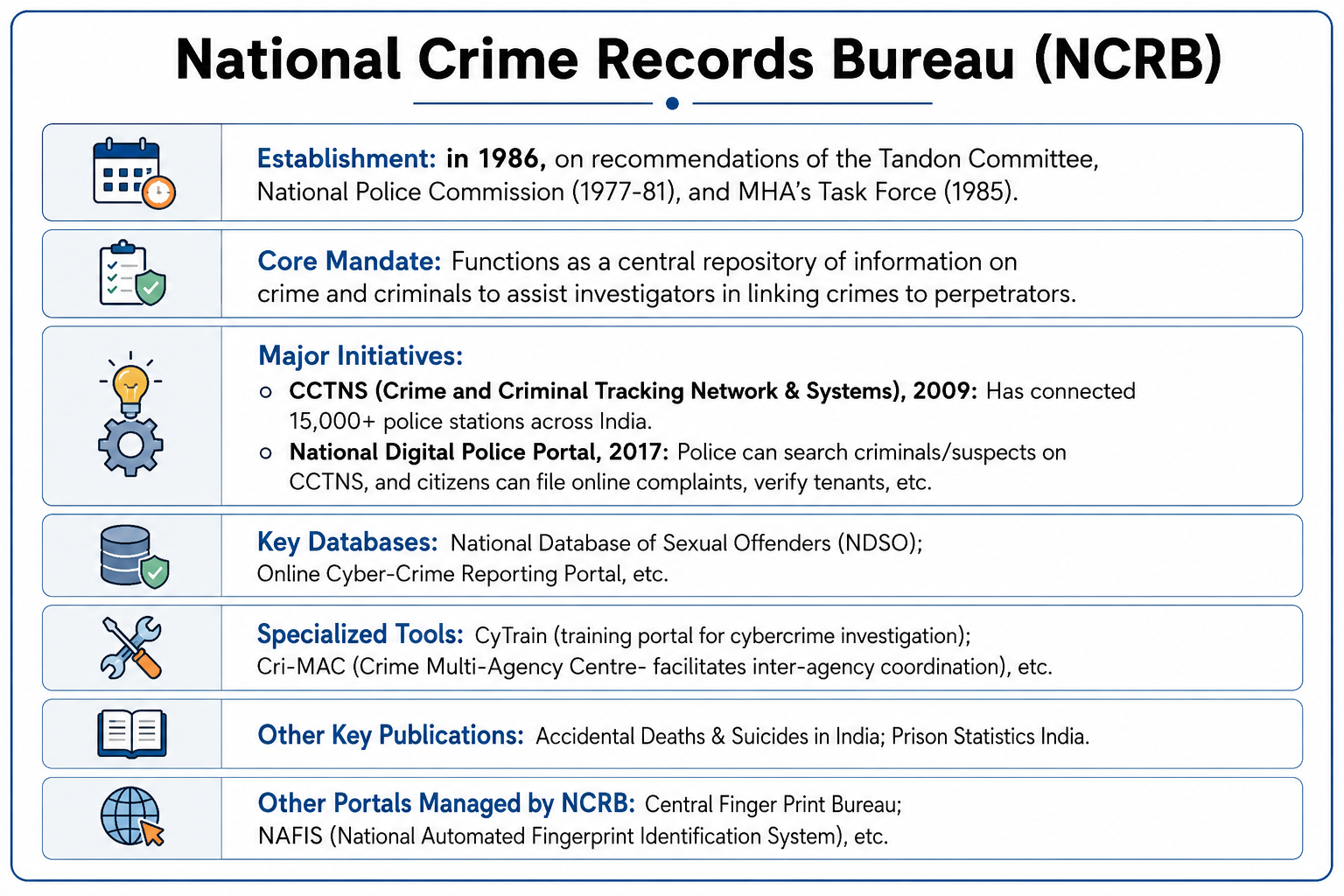
The Accidental Deaths & Suicides in India 2024 released by NCRB provided data on Accidental Deaths due to Forces of Nature and Other Causes including Traffic and Road Accidents.
Key Highlights of the Report on Accidental Deaths
- Rate of Accidental Deaths (per lakh population): Increased to 33.3 (2024) from 31.9 (2023) with maximum causality reported in age of 30 to below 45 years (31.3%).
- Accidents due to Forces of Nature: 7,903 deaths (35.7% deaths due to ‘Lightning’, 23.2% deaths due to ‘Heat/Sun Stroke’ and 10.5% deaths due to ‘Exposure to cold’.)
- Madhya Pradesh (577), Bihar (360), Uttar Pradesh (275) accorded maximum of lightning deaths.
- Accidents due to Other Causes: Accounted for 4,59,954 deaths with a greater share of men than women.
- Major causes: ‘Traffic Accidents’ (43.4%), ‘Sudden Deaths’ (16.5%), ‘Drowning’ (8.7%), ‘Falls’ (5.7%), ‘Poisoning’ (4.7%) and ‘Electrocution’ (3.4%).
- Fire Accidents: 5,971 cases of reported fire accidents caused 5, 888 deaths in 2024.
- Road Accidents: Road Accidents (87.8%) contributed to the largest share (railway accidents reported nil deaths) among Traffic Accidents.
- Major Cause: Over speeding was prime cause contributing to 61.2% of road accidents.
- Regional Extent: Greater accidents were reported from the rural areas (59.7%) compared to urban areas (40.3%).
- Location of Occurrence: 31.2% of total road accidents were reported near residential areas.
Key Highlights of the Report on Suicides
- Rate of Suicides (per lakh population) decreased from 12.3 (2023) to 12.2 (2024).
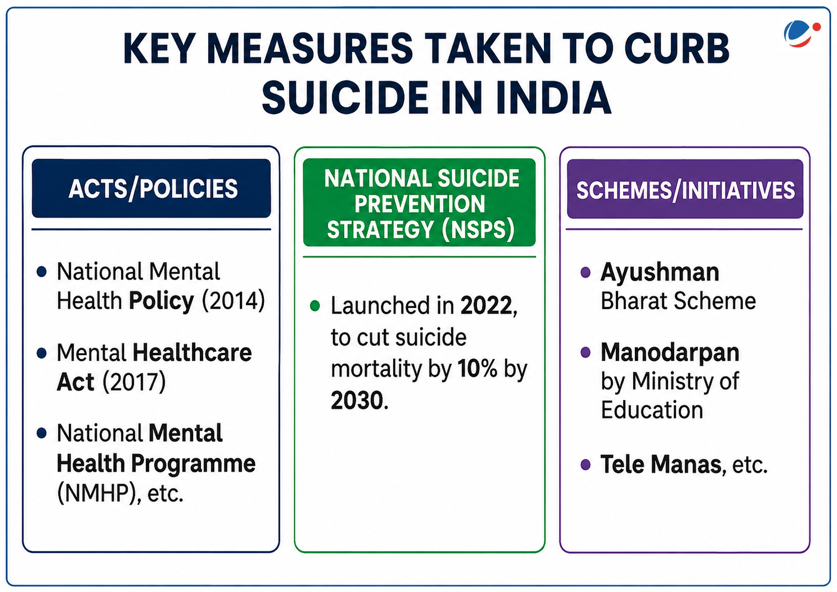
- Causative Factors of Suicides:‘Family Problems (other than marriage related problems)’ (33.5%), ‘Illness’ (18.0%) and ‘Drug abuse/addiction’ (7.6%) together accounted for 59.0% of total suicides in the country during 2024.
- State wise distribution: Majority were reported in Maharashtra followed by Tamil Nadu.
- Delhi reported highest number of suicides (2,905) among UTs, followed by Puducherry.
- Education Status of Victims: Only 5.6% of total suicides victims were graduate and above.
- 10.1% victims of suicide were illiterate.
- Trends in Cities: Suicide rate in cities (16.3) was higher compared to all-India suicide rate (12.2).
- Professional Status of Suicide Victims: Among male suicides, maximum suicides were committed by daily wage earners.
- Amongst females, highest number was of house-wives.
- In farming sector, 10,546 persons (6.2%) accounted for total suicide victims.
- Overall male: female ratio: Stood at 73.5 : 26.5.
Article Sources
1 source- The Supreme Court in Shaheen Malik Vs Union of India (2025) invoked Article 142 to hold that persons forcibly made to consume acid, as well as those suffering internal injuries without visible external harm, fall within the ambit of 'acid attack victims' under the Rights of Persons with Disabilities Act, 2016.
- The court also informed the government that existing punishment for acid attack had failed as a deterrent, suggested reversing the burden of proof onto the accused and said acid sellers should be made co-accused in such cases.
- The court had also suggested framing a comprehensive policy framework to protect the survivors, who, even if they survived, require extensive and continuous medical treatment.
- The deemed recognition would aid victims of forcible acid ingestion to claim disability benefits due under the 2016 Act.
- Earlier, the 2016 law recognised only victims of acid-throwing, and not forcible acid ingestion.
- Though the Bharatiya Nyaya Sanhita (BNS) accepted both the act of acid-throwing and the administration of acid as offences punishable with imprisonment from 10 years to a life sentence under Section 124 (voluntarily causing grievous hurt).
Article Sources
1 sourceMinistry of Health and Family Welfare launched JANANI (Journey of Antenatal, Natal and Neonatal Integrated Care) platform.
About JANANI
- Service-oriented digital platform to comprehensively monitor and maintain digital health records of women during reproductive age.
- An upgraded version of existing RCH (Reproductive and Child Health) portal, creating a longitudinal health record by capturing key service delivery events across continuum of care.
- Key Features:
- Interoperability: Enabling integration with national platforms like U-WIN and POSHAN.
- Unique Identifiers: Like ABHA, Aadhaar (OTP and biometric) and mobile number for registration of beneficiaries.
- Others: QR-enabled digital Mother and Child Health (MCH) Cards; automated alerts for high-risk pregnancies, real-time dashboards for supervisory review, etc.
Article Sources
1 sourceThe 13th Session of the World Urban Forum (WUF-13) was held in Baku.
About World Urban Forum
- Established: 2001 by the United Nations.
- First Session: Held in Nairobi in 2002.
- Organized by: United Nations Human Settlements Programme (UN-Habitat).
- Nature: Premier global conference and high-level, open and inclusive platform on sustainable urbanization.
- Objective:
- Raise awareness on sustainable urbanization.
- Promote exchange of best practices and policy experiences.
- Strengthen collaboration among governments, local authorities, civil society, academia and private sector stakeholders.
World Urban Forum 13:
- Theme: "Housing the World: Safe and Resilient Cities and Communities."
- Venue: Baku, Azerbaijan.
- Co-organized By: UN-Habitat and the Government of Azerbaijan.
- Linked Agenda: Supports implementation of the New Urban Agenda (2016) and SDG 11 (Sustainable Cities and Communities).
- Outcome Document: Baku Call to Action.
- Baku Call to Action urges accelerated global action to address the housing crisis and promote inclusive, resilient, sustainable and adequately financed urban development.
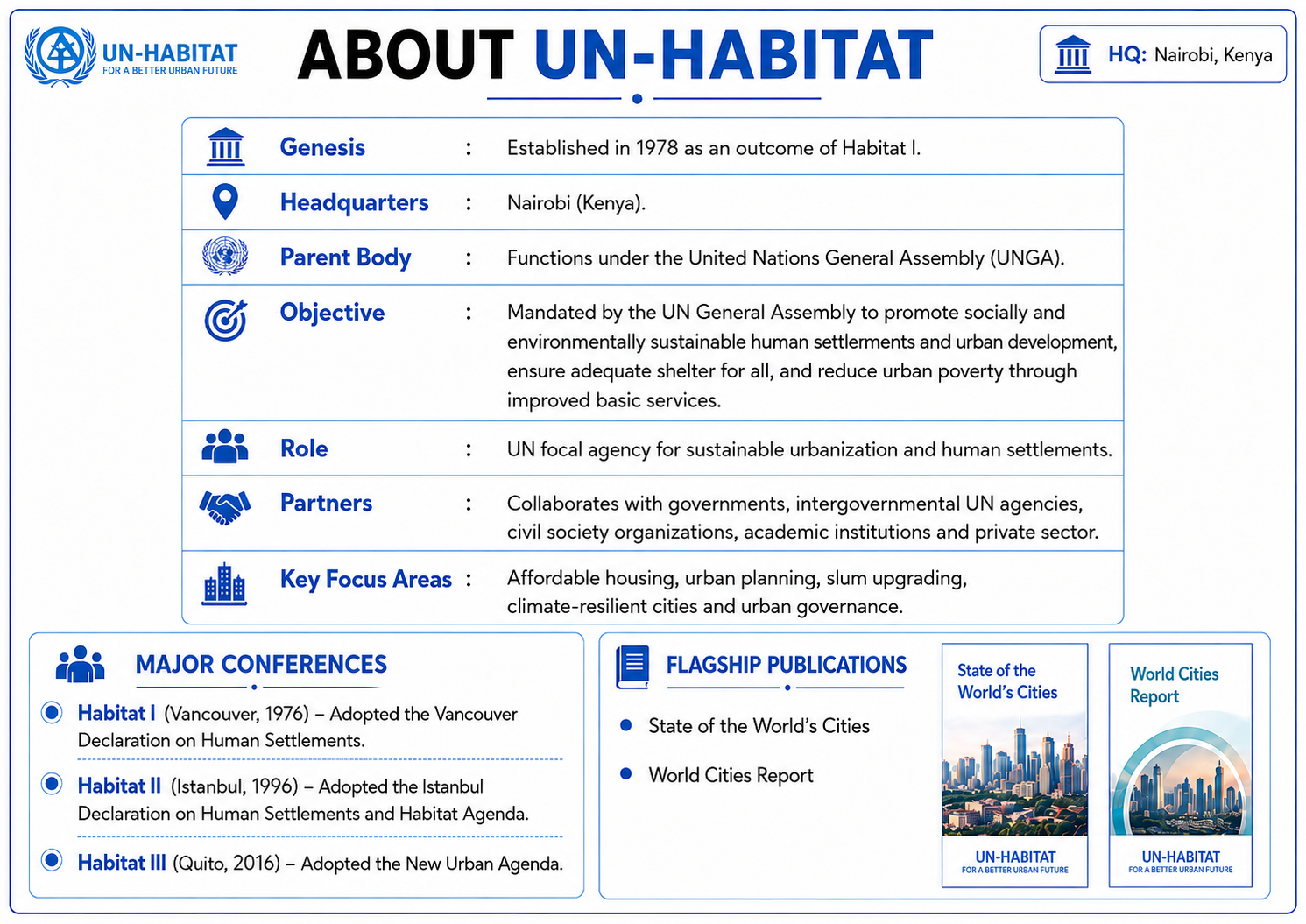
Related News: World Cities Report 2026 Released by UN-HabitatTitled “The Global Housing Crisis Pathways to Action”, report highlights affordability constraints, pervasive informality, increasing climate-related risks, etc., as interlinked and mutually reinforcing challenges. Key Highlights of the Report
India’s Mumbai and Delhi record price-to-income ratios of 14.3 and 10.1. |

