


Why in News?
Economic Advisory Council to PM (EAC-PM) released a Working Paper on Care Economy.
More on the News
- It calls for paradigm shift, treating care as foundational social and economic public infrastructure rather than private household responsibility.
About Care Economy (Purpleeconomy)
- It encompasses all activities whether paid and unpaid, direct and indirect that meet the physical, psychological, and emotional needs of children, the elderly, persons with disabilities, and the able-bodied
- UnPaid: Nursing an ill partner, cooking, cleaning, child care, unpaid farm labour, eldercare etc. without monetary compensation (mostly done by women)
- Paid: Childcare centres, eldercare institutions, domestic workers against a monthly wage etc. (men spend a little bit more than half (0.57) times more time than women in paid work.
Major Challenges
- Systemic Invisibility: Because care is often an "unremunerated act of love," it remains excluded from GDP calculations E.g. Unpaid domestic and care work by women, is valued at ~15–17% of India's GDP
- Gender Disparity: e.g. Women spend ~289 minutes daily on unpaid domestic work, against ~88 minutes by men impacting their education and employment (time poverty). -Time Use Survey 2024.
- Policy issues: Maternity-centric policies reinforce women as default caregivers and distort hiring incentives, interrupts career and cause wage gap E.g. Maternity Benefits act 1961 vs No statutory paternity law.
- no paternity leave in private sector and only 15 days to central government servants under Central Civil Services (Leave) Rules 1999 (vs 26 weeks for women in units with >10 employees)
Absence of framing Child care or eldercare as employment-enabling infrastructure.
- Lack of social security: Frontline care workers like ASHAs and Anganwadis doesn't have fixed wage and lack social security, while domestic workers face total subjugation to employers due to absence of a dedicated law
- Lack of dedicated funding: India spends less than 1% of its GDP on care economy. This leads to poor public infrastructure and concentration of private unaffordable care services in urban areas
- Fragmented Governance: Care is treated as narrow welfare intervention under Ministry of Women and Child Development (MoWCD) rather a horizontal policy priority across finance, labor, and urban planning ministries
- Human Resource: e.g. In India there are only ~ 5 formal care workers per 100 persons aged 65 and above and caregiver-to-child ratio is 1:50 vs international observed ratios of 1:10-15.
Government's Initiatives for Care Economy
- Atal Vayo Abhyuday Yojana: umbrella scheme for elderly welfare that includes residential care facilities, Rashtriya Vayoshri Yojana (providing assistive devices to low-income seniors) etc.
- Palna Scheme (under Mission Shakti): centrally sponsored scheme, for establishing Anganwadi-cum-Crèches to provide institutional daycare for children aged 6 months to 6 years.
- Saksham Anganwadi and POSHAN 2.0: for early childhood care, reaching children up to 6 years of age for supplementary nutrition, immunisation, and pre-school education
- Pradhan Mantri Kaushal Vikas Yojana: via the National Skill Development Corporation for training for care roles through councils like Home Management and Care Givers Sector Skill Council
- Indo-Japan Technical Intern Training Programme allows Indian caregivers to undergo on-the-job training in Japan's elderly care sector before returning to India.
Way ahead
EAC-PM proposed a 4-pillar framework to transform care into social and economic infrastructure.
Pillar1: Innovative Financing
- Establish Parivar Seva Kosh (Family Care Fund): An outcome-based fund in Ministry of Finance for community-based multi-generational care facilities (for centre and home-based child and elder care services)
- Create a "Carepreneur Fund": by Ministry of MSME for concessional finance to care startups and cooperatives
Pillar 2: Care Workforce Development
- Standardize training and certifications (by Ministry of skill development) for professionalisation and expansion of the care workforce
- Global Partnerships: World Bank funded Tamil Nadu's Women Employment and Safety Programme to provide childcare for working women.
Pillar 3: Policy Reforms
- Shared Parental Leave: E.g. Sikkim's extended paternity leave, and monthly financial assistance for mothers in private sector
- Urban Planning: Embed care facilities as "essential social infrastructure" in city master plans by utilizing land reservation, co-location of childcare in government schools (community proximity and utilisation of underutilised space), linking care indicators with project appraisal etc.
Pillar 4: Quality Assurance: Establish National Minimum Standards for staffing ratios, infrastructure, and safety across all public, private, and NGO providers e.g. MoWCD's National Minimum Standards for creche facilities.
Conclusion
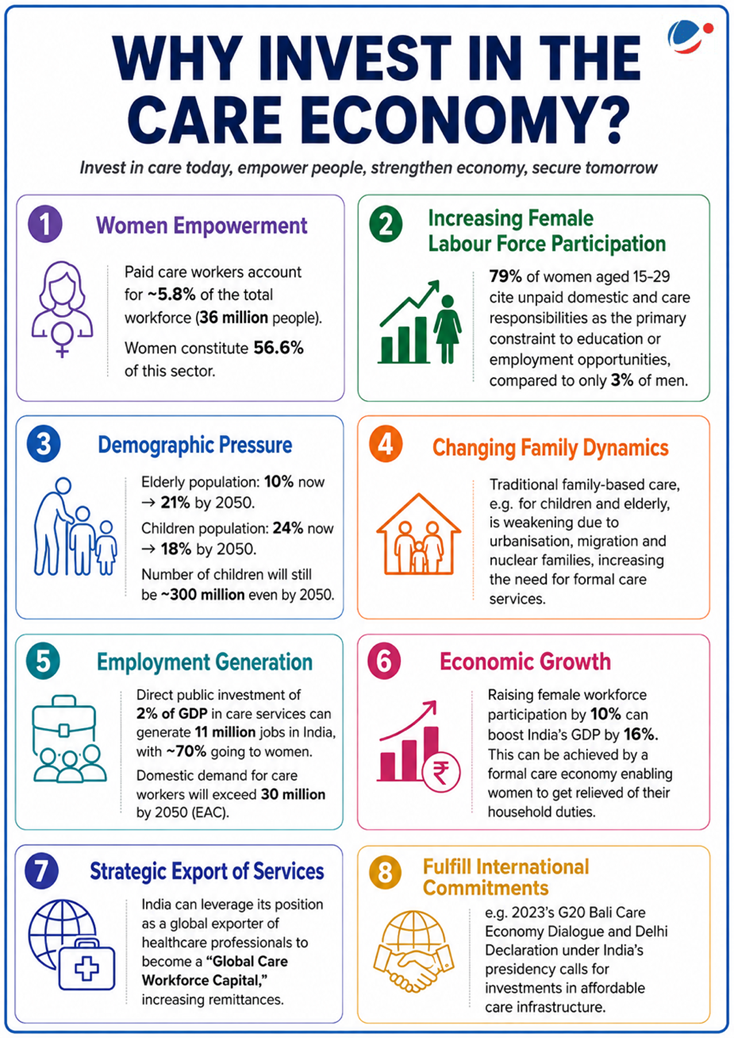
A robust care economy is not merely a social welfare measure but a strategic economic investment that can enhance women's workforce participation, create quality jobs, and support inclusive growth. Recognising care as essential social infrastructure, backed by adequate financing, skilled workforce, and gender-responsive policies, will help India harness its demographic dividend while advancing SDG 5 (Gender Equality) and SDG 8 (Decent Work and Economic Growth).


