Why in the News?
India and United Arab Emirates (UAE) signed Framework for the Strategic Defence Partnership during the official visit of the Indian Prime Minister to the United Arab Emirates.
Key outcomes of visit
- Framework for the Strategic Defence Partnership: It will promote Defence Industrial collaboration, innovation and advanced technology, training, exercises, education and doctrine and interoperability, etc.
- Energy Security and Strategic Reserves:
- Strategic Petroleum Reserves (SPR) Expansion: MoU was signed to scale UAE's participation in India's SPR to 30 million barrels—a near-fivefold increase.
- This involves utilizing facilities in Vishakhapatnam, Andhra Pradesh, and developing new reserves in Chandikhol, Odisha.
- Fujairah Storage and Gas Reserves: The agreement explores establishing Indian strategic crude storage at the Port of Fujairah in the UAE, alongside jointly developing strategic gas reserves within India.
- Strait of Hormuz: Prime Minister also conveyed India's clear position in favour of ensuring safe transit passage and unimpeded navigation through the Strait of Hormuz vital for energy and food security.
- Investment: The leaders welcomed an announced US$5 billion investment commitment from UAE entities.
- Vadinar Ship Repair Cluster: Cochin Shipyard Limited (CSL) and Dubai's Drydocks World (DDW) signed a MoU to set up a major ship repair and offshore fabrication cluster at Vadinar, Gujarat under the Maritime Development Fund Scheme of India.
- Super Computing Cluster: In a major push for artificial intelligence, India's CDAC and the UAE's G-42 agreed to set up an 8 Exaflop Super Computing Cluster in support of the India AI Mission.
- Virtual Trade Corridor: The visit saw the operationalization of the Virtual Trade Corridor utilizing the MAITRI (Master Application for International Trade and Regulatory Interface) digital framework.
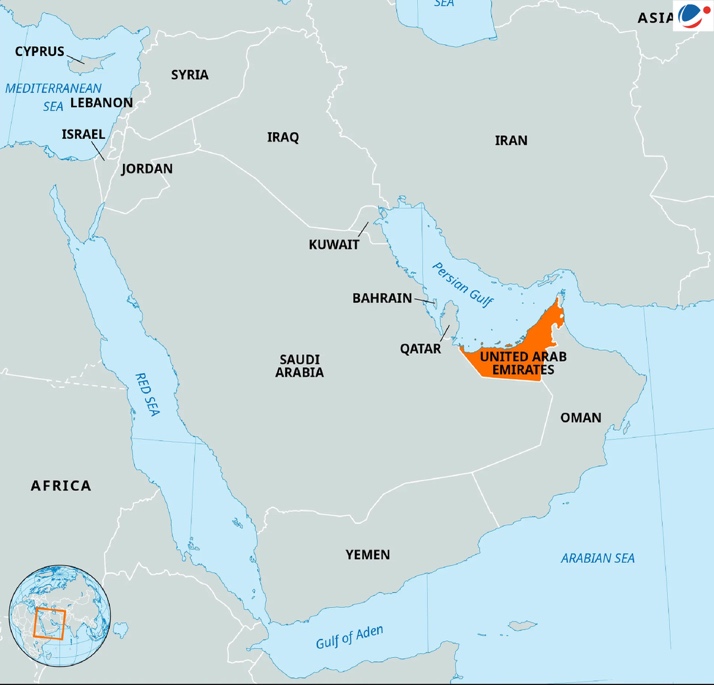 About UAE
|
Importance of UAE for India
- Economy and Trade: Both countries negotiated the Comprehensive Economic Partnership Agreement (CEPA) in a record 90 days in 2022 boosting overall trade.
- Source of Investment: UAE accounts for around 81% of all investments coming in India from the Arab world with overall seventh-largest overseas investor in India.
- Diaspora: The UAE hosts between 3.5 to 4 million Indians, making them the largest ethnic group in the country (constituting roughly 35% of the UAE's total population).
- Energy security: UAE stood as the fourth largest source of crude oil, third largest source of LNG, largest supplier of LPG and second largest export destination for India's finished petroleum products.
- Internationalization of rupee: The two nations have established a Local Currency Settlement (LCS) system, allowing cross-border transactions and trade to be settled directly in Indian Rupees (INR) and UAE Dirhams (AED).
- Gateway to West Asia: For India, the UAE serves as the most important strategic gateway into the Gulf and the broader West Asian region.
- The UAE is India's third-largest trading partner globally and its second-largest export destination with bilateral merchandise trade reaching USD101.25 billion in FY 2025-26.
- UAE is the only foreign nation to participate in India's Strategic Petroleum Reserve (SPR) program.
- Fintech cooperation through agreement on interlinking of the instant payment platforms UPI (India) and AANI (UAE), Agreement on inter-linking domestic debit/credit cards RuPay (India) with JAYWAN (UAE).
- I2U2 and the India-Middle East-Europe Economic Corridor further illustrate how both are trying to shape new regional architectures that are economic, technological, and connectivity-driven rather than security-centric.
Importance of India for UAE
- Defence Cooperation: Both countries also participate in International Defence Exhibition and Conference (IDEX) and the Naval Defence and Maritime Security Exhibition (NAVDEX) and in military exercise such as Desert Flag, Desert Cyclone.
- Space Cooperation: ISRO is working with the UAE Space Agency for exploration and use of outer space for peaceful purposes and is an important element of the I2U2 cooperation as well.
- Food Security: India is a reliable supplier of food grains, rice, sugar, fruits, vegetables, and processed food; supporting the UAE's National Food Security Strategy 2051.
- Geopolitical Partner: In a volatile and polarized West Asian region, the UAE views India as a highly stable and capable security partner being relatively free from ideological baggage or interventionist ambitions.
Challenges in India-UAE relationship
- Regional instability: Deteriorating regional peace in region due to the on-going conflict in Iran-USA-Israel, Israel-Palestine may impact IMEC also increasing energy security issues for India and economic stability for UAE.
- Recent escalations have included a drone strike on the Fujairah Oil Industry Zone that injured three Indian nationals.
- Rights of emigrant labourers: Largely due to Kafala system in UAE granting disproportionate power to employers over immigrant labourers, leading to human rights violations.
- Non-Tariff Barriers: Indian exporters, particularly in the processed food sector, face hurdles due to non-tariff barriers like the UAE's mandatory Halal certification requirements
- Maritime Security: Piracy, drone attacks, and disruptions in the Strait of Hormuz and Red Sea affect trade and energy security.
- Increasing Trade Deficit: Despite the significant boost in trade, India's trade deficit with the UAE has widened. In FY 2024-25, India's trade deficit with the UAE reached USD 26.8 billion.
Conclusion
India-UAE share a multidimensional partnership encompassing trade, technology, connectivity, maritime security, and regional stability as quoted by Dr. S. Jaishankar "India-UAE ties are a model of how India engages the Gulf in the 21st century."