


Why in the News?
Recently, Prime Minister of India paid an official visit to two Nordic countries, Norway and Sweden and participated in the 3rd India-Nordic Summit along with Prime Ministers of Nordic countries.
Significant outcomes of the visit
- India and Norway:
- Enhanced co-operation: India-Norway relations elevated to Green Strategic Partnership aims to deepen cooperation in sectors ranging from Clean Energy to Climate Resilience, Blue economy to green shipping
- Indo Pacific Ocean Initiative: Norway announced its participation in India's Indo Pacific Ocean Initiative (IPOI).
- IPOI was launched by India at the East Asia Summit in 2019, builds upon the "Security and Growth for All in the Region" (SAGAR) initiative.
- India-Norway Digital Development Partnership: Establishes a framework for cooperation on digital public goods, etc.
- Award: The Indian Prime Minister was awarded the Grand Cross of the Royal Norwegian Order of Merit by His Majesty King Harald V of Norway.
- India and Sweden:
- Elevation to Strategic Partnership: India and Sweden officially agreed to upgrade their bilateral relationship to a Strategic Partnership.
- Trade and Investment Goals: The two countries set a shared ambition to double their bilateral trade and investment within the next five years.
- Space Exploration: An agreement was advanced proposing the inclusion of a Swedish payload on India's Venus Orbiter Mission.
- Counter-Terrorism Efforts: Reaffirming a joint stance against global threats, both countries pledged to continue fighting terrorism and its supporters in all forms.
- 3rd India-Nordic Summit outcomes:
- Partnership Elevation: Bilateral relations were upgraded to "Green Technology and Innovation Strategic Partnership", with focus on renewable energy, green hydrogen, digital innovation, and sustainable manufacturing.
- Trade: Agreement to leverage India-EU FTA and India-EFTA TEPA for greater trade, technology, also Prime Minister invited Nordic nations to set up a presence in GIFT City, Gujarat.
- Climate Action: Collaborative climate efforts feature India's Mission LiFE (focusing on sustainable behavioral change) and the Leadership Group for Industry Transition (LeadIT), which Iceland has officially expanded to join.
- Maritime & Blue Economy: Cooperation was strengthened through the Indo-Pacific Oceans Initiative (IPOI) and India's maritime vision 'MAHASAGAR'.
- The nations also pledged support for the Hong Kong Convention to ensure sustainable ship recycling, and instituted new Maritime Security Dialogues with Norway and Denmark.
- Space & Arctic Exploration: Leaders pushed for joint polar research and indigenous knowledge exchange within the Arctic Council framework, where India serves as an observer.
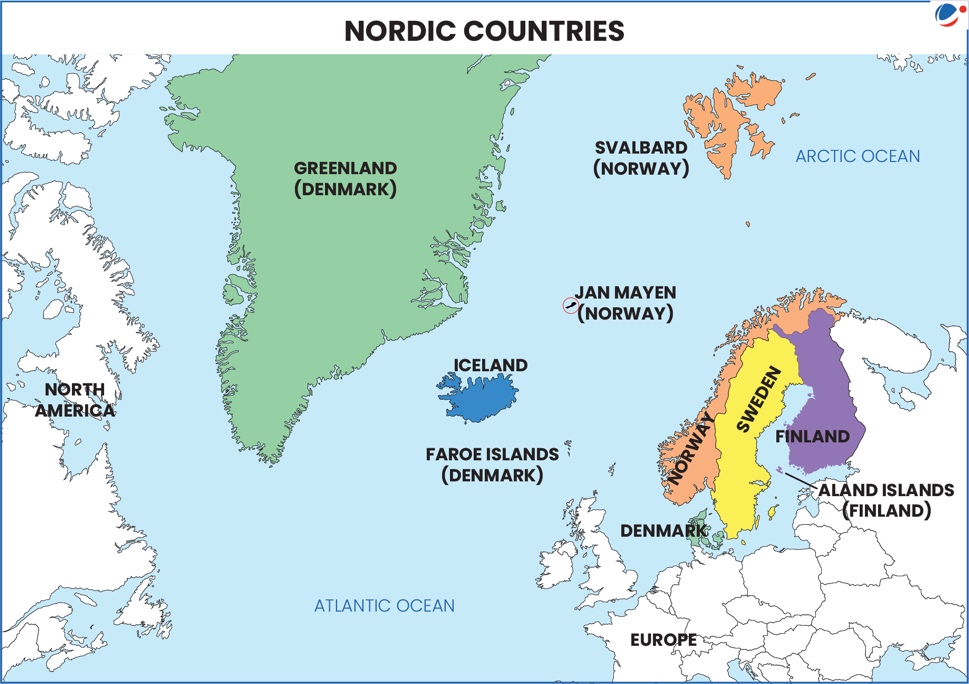
About Nordic Region
|
Areas of convergence of Nordic countries and India
- Economic and Trade: The Nordic bloc is an advanced region with a combined GDP of around $2 trillion.
- Bilateral trade between India and the Nordics reached $19 billion in 2024.
- India and EFTA (includes Norway and Iceland) signed the Trade and Economic Partnership Agreement (TEPA) aimed for investment of USD 100 billion leading to creation of 1 million direct jobs in India.
- Strategic Access to the Arctic Region: As all 5 Nordic nations are members of the Arctic Council, a vital gateway to Arctic engagement serves as a counterweight to China's "Polar Silk Road" initiative in the region.
- India established 'Himadri,' its first permanent Arctic research station, in July 2008 at Ny Alesund, Norway, and has held Observer Status in the Arctic Council since 2013.
- Technological and Green Expertise: E.g., Iceland offers deep expertise in geothermal energy, Sweden provides strength in advanced manufacturing, and Finland specializes in telecommunications.
- Space exploration: ISRO uses Norway's Svalbard Ground Station for satellite data reception.
- Global Governance & Security: The Nordic countries back India's permanent membership in a reformed UN Security Council and supported its entry into the Nuclear Suppliers' Group (NSG).
Challenges in India-Nordic relationship
- Divergent Threat Perceptions (The Russia-China Matrix): For the Nordic nations, Russia represents a primary security threat, especially following the NATO accession of Finland and Sweden.
- Limited Trade: India's total merchandise trade with the Nordic nations is $19 billion in 2024, only around 1% of India's global trade
- Regulatory Friction and Trade Asymmetry: Despite breakthroughs like the EFTA-TEPA, trade is hampered by complex regulatory differences, non-tariff barriers, and logistical constraints.
- Connectivity & Logistics Constraints: Long distance and limited direct shipping/air connectivity increase logistics costs due to absence of dedicated maritime corridors and limited direct flights.
- Conversely, India treats China as its primary adversary.
Conclusion
India and the Nordic countries should transform their shared commitment to sustainability, innovation, and resilient supply chains into a comprehensive strategic partnership. By deepening cooperation in clean technologies, defence, climate action, connectivity, and people-to-people ties, both sides can emerge as trusted partners in shaping an inclusive, green, and rules-based global order.


